

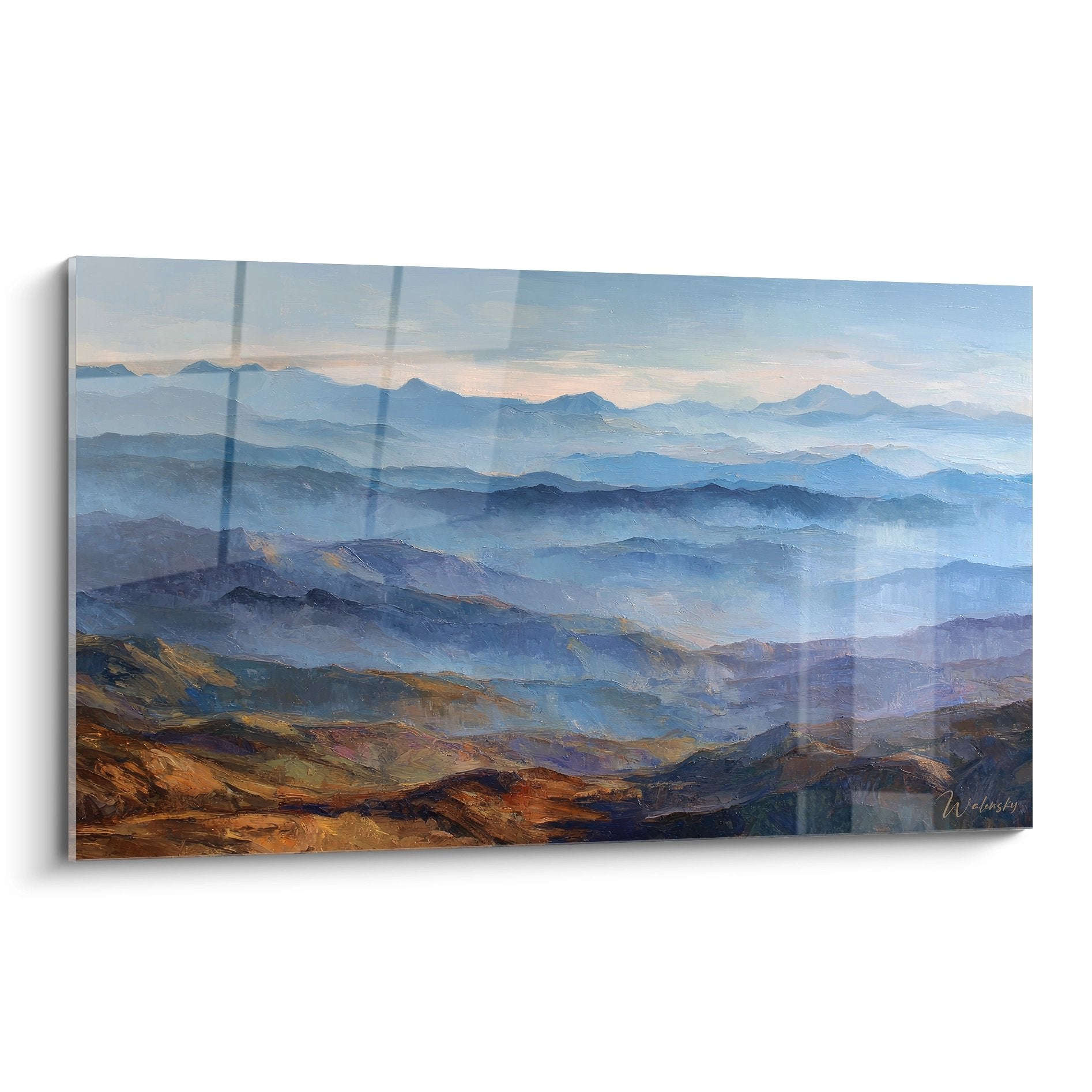






How do you centre and hang a square painting without drilling?
8 min read · by Walensky
WALL ART MOUNTING HARDWARE
The living room wall has been teasing you for weeks. You have the painting and you know where it should go, but one question holds you back: how can you be sure it lands exactly in the centre without taking out the drill? Because a square format forgives nothing: one centimetre off and the eye spots it instantly, unlike a wider rectangle that tolerates a bit of approximation.
The direct answerTo centre and hang a square painting without drilling, first measure the exact centre of the wall or reference furniture, transfer that point to the floor using a paper template the size of the painting, check the verticality with a spirit level, then fix the artwork with double-sided adhesive strips or a nail-free hook suited to its weight. Precise centring is decided before fitting, never after.A square painting of 100x100 cm or more is not a format to hang by instinct. Its perfect symmetry reveals the slightest offset, and its generous surface weighs more than you might imagine on an adhesive fixing.
- Centring is calculated and checked BEFORE sticking anything, using a paper template.
- The square format demands more rigour than a rectangle: symmetry magnifies the slightest visual flaw.
- The choice of drill-free fixing depends on the painting's actual weight, not on how light it looks.
Why does centring a square painting without drilling pose a particular challenge?
A wide rectangle forgives an offset of two or three centimetres: the eye compensates. A square does not. Its perfect symmetry means the brain instantly detects any misalignment, even a slight one, like an unevenly shaved eyebrow on a face.
On top of this, the square format brings a mechanical constraint: the weight spreads evenly across the entire contact surface, unlike a vertical rectangle where the load concentrates towards the top. As a result, a drill-free fixing often has to hold more weight than expected, over a bonding area that can be small if the painting is light but wide.
A square painting that is off-centre can be spotted from ten metres away. A square painting that is well centred, on the other hand, is forgotten, and that is the whole art of it.
This is why the method that follows treats both problems together: the precision of the centring, then the strength of the fixing. Tackling one without the other risks either a crooked painting or one that ends up on the floor.
Drill-free fixing solutions suited to square paintings
Not all drill-free fixings are equal when faced with a square format of 100x100 cm or more. The choice depends directly on the painting's weight and the type of wall.
Repositionable double-sided adhesive strips
Command-type strips remain the most widespread solution for painted or plasterboard walls. They generally support a maximum weight stated on the packaging, which should always be checked before purchase: an oversized square painting in Alu Dibond, lighter than you might think, is still heavier than a simple photo frame.
The paintings in the shop are printed on acrylic glass or Alu Dibond, two lightweight supports delivered with their fixings. Alu Dibond, lighter still, makes drill-free fitting noticeably easier on an XL or XXL square format.
Press-activated nail-free hooks
These hooks spread the weight over a wide surface thanks to a system of fine pins that barely penetrate the paint. They are well suited to fragile plasterboard walls, where a standard adhesive strip could tear off with a piece of paint when removed.
Rails or adhesive paste for heavier paintings
For a square 4XL or 5XL format, the adhesive paste for wall mounting provides a sturdier hold, provided it is applied at several points spread across the back of the painting, not just in the center. A horizontal rail without drilling, on the other hand, distributes the weight across the entire width — an option to consider if the wall has already rejected a standard adhesive strip.
| Fixation | Weight capacity | Ideal for |
|---|---|---|
| Double-sided adhesive strip | Low to medium | Size L to XL, painted wall |
| Nail-free hook | Medium | Fragile plasterboard, rental lease |
| Multi-point adhesive paste | Medium to high | XXL size and larger |

Staff pick
Panda Painting hung on a bamboo stick - Plant Cuddle - Panda Edition
From €228.90
Discover this paintingThe step-by-step method for centering your square painting before hanging
Centering a painting cannot be left to guesswork. Here is the method that prevents having to start over once the painting is stuck.
Calculating the center of the reference wall or furniture
Measure the total width of the wall or furniture beneath the painting (sofa, sideboard, console) and divide it by two to find the horizontal center point. For height, the professional rule remains reliable: the center of the painting should sit at the eye level of a standing person.
Using a paper template to check the centering
Cut a template from kraft paper to the exact dimensions of the square painting, tape it to the wall at the calculated spot, then step back a few paces. This is the only reliable way to visualize the result before committing to an adhesive that leaves marks when removed.
- Check the template's alignment with a spirit level, not just by eye.
- Mark the four corners of the template in pencil before removing it.
- Note these marks relative to a fixed point (electrical outlet, skirting board) so you can find them again.
— Our selection


Practical cases: centering a 50x50 or 80x80 square painting without drilling holes
The square formats sold in the shop start at size L, at 100x100 cm, up to 5XL at 200x200 cm, with custom sizes available for more constrained walls. For a narrow entrance, size L remains the base: its width ideally occupies 60 to 75% of the width of the furniture or wall section beneath which it is placed.
A black-and-white painting of pandas, for example, works very well in size L above a narrow entrance console. Choosing the painting's colour in relation to the wall paint is also worth planning in advance, as explained in our guide to square painting colours according to wall shade. The graphic contrast of the drawing also suits a fixing without drilling, since the Alu Dibond backing stays light even at 100x100 cm.
For a wider living room, an XXL or 3XL size requires a sturdier fixing: multi-point adhesive paste or a rail without drilling rather than a simple strip. A square painting showing a sunset over the sea for a relaxation area, for example, makes the most sense in a large format above a sofa, like the square sunset over the sea paintings for a relaxation area that ideally decorate a living room.
— You may also like


Mistakes to avoid and tips for lasting hold
Preparing the wall matters as much as choosing the fixing. A freshly painted wall must dry completely before any adhesive is applied, as the glue will not grip fresh paint, even if it feels dry to the touch.
- Clean the bonding area with household alcohol to remove dust and greasy residue.
- Avoid sticking to a wall below 15°C or during periods of high humidity: the adhesive loses its hold.
- To remove a strip without damaging the paint, pull slowly and horizontally, never perpendicular to the wall.
Always check the maximum weight load stated on the fixing packaging, and compare it with the actual weight of the chosen square painting, not an estimate. A 4XL or 5XL size far exceeds the capacity of a standard simple adhesive strip.
Centring a single square painting on a large wall requires a slightly different approach when the wall is very large and the painting sits isolated in the middle of the space. If your painting is rather rectangular, the method of hole-free fixing for a large rectangular painting applies with a few adjustments to how the weight is distributed.

In the same spirit
Portrait Painting of a Focused Archer - Artistic Precision - Archery Edition
From €228.90
Discover this painting →Frequently asked questions
Which adhesive holds best for hanging a painting without drilling?
Command-style double-sided strips remain the most reliable for sizes L to XL on painted walls. For a larger format, a multi-point adhesive paste spread across the entire back of the painting offers better hold.
How can you tell if a wall is straight enough to centre a painting?
Place a spirit level directly against the wall, horizontally then vertically. A slight lack of plumb in the wall is corrected by adjusting how the painting is hung, rather than blindly following the lines of the wall.
What is the maximum weight for a fixing without drilling?
It depends entirely on the product chosen: each strip or hook states its maximum load on the packaging. Always weigh the actual painting before choosing, rather than relying on its visual size.
How do you remove an adhesive fixing without damaging the paint?
Pull the strip slowly, horizontally and not perpendicular to the wall, gently warming the glue with a hair dryer if it resists. This gradual pull prevents tearing the paint.
A square painting that is well centred and securely fixed without drilling is not a compromise: it is a method. The paper template first, the fixing suited to the weight afterwards, and the wall stays intact, and so does the lease. To find the fixing that matches your exact size, head to the wall painting fixing collection — your wall will thank you, and your landlord will never notice a thing.
Explore our collections


