





Realistic Saber-Toothed Tiger Wall Art
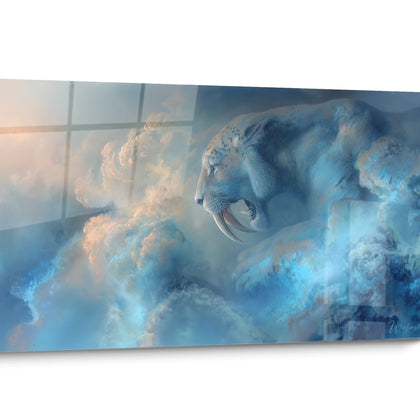
The Sabre-toothed tiger painting Realistic captures the majesty of extinct prehistoric predators. This collection showcases the raw power and wild elegance of the realistic sabre-toothed tiger, immortalizing each anatomical detail with striking precision. The prehistoric feline paintings reveal the fierce beauty of these legendary creatures, offering a spectacular wall decoration that transports your space to the ice age.
 Smilodon in Action Painting - Prehistoric Predator - Saber-Toothed Tiger Edition273,90 €
 Smilodon Painting in Tall Grass - Prehistoric Predator - Saber-Toothed Tiger Edition273,90 €
 Majestic Smilodon Wall Art - Intense Gaze of the Predator - Saber-Toothed Tiger Edition228,90 €
Explore further
In Realistic Saber-Toothed Tiger Wall Art


All about Realistic Saber-Toothed Tiger Wall Art
- Presentation Painting Saber-Toothed Tiger Realistic
- Paleontological Visual Impact
- Morphology and Anatomical Details
- Decorative Integration
The painting saber-toothed tiger realistically captures the raw essence of a prehistoric predator that disappeared over 10,000 years ago. This ultra-detailed photographic representation of Smilodon fatalis highlights each distinctive feature of this legendary feline: its oversized upper canines reaching up to 28 centimeters, its massive musculature adapted for hunting megafauna, and its piercing gaze of a Pleistocene apex predator. Unlike fanciful artistic interpretations, this realistic reproduction is based on the most recent scientific reconstructions based on fossils discovered at La Brea Tar Pits in California. The hyperrealistic rendering gives this extinct creature an almost tangible presence, creating a true temporal portal to the Ice Age in your space. Every hair follicle, every territorial combat scar, every nuance of tawny fur testifies to exceptional documentary precision that will satisfy both paleontology enthusiasts and lovers of exceptional decoration seeking a unique conversation piece.
Paleontological Authenticity Serving Contemporary Decoration
A realistic saber-toothed tiger painting represents much more than a simple animal representation: it is a window into the Quaternary period that radically transforms the atmosphere of a space. The fidelity to paleontological discoveries gives this work a scientific legitimacy appreciated in modern cabinets of curiosities, offices of architects specializing in biophilic design, or residential spaces adopting a museum aesthetic.
Why choose a scientifically accurate representation of Smilodon?
Anatomical precision fundamentally distinguishes this realistic approach from stylized or imaginary versions. The specific cranial proportions of Smilodon fatalis – a jaw that can open to 120 degrees to deploy its sabers – are respected according to craniometric studies conducted on Californian fossil specimens. This scientific accuracy brings a documentary credibility that fascinates curious minds and fuels conversations about the evolution of large carnivores.
The realistic aspect also captures behavioral details reconstructed by paleontologists: the characteristic stalking posture, the facial muscles tense before the attack, the predatory expression that reveals the hunting intelligence of this social species. These narrative elements create a palpable dramatic tension that visually energizes a spacious living room or a private library.
The psychological impact of an extinct predator in your environment
Unlike contemporary felines, the saber-toothed tiger simultaneously evokes primal power and tragic extinction. This conceptual duality generates a particular emotional resonance: admiration for evolutionary perfection combined with the melancholy of definitive disappearance. In an urban loft or a contemporary residence, this prehistoric presence creates a striking temporal contrast that questions our relationship with nature and the permanence of species.
The monumental format amplifies this visceral impact. Confronted at actual or larger scale, the viewer physically feels the threat that this superpredator represented to Pleistocene hominids. This immersive experience transforms an ordinary wall into a paleontological portal, particularly effective in reception areas where the element of surprise enhances the owner's decorative boldness.
Complementarity with naturalist and scientific collections
For collectors of fossils, minerals, or taxidermied specimens, this painting naturally fits into a coherent museum-like approach. It dialogues perfectly with elements such as framed megalodon teeth, fossilized ammonites, or skulls of extinct mammals. If you also appreciate chromatic variations, discover our painting of a saber-toothed tiger with colored teeth, which offers a contemporary interpretation of the same subject.
This realistic approach is also an exceptional educational tool in educational environments or family spaces. It stimulates children's scientific curiosity while serving as a visual anchor for discussing evolution, climate adaptation, and extinct biodiversity. The photographic realism promotes memorization and understanding of morphological characteristics better than any textbook.
Decoding the Anatomical Details of the Smilodon in High Definition
The documentary value of a realistic saber-toothed tiger painting rests entirely on the fidelity of representation of the morphological specificities that distinguish this feline from current species. Each anatomical detail tells a fascinating evolutionary story that only an ultra-precise reproduction can effectively convey.
The hypertrophied canines: an emblematic signature of the genus Smilodon
The sabers of Smilodon fatalis reached lengths of 18 to 28 centimeters, far exceeding the lower jaw even with the mouth closed. This extraordinary characteristic imposes unique biomechanical constraints: an overdeveloped cervical musculature visible in the realistic rendering as powerful trapezoidal masses, and a reinforced skull structure to absorb vertical bite forces. The painting captures this specialized skull architecture with millimeter precision based on 3D scans of authentic fossils.
Contrary to popular belief, these canines were not designed for bone penetration but for sectioning the soft tissues of large prey. Their flattened section and toothed edges – details visible only on a high-resolution reproduction – testify to this targeted bleeding function. This functional particularity is reflected in the hunting posture represented, often with a maximum mouth opening showing the full extent of these formidable weapons.
How to recognize a scientifically validated reconstruction?
Several anatomical markers distinguish a rigorous representation from a fanciful interpretation. The Smilodon possessed a stocky and massive body, very different from the slender silhouette of modern panthers. Its particularly muscular forelimbs were used to immobilize prey sometimes three times heavier than itself – ancient bison, prehistoric horses, or even young mammoths. An authentic realistic painting shows this characteristic disproportion between the powerful forelegs and the relatively modest hindquarters.
The relatively short tail is another indicator of scientific accuracy. While modern large felines use their long tail for balance when running, the Smilodon probably hunted in ambush in the forested or semi-open environments of the American Pleistocene, making this counterweight unnecessary. Faithful reconstructions respect this reduced caudal proportion often neglected by approximate commercial representations.
Fur texture and prehistoric camouflage
Although no fossilized fur has survived, paleontologists extrapolate the likely coat of the Smilodon based on its reconstructed habitats and camouflage principles observed in modern felines. High-quality realistic paintings incorporate these scientific hypotheses: uniform tawny hues for savanna environments, or discreet patterns for fragmented forest environments. The suggested pilosity density in the rendering also reflects the climatic variations of the late Pleistocene.
Texture details – dense undercoat visible at the neck and flanks, stiffer guard hairs on the back – add a virtual tactile dimension that reinforces the impression of physical presence. This textural depth transforms the realistic saber-toothed tiger painting into an almost haptic experience, where the eye instinctively perceives the difference between areas of thick fur protecting against counterattacks and smoother areas optimizing thermoregulation.
The behavioral expression captured in the decisive instant
Beyond static anatomy, the best realistic renderings capture micro-behavioral expressions documented through comparative study with living felines. Pupillary dilation pre-attack, ear position in maximum alert, lip retraction exposing gums before deploying canines – these ethological details create a behavioral narrative that projects the viewer into the moment preceding the hunt.
This capture of the critical instant radically differentiates a realistic work from a simple zoological illustration. It conveys not only the appearance of the Smilodon but its predatory essence, its hunter’s psychology, transforming your wall into a temporal window to a prehistoric drama frozen at its climax.
Elevating a Prehistoric Predator in Modern Interior Architecture
Integrating a realistic saber-toothed tiger painting requires specific spatial and chromatic considerations to maximize its dramatic impact without compromising the overall harmony of the space. Its powerful iconographic nature makes it a visual focal point that immediately restructures the perceptual hierarchy of a room.
Which architectural spaces magnify this paleontological theme?
Generous volumes with a ceiling height of more than 2.80 meters allow for full exploitation of the monumental format without creating visual oppression. Converted industrial lofts, with their exposed brick walls and metal structures, create a fascinating material dialogue between the industrial era and the Pleistocene. The contrast between the mineral roughness of the surfaces and the organic vitality of the depicted predator generates a sought-after aesthetic tension in sophisticated contemporary interiors.
Private libraries and studies constitute the ideal environment for this scientific iconography. The saber-toothed tiger functions as an intellectual catalyst, symbolizing the quest for paleontological knowledge and fascination with the mysteries of the Earth’s past. Placed facing the main desk, it inspires a predatory determination applicable metaphorically to professional challenges, while also serving as a meditative focal point during reflective breaks.
Chromatic strategies to frame a prehistoric icon
Neutral wall palettes – anthracite gray, mineral beige, off-white – create a museum-like setting that projects the subject to the forefront without chromatic competition. This environmental sobriety reproduces the exhibition conditions of scientific institutions, implicitly conferring legitimacy as a documentary painting. Earthy tones also evoke the sedimentary strata where fossils rest, creating a thematic coherence subliminally.
For the bold, a wall in rust or burnt ochre evokes the arid landscapes of the late Pleistocene and amplifies the tawny tones of the fur. This immersive chromatic approach transforms the painting into a central element of a complete scenography, mentally transporting viewers to reconstructed prehistoric environments. The addition of warm directional lighting accentuates this displaced temporal ambiance.
Decorative associations reinforcing the paleontological narrative
The accompaniment of raw natural elements – massive driftwood, volcanic stones, quartz geodes – creates a constellation of objects evoking the geological depth of time. Wall shelves made of raw steel supporting a collection of minerals or replicas of Upper Paleolithic lithic tools construct a coherent visual narrative around prehistory and terrestrial origins.
Furniture with clean lines and raw materials – patinated leather, brushed steel, polished concrete – avoids stylistic competition while enhancing material authenticity. A rug made of coarse natural fibers recalls the organic textures of the ice age without falling into literal reconstruction. This material sobriety highlights the visual complexity of the painting without peripheral distractions.
Optimization of visual perception according to spatial layout
The ideal viewing distance for a monumental format is between 3.50 and 5 meters, allowing for the simultaneous apprehension of the entire compositional ensemble and the richness of the micro-details. Positioned on the main wall facing the entrance to a room, the painting creates a maximal immediate impact that instantly establishes the character of the space. This placement strategy transforms each entry into the room into a renewed discovery experience.
Orientation with respect to natural light sources deserves particular attention. A grazing lateral lighting reveals the textural depth of the realistic rendering and creates dynamic shadow play that animates the representation throughout the day. Avoid direct backlighting which would flatten subtle nuances and reduce the three-dimensional impact of the subject.
Where to place a realistic saber-toothed tiger painting to maximize its visual impact?
Prioritize main walls with sufficient viewing distance, ideally in reception areas, libraries, or spacious entrance halls where the monumental format can deploy its dramatic presence without spatial constraints.
Is a realistic saber-toothed tiger painting suitable for all decorative styles?
This paleontological theme particularly integrates well into contemporary minimalist, industrial interiors, or those adopting a museum aesthetic. It also works in cabinets of curiosities and spaces with educational or scientific purposes.
How to maintain a realistic large format saber-toothed tiger painting?
Regular dusting with an anti-static microfiber cloth is generally sufficient. Avoid prolonged direct exposure to sunlight, which could alter the pigments over time, and maintain a stable humidity between 40-60% to preserve the integrity of the support.
L'art qui suscite l'envie
Maison belge d'art mural grand format
14 jourspour changer d'avis*
Protection Walenskyincluse
Fabriquéen Italie
FormatXXL
Kit de fixationtoujours fourni
* Hors tableaux personnalisés et tailles personnalisées


