


English Setter Dog Painting Contemplation
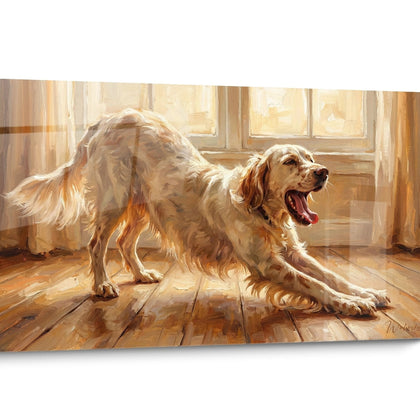
The Painting English Setter Dog Contemplation celebrates the timeless grace of this noble hunting dog. This work captures the suspended moment where natural elegance meets the depth of a contemplative gaze. Perfect for lovers of artistic canine decoration and enthusiasts of pedigree dogs, this painting brings a touch of distinction to your interior. The meditative posture of the English Setter evokes serenity and the beauty of contemporary animal painting, creating a refined focal point.
 English Setter Contemplating the Twilight Behind the Window - Nocturnal Melancholy - English Setter Edition233,90 €
 Drenched Dog in the Rain Canvas - Autumn Melancholy - English Setter Edition233,90 €
 Dog in Misty Marshes Wall Art - Aquatic Contemplation - English Setter Edition233,90 €
 White Dog on Rock Facing Misty Mountains Canvas - Contemplation of the Peaks - English Setter Edition232,90 €
 Melancholic Canine Portrait Canvas in Gray and Beige Tones - Contemplative Gaze - English Setter Edition213,90 €
 English Setter Dog Looking at Sky Wall Art - Contemplative Portrait - English Setter Edition213,90 €
Explore further
In English Setter Dog Painting Contemplation


All about English Setter Dog Painting Contemplation
- English Setter Contemplation Presentation
- The Suspended Moment of the Setter
- Meditative Canine Atmosphere
- Feline Emotional Depth
An English Setter Contemplation dog wall art captures the essence of a moment of absolute grace, where the hunter's gaze is lost in the horizon, far from the frenzy of the chase. This artistic representation privileges the philosophical dimension of the hunting companion, frozen in a posture of silent reflection that transcends his traditional role. These large-scale wall creations magnify the intensity of the gaze, the nobility of the head carriage and this unique capacity of the Setter to shift from explosive action to a fascinating meditative stillness.
The aristocratic tranquility of the English Setter at mental rest
The English Setter Contemplation dog wall art reveals a little-known facet of this emblematic breed: its natural propensity for introspection between hunting outings. Unlike the dynamic representations found in an English Setter Hunting dog wall art, this artistic approach explores the transition moments where the animal seems to meditate on the experience lived in the woods.
Why does the English Setter express this unique contemplative depth?
The cranial morphology of the English Setter, with its marked stop and expressive almond-shaped eyes, gives its gaze an emotional depth that few hunting breeds possess. Specialists in this theme capture precisely that instant when the dog, seated in a sphinx position or lying in lateral extension, fixes an invisible point that evokes a form of ancestral wisdom. The chromatic variations of the Belton coat - these blue, orange or tricolor speckling - add a visual texture that reinforces the impression of inner movement despite physical stillness.
Spatial integration in decision and reflection environments
These monumental wall representations find their privileged place in private libraries, study rooms or reception halls where an atmosphere conducive to intellectual concentration reigns. The silent presence of the Setter in contemplation acts as a catalyst for mental appeasement, particularly appreciated by professionals in fields requiring discernment and patience. The imposing formats accentuate this sensation of being observed by a companion who understands the value of strategic silence.
Chromatic nuances in service of static emotion
Contemporary artists exploit the contrasts between shadowed areas of silky coat and luminous reflections on the wet nose to create subtle visual tension. The blue-gray ranges of Belton Blue coats harmonize beautifully with twilight backdrops or soothed autumnal settings, reinforcing this impression of canine meditation that characterizes the Setter after exertion. This chromatic palette favors integration into refined interiors privileging muted tones and hushed ambiances.
Canine psychology revealed by observant stillness
An English Setter Contemplation dog wall art constitutes much more than a simple animal representation: it becomes the visual medium for reflection on animal consciousness and the introspection capacity of evolved working breeds. Collectors specifically seek these works for their psychological dimension, capturing the precise instant when the Setter seems to mentally evaluate past performance or anticipate the next outing.
How to identify an authentic representation of canine contemplation?
The distinctive criteria of a true contemplative scene include the direction of the gaze - slightly offset from the frontal axis, avoiding direct visual contact with the observer - and the position of the ears, neither raised in alert nor completely relaxed. The musculature of the neck must appear relaxed without being slack, conveying a state of passive vigilance characteristic of the Setter between two phases of intense activity. The front paws, whether folded or extended, reveal through their position a form of temporary detachment from earthly preoccupations.
The mirror effect on contemporary living spaces
English Setter owners particularly appreciate these representations because they immortalize fleeting moments they observe daily but struggle to photograph: that gaze lost in the distance after a day in the field, that semi-reclining posture by the fireplace where the animal seems to mentally relive successful points. The monumental formats allow appreciation of infinitesimal details - the relaxed whiskers, the slight tilt of the skull - that differentiate authentic contemplation from simple physical rest.
Decorative associations reinforcing the meditative dimension
The plant life present in these artistic creations plays a crucial role in establishing the contemplative atmosphere. Artists privilege tall grasses slightly stirred by an invisible wind, woodlands with filtered light or motionless water banks that serve as metaphorical mirrors to the dog's inner state. This environmental staging transforms the contemplative Setter into a mediating figure between wild nature and domestic civilization, perfectly embodying the duality of hunting breeds refined by centuries of selection.
Emotional investment in the representation of canine serenity
Acquiring an English Setter Contemplation dog wall art responds to a particular aesthetic quest: that of surrounding oneself with images conveying strategic patience, tempered nobility and this rare form of animal dignity that requires no demonstration of strength. Enthusiasts of these works seek pieces evoking the behavioral maturity of the experienced Setter, one who has transcended juvenile exuberance to achieve an admirable psychological balance.
What compositional elements guarantee lasting emotional impact?
The success of a contemplative composition rests on balance between three visual zones: the main subject occupying approximately 40% of the surface, substantial negative space allowing the observer's gaze to circulate freely, and subtle contextual elements suggesting the location without excessive detail. The best creators use the rule of thirds to position emotional anchor points - typically the Setter's eye and a significant environmental area - thus creating a resolving visual tension that mentally appeases the observer.
Heritage valorization of intimate canine scenes
The hunting art market experiences a remarkable evolution: action representations progressively lose ground to intimate and contemplative scenes that better correspond to contemporary sensibilities. Discerning collectors constitute thematic ensembles contrasting the Setter's different psychological states - action, rest, contemplation - to create complete visual narratives in their interiors. The imposing formats of these works confer a wall presence comparable to traditional equestrian portraits, thus legitimizing their place in demanding artistic collections.
Harmonization with heritage and modern environments
Paradoxically, these contemplative representations integrate as well in rural manors with ancient wood paneling as in urban lofts with clean lines. In the former case, they extend a centuries-old British iconographic tradition celebrating the hunting companion at rest; in the latter, they introduce a soothing organic presence counterbalancing the mineral coldness of contemporary materials. Interior decorators exploit this versatility to create emotional focal points in spaces otherwise dominated by geometry and abstraction.
Is an English Setter Contemplation dog wall art suitable for professional spaces?
Absolutely, these works find their place in reception rooms of liberal professions, law offices or executive suites where they convey values of reflection, patience and discernment particularly appreciated in environments requiring measured decision-making.
What is the fundamental difference with English Setter representations in action?
Where action scenes capture muscular explosivity and chase intensity, contemplative representations explore the dog's psychological and emotional dimension, offering a more introspective reading that generates lasting visual impact rather than immediate stimulation.
How does an English Setter Contemplation dog wall art influence a room's atmosphere?
These wall creations act as emotional space regulators, unconsciously slowing the mental rhythm of occupants through the serenity emanating from the represented subject, particularly effective in visually cluttered environments or those under constant time pressure.


