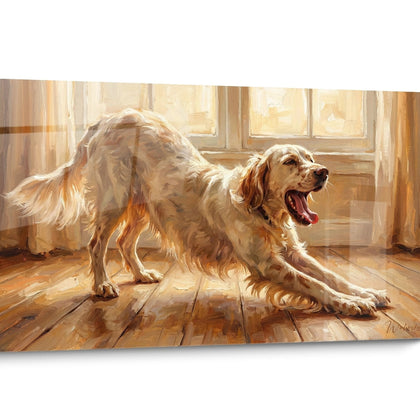
The English Setter hunting dog wall art constitutes a visual tribute to the functional elegance of this field companion. This mural representation captures the intensity of the Setter in action, legs extended through tall grass, nostrils quivering on a fresh scent. For bird hunting enthusiasts, this artwork immediately evokes misty mornings, the excitement of fieldwork, and that unique bond between hunter and pointing dog. Beyond mere decoration, this piece visually reconstructs the atmosphere of hunting territories traversed season after season.
Dynamic Representation of the Setter in Full Hunting Action
A large-scale English Setter hunting dog wall art transcends static photography to restore the energy deployed during a productive hunt. The imposing formats allow detailing the muscular extension of the dog when it locks on game scent, that characteristic posture where each muscle fiber communicates the presence of partridges or woodcock. Artists specializing in this theme master the representation of mottled coat in motion, the shifting reflections on the tricolored coat swept by the wind of open fields.
Which hunting scenes to prioritize for a trophy room?
Discerning collectors select compositions showing the Setter in revealing configurations: the extended point at the edge of grain fields, the delicate retrieval of game, or the crossing of a stream during a forest drive. These hunting visuals work particularly well in rooms dedicated to storing hunting equipment, creating thematic continuity between actual gear and its artistic representation. The earthy tones of the coat naturally harmonize with dark woodwork and patinated leather of vintage game bags.
How the artwork captures controlled predatory instinct
Unlike the static representations found in collections of English Setter in contemplative posture, hunting-oriented versions stage muscular tension, the gaze fixed toward an off-frame point, whiskers raised. This fundamental difference answers the expectations of hunters wishing to visually relive the excitement of hunting season. The finest creations incorporate contextual elements: Scottish heather, freshly cut stubble, late afternoon light filtering through foliage.
The importance of monumental format for reception spaces
In a hunting lodge dining room or rustically decorated living room, a large-scale artwork representing the Setter at work becomes the focal point around which hunting stories are organized. Generous dimensions allow appreciating anatomical details that distinguish this breed: the particular angulation of hindquarters during gallop, the silky fringe undulating with effort, the concentrated expression during scent tracking. These voluminous works require sufficient distance to be contemplated in their entirety, ideally on a wall facing the main entrance.
Evoking Hunting Terrain Through Visual Composition
A successful English Setter hunting dog wall art is not limited to the canine subject; it restores the specific atmosphere of biotopes frequented. Meticulously crafted backgrounds suggest the diversity of hunting territories: windswept Breton moorlands, harvested beet fields, sparse woodlands where autumn light emerges. This geographical contextualization amplifies emotional impact for owners recognizing their own preferred hunting grounds.
Which landscape elements reinforce hunting authenticity?
The most sought-after compositions integrate characteristic territorial markers: tractor furrows, hawthorn hedgerows delimiting plots, church steeples announcing late morning. These secondary details transform a simple animal representation into testimony of a hunting lifestyle. For a rural estate office or library with heritage furnishings, these landscape references establish narrative coherence with the real environment visible through windows.
Seasonality in representing the working Setter
Experienced collectors sometimes assemble thematic series illustrating different hunting periods: the young Setter in summer training, the mature dog during September openings, the wise veteran in late season winter. This narrative approach allows punctuating a hallway or gallery with chronological succession, creating a visual story of hunting cycles. The lighting and vegetation variations between these representations significantly enrich overall decorative impact.
How to coordinate the artwork with mounted specimens?
In interiors where taxidermy pieces and pictorial representations coexist, the English Setter hunting dog wall art establishes visual dialogue with mounted specimens displayed under glass. The two-dimensional work brings the dynamism and movement that fixed specimens cannot restore, while the latter confirm the materiality of hunted species. This complementarity works particularly well in hunting lodge reception rooms, where the accumulation of hunting references reinforces the space's identity.
Preserving Hunting Heritage Through Mural Art
Beyond its decorative function, an English Setter hunting dog wall art constitutes a transmission vector between generations of hunters. These artworks immortalize specific canine lineages, working configurations that have become rare with evolving practices, or agricultural landscapes modified by successive land consolidations. For families practicing hunting over multiple generations, these representations acquire heritage dimension comparable to vintage photographs or hunting journals.
Why choose a representation of your own dog?
Some enthusiasts commission personalized creations reproducing their own Setter in an emblematic pose captured during a memorable outing. These custom works require providing reference photos showing the dog in its habitual working environment, with characteristic lighting and atmosphere. The result transcends simple artistic commission to become an individualized tribute to an exceptional field companion, particularly cherished after the animal's passing.
Integration into a multi-generational space devoted to hunting heritage
Rural manor houses often contain a room devoted to family hunting history, accumulating antique firearms, dog show medals, confirmation diplomas, and yellowed photographs. In this heritage context, a Setter action painting establishes visual continuity between past and present, anchoring contemporary practice in historical lineage. Monumental formats naturally assert themselves on the walls of these memory-laden spaces.
How the artwork influences young hunters' cynological education?
For new generations discovering hunting with pointing dogs, these mural representations function as informal educational supports, illustrating correct postures, appropriate working distances, or necessary harmony between handler and auxiliary. Detailed scenes allow analyzing hunting technique with more precision than a fixed photograph, artistic interpretation accentuating significant technical elements. This educational dimension justifies the presence of such artworks in common rooms of local hunting societies.
Is an English Setter hunting dog wall art suitable for urban residences?
Absolutely, these artworks allow urban hunters to maintain permanent visual connection with their passion, transforming a city apartment into symbolic extension of their rural hunting territories. Large dimensions compensate for geographical distance from practice areas.
What difference exists with English Setter dog show representations?
Hunting-focused paintings prioritize functional action and natural environment, while show versions emphasize anatomical conformation and static presentation on manicured grass. The former address practitioners, the latter breeders and judges.
How to maintain a large-scale English Setter hunting dog wall art?
These artworks require regular dusting with dry microfiber cloth, positioning avoiding direct sun exposure that would degrade pigments, and ideally humidity monitoring in rooms not permanently heated such as seasonal hunting lodges.


 English Setter in Purple Heather Painting - Pointing Dog - English Setter Edition233,90 €
 Dog on Point in the Countryside with Bird - Hunting Instinct - English Setter Edition233,90 €
 Hunting Dog in Motion Among Autumn Foliage Wall Art - Natural Elegance - English Setter Edition233,90 €
 White and Orange Dog Painting in Golden Prairie - Movement and Harmony - English Setter Edition233,90 €
 White Dog in Motion Expressive Painting - Wild Momentum - English Setter Edition233,90 €