


Realistic Underwater Diving Wall Art
Discover our Underwater painting Realistic collection that captures the essence of ocean depths with striking precision. Each artwork celebrates the beauty of realistic underwater scenes through detailed compositions that immortalize aquatic life, coral reefs, and marine fauna. These artistic creations transform your interior into a window onto the ocean. Our realistic underwater art collection offers a unique visual immersion, perfect for diving enthusiasts and marine universe lovers.
 Underwater Divers Painting - Duo in Depth - Underwater Diving Edition242,90 €
 Divers Equipment Preparation Wall Art - Buddy Teams of the Depths - Scuba Diving Edition273,90 €
 Freediver Painting - Emergence from the Depths - Scuba Diving Edition273,90 €
 Scuba Diver Mask Painting - Bubble Escape - Scuba Diving Edition273,90 €
 Dive Mask Painting - Underwater Gaze - Scuba Diving Edition273,90 €
 Diver Silhouettes Painting - Exploration of the Depths - Scuba Diving Edition273,90 €
 Diver Air Bubbles Artwork - Underwater Respiration - Underwater Diving Edition273,90 €
 Diver's Hand Wall Art - Seabed Exploration - Underwater Diving Edition273,90 €
 Smiling Diver Painting - Joyful Water Surface - Underwater Diving Edition228,90 €
Explore further
In Realistic Underwater Diving Wall Art

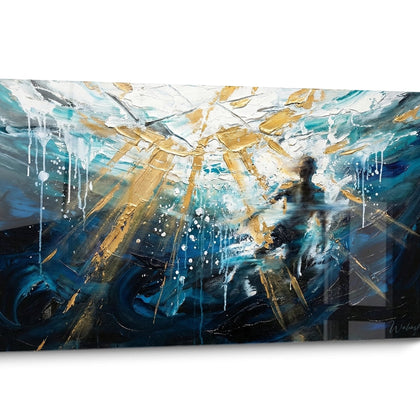
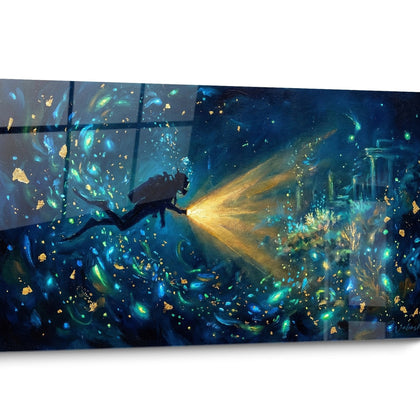
All about Realistic Underwater Diving Wall Art
- Realistic Underwater Diving Wall Art Presentation
- Authentic Marine Atmospheres
- Photographic Renderings of the Aquatic World
- Selection and Visual Impact
Dive into the captivating universe of the oceans through wall decoration that captures the authentic beauty of the seafloor. A realistic underwater diving painting offers striking visual immersion, reproducing with precision the captivating details of aquatic fauna, coral formations and characteristic light play of great depths. These large-format creations instantly transform your living space into a true window onto the marine world, bringing a contemplative and soothing dimension to your interior. Whether you're a diving enthusiast, marine ecosystem lover or simply seeking a relaxing atmosphere, this form of documentary artistic expression responds to a growing aspiration for visually immersive and scientifically inspired environments.
The authenticity of underwater ecosystems captured in large format
A realistic underwater diving painting stands out for its ability to faithfully reproduce the biological and geological characteristics of marine habitats. Unlike stylized representations, these compositions prioritize precise visual documentation of species in their natural environment. Coral reef reproductions show the architectural complexity of madreporian formations, while pelagic scenes capture schools of fish in their characteristic coordinated movements.
Which marine species are favored in realistic compositions?
Creations focused on marine realism frequently incorporate iconic subjects such as sea turtles gliding between gorgonians, sharks evolving in deep blue waters, or majestic manta rays. Macro-compositions highlight fascinating details of nudibranchs, camouflaged seahorses or clownfish nestled in their symbiotic anemones. This taxonomic precision gives decoration an educational dimension.
The restoration of underwater light gradients
One of the technical challenges of realistic underwater diving paintings lies in reproducing aquatic optical phenomena. Sunrays filtering from the surface create dancing luminous columns, while the blue dominance intensifies with depth. Shadow areas under rocky overhangs contrast with lit reef sections, creating striking three-dimensional depth. These subtle chromatic variations radically distinguish naturalistic renderings from freer interpretations such as abstract underwater diving painting which prioritizes artistic expression over documentary constraints.
Textures and materials of the benthic world
Coral surfaces present exceptional textural richness that high-definition reproductions now successfully restore. Translucent polyps, tubular sponges, undulating algae and eroded limestone formations constitute a complex visual vocabulary. Enlargements reveal details invisible to the naked eye during traditional diving, offering a quasi-scientific perspective on these fragile ecosystems.
Photographic techniques and hyperrealistic rendering of the depths
The production of a realistic underwater diving painting relies on advanced underwater imaging technologies. Specialized photographers use professional waterproof housings, powerful underwater lighting and wide-angle lenses to capture the vastness of marine panoramas. Mastery of buoyancy allows for stable photography, while understanding animal behavior ensures natural and non-invasive compositions.
How to recognize museum-quality reproduction?
High-end creations are recognized by several technical indicators. Print resolution must preserve the sharpness of fine details such as individual scales or gill filaments. Extended color gamut faithfully renders the fluorescent hues of certain corals and the bioluminescence of certain deep-sea species. Imposing formats, often exceeding 120 centimeters, maximize the immersive effect and transform the wall into a true panoramic window.
The importance of underwater white balance
A major challenge of underwater photography lies in compensating for chromatic filtration. Water progressively absorbs red wavelengths, creating a cyan-greenish dominance in depth. Professional-quality realistic paintings apply precise colorimetric corrections to restore the natural hues of organisms, revealing brilliant reds and vivid yellows often invisible to the diver's eye without artificial lighting.
Perspectives and architectural compositions of reefs
Photographers exploit underwater geological formations to create visually structured compositions. Coral arches, underwater canyons, vertical drop-offs and semi-lit caves offer spectacular natural frames. These organic architectural elements guide the eye through the image, creating leading lines that enhance depth of field. The inclusion of divers as a scale reference accentuates the majesty of formations and the immensity of pelagic landscapes.
Decorative integration and enhancement of contemporary spaces
Installing a realistic underwater diving painting radically transforms the perception of an interior space. These large-format creations work particularly well in professional environments related to the maritime sector, medical offices seeking soothing atmospheres, or primary residences of oceanography enthusiasts. The contemplative dimension of these aquatic scenes induces a slowing of heart rate and promotes concentration, properties validated by several behavioral studies.
Which spaces benefit most from a realistic marine ambiance?
Open living rooms with clear walls constitute the ideal location for these immersive compositions. Home offices benefit from the relaxing effects to improve creative productivity. Meditation spaces, yoga rooms or relaxation zones find in these oceanic representations a visual support fostering introspection. Thalassotherapy centers and spas naturally exploit this theme to strengthen their sensory identity.
Chromatic associations and complementary decorative elements
The palette dominated by deep blues, turquoises and marine greens naturally harmonizes with materials such as driftwood, woven rattan or natural fibers. Touches of bright white evoking sea foam create luminous contrasts. The integration of plants with graphic foliage recalls organic shapes of algae and gorgonians. Indirect lighting highlights tonal variations without creating disturbing reflections on the print surface.
Selection criteria for a relevant purchase
Several factors determine optimal choice. The biodiversity represented must correspond to your personal preferences: do you prefer the colorful coral scenes of the tropics, pelagic encounters with large predators, or temperate underwater landscapes with cooler tones? Simulated depth influences ambiance: surface scenes bathed in light bring vitality, while deep-water views establish a more meditative atmosphere. Human presence (divers) creates a different narrative dimension from exclusively natural compositions.
Is a realistic underwater diving painting suitable for small spaces?
Imposing formats are generally recommended to maximize the immersive effect, but vertical compositions can adapt to narrow walls. The essential lies in maintaining sufficient viewing distance to embrace the entire scene without visual fragmentation.
How to preserve the color quality of a realistic underwater diving painting?
Avoid direct exposure to solar radiation which progressively degrades cyan and blue pigments. UV-protective glazing or positioning perpendicular to windows significantly extends the durability of colors. Environments with controlled humidity better preserve the integrity of the print support.
What is the difference between photographic reproduction and naturalistic illustration?
Photographic reproductions capture real moments with their authentic imperfections, while scientific illustrations can combine multiple species rarely observed simultaneously in nature. Both approaches possess documentary value, but photography offers superior emotional authenticity for diving enthusiasts seeking to relive their underwater experiences.


