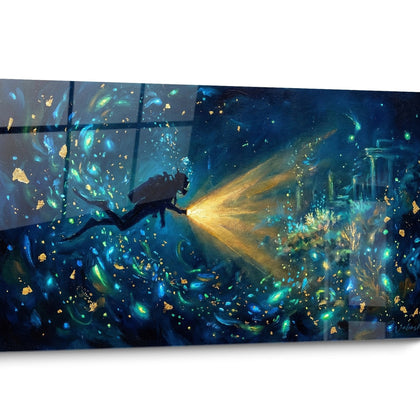
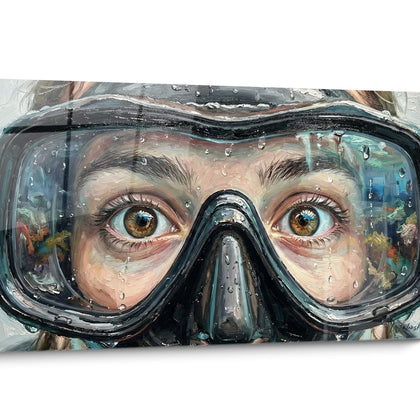
The abstract underwater diving wall art reinvents the representation of marine depths by abandoning photographic realism in favor of a refined and conceptual visual interpretation. This artistic approach captures the very essence of the aquatic universe through stylized forms, fluid movements and visual suggestions that evoke the sensation of immersion without resorting to conventional figuration. These large-scale wall creations transform living spaces by creating a contemplative atmosphere where chromatic nuances and visual textures replace traditional narrative details. Abstraction allows personal interpretive freedom while maintaining a strong thematic anchor in oceanic imagination, thus offering a sophisticated decorative solution for contemporary art enthusiasts sensitive to minimalist marine aesthetics.
Gestural abstraction in service of the marine universe
The abstract underwater diving wall art transposes aquatic movements into dynamic pictorial gestures that suggest fluidity without representing it literally. Contemporary artists exploit techniques of drips, controlled splashes and chromatic superimpositions to evoke submarine turbulence, density interplay and pressure variations that characterize the abyssal environment.
Visual transcription of hydrodynamic phenomena
The non-figurative approach makes it possible to capture the essence of ocean currents, whirlpools and liquid stratifications through compositions where organic forms dissolve progressively. This abstract interpretation of oceanic dynamics creates a particularly sought-after meditative visual experience in contemporary residential spaces dedicated to relaxation. Modern marine art collectors appreciate this ability to suggest rather than describe, thus offering superior conceptual depth compared to conventional representations.
How does abstraction amplify the marine sensory dimension?
By eliminating anecdotal details, the abstract underwater diving wall art concentrates attention on pure sensations associated with immersion: environmental pressure, gravitational suspension, perceptual distortion. Monumental formats accentuate this immersive effect by encompassing the viewer's visual field, creating a true contemplative installation that transcends mere decorative function. This approach particularly appeals to buyers seeking works capable of generating a distinctive atmosphere without imposing rigid narrative reading.
Formal vocabulary of aquatic abstraction
Creators develop a specific visual language combining transparencies, stratified opacities, evolving chromatic gradients and controlled dilution zones. These formal elements visually translate the physical properties of water: light refraction, progressive dissolution, undefined liquid boundaries. For professional spaces requiring sophisticated decoration without overly explicit connotation, this thematic abstraction represents an ideal compromise between aesthetic neutrality and affirmed identity character. Subtle tonal variations also enable harmonious integration with diverse decorative palettes, while maintaining a distinctive visual signature recalling the oceanic universe in a conceptual manner.
Chromatic palettes and symbolism of abstract depths
The abstract underwater diving wall art exploits specific color ranges that evoke different oceanic strata without reproducing them literally. Transitions between deep blues, oxidized emerald greens, abyssal violets and silvery luminous touches create an emotional mapping of marine zones through a purely chromatic approach.
Abstract translation of bathymetric gradients
Contemporary artists transpose brightness variations according to depth into stratified compositions where concentrated dark hues suggest the abyss while punctual lightenings evoke light breakthroughs. This technique generates vertical spatial reading that unconsciously reproduces the progressive descent experience characteristic of underwater exploration. For buyers of monumental wall works, this vertical chromatic organization also offers compositional advantages in structurally visualizing double-height spaces or stairwells. Complex polychromatic compositions rival monochromatic approaches favorably, particularly in minimalist environments requiring a vibrant focal point.
Which color associations reinforce abstract marine evocation?
Beyond predictable blues, abstraction permits integration of unexpected hues: rusty ochres evoking oxidized wrecks, charcoal blacks suggesting volcanic trenches, milky whites recalling planktonic suspensions. This enlarged chromatic freedom fundamentally distinguishes the abstract underwater diving wall art from realistic representations constrained by photographic fidelity. Collectors seeking works simultaneously thematically recognizable and sufficiently open to support diverse interpretations favor these enriched chromatic compositions. Occasional inclusion of metallic or iridescent touches also reproduces bioluminescence optical effects without resorting to figurative representation of marine organisms.
Contrasted harmonies versus soft transitions
Some creations privilege frank ruptures between color zones, visually translating thermoclines and haloclines that vertically segment oceanic masses. Others opt for progressive blends evoking the fluid continuity and absence of fixed boundaries characteristic of the liquid environment. To complement decoration already including a golden underwater diving wall art, abstract versions with cool tonalities create a thermal contrast enriching the visual ensemble. This complementarity enables exploration of different facets of marine aesthetics within the same residential or commercial space, offering thematic coherence despite divergent stylistic treatments.
Perceptual dimensionality and immersive spatiality
The abstract underwater diving wall art manipulates depth perception through sophisticated compositional strategies that create spatial penetration illusion without resorting to traditional perspective codes. Monumental formats amplify this immersive dimension by establishing an encompassing scale relationship between the work and the viewer.
Depth construction without linear perspective
Oceanic abstraction employs layering of semi-transparent strata, tonal graduation and visual density variation to suggest the progressive distance characteristic of underwater vision. This approach avoids geometric perspective artifices in favor of more organic and fluid atmospheric spatiality. Buyers of large-scale wall works particularly appreciate this capacity to generate three-dimensional sensation that psychologically transforms surrounding architectural volume. Installations in circulation spaces notably benefit from this visual appeal effect that encourages movement and progressive composition exploration.
Why does marine abstraction favor prolonged contemplative experience?
The absence of precise narrative details encourages repeated observation where each glance discovers new formal and chromatic relationships. This evolving perceptual richness distinguishes the abstract underwater diving wall art from documentary representations exhausted after few viewings. Professional environments like medical spaces, premium waiting areas or executive offices specifically seek this meditative quality fostering stress reduction without imposing distracting content. Format monumentality reinforces this soothing effect by creating an encompassing visual environment comparable to a virtual window opening onto abstract ocean.
Visual textures and suggested tactility
Impasto techniques, scraping, projection and dripping generate surface richness adding quasi-tactile dimension to visual experience. These textural variations abstractly evoke different marine environment consistencies: viscosity of dense currents, lightness of oxygenated zones, roughness of suggested mineral formations. For collectors prioritizing investment in unique pieces rather than standardized reproductions, these material qualities constitute a major decision criterion. The work's ability to perceptually modify its appearance according to ambient lighting and observation angle adds a performative dimension appreciated in upscale residential spaces.
Frequently asked questions about abstract underwater diving wall art
Is abstract underwater diving wall art suitable for demanding professional environments?
Absolutely, thematic abstraction offers the ideal compromise between professional neutrality and distinctive character. Non-figurative compositions avoid overly personal connotations while creating a recognizable atmosphere that humanizes corporate spaces without compromising their seriousness.
How to identify quality abstract underwater diving wall art for lasting wall display?
Prioritize creations using UV-resistant pigments, dimensionally stable rigid supports and protective finishes adapted to hygrometric variations. Monumental formats also require reinforced fastening systems capable of durably supporting the substantial weight of large surfaces.
What is the added value of abstract underwater diving wall art compared to figurative versions?
Abstraction offers superior aesthetic longevity by escaping ephemeral style trends. It also permits evolving personal interpretation that maintains visual interest over time, unlike literal representations whose reading becomes exhausted quickly.


 Abstract Diver Painting - Azure Immersion - Scuba Diving Edition233,90 €
 Urban Diver Painting - Abstract Underwater Art - Scuba Diving Edition233,90 €
 Air Bubbles Underwater Painting - Aquatic Escape - Scuba Diving Edition233,90 €
 Abstract Marine Painting - Ocean Depths - Scuba Diving Edition233,90 €
 Scuba Diving Painting - Golden Rays in the Depths - Scuba Diving Edition233,90 €
 Underwater Storm Painting - Turbulent Depths - Scuba Diving Edition233,90 €
 Under-Ice Diver Wall Art - Glacial Exploration - Underwater Diving Edition233,90 €
 Diver Silhouette Painting - Crystalline Immersion - Underwater Diving Edition213,90 €
 Air Bubbles Crystalline Painting - Aquatic Ascent - Underwater Diving Edition213,90 €