


German Shepherd Pop Art Canvas
The Painting German Shepherd Pop Art transforms the iconic shepherd dog into a vibrant contemporary artwork. This collection celebrates the nobility and intelligence of this legendary breed through pop art canine portraits with bright and contrasting colors. Each creation captures the characteristic expression of the German shepherd in an artistic style inspired by the great masters of the pop art movement. Perfect for dog lovers and fans of modern animal art, this collection brings a dynamic and original touch to your interior decoration.
 German Shepherd Canvas Multicolor Splatters - Artistic Explosion - German Shepherd Canvas Edition273,90 €
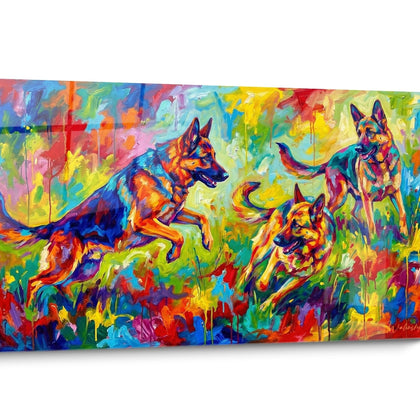
 Multicolor Expressionist German Shepherds Canvas - Vibrant Canine Trio - German Shepherd Canvas Edition273,90 €
 German Shepherd Painting Multicolor Neon Tones - Contemporary Portrait - Edition German Shepherd Painting228,90 €
 German Shepherd Wall Art in Turquoise and Orange Colors - Expressionist Portrait - German Shepherd Edition228,90 €
Explore further
In German Shepherd Pop Art Canvas



All about German Shepherd Pop Art Canvas
- Presentation German Shepherd Painting Pop Art
- The Chromatic Explosion of Pop Art
- The Canine Warhol Legacy
- Visual Impact and Decoration
The German shepherd pop art painting represents a bold fusion between the iconoclastic aesthetics of the pop art movement of the 1960s and the natural bearing of this emblematic dog breed. This artistic variation radically transforms the traditional perception of the German shepherd by applying the revolutionary visual codes popularized by Andy Warhol and Roy Lichtenstein. The available XXL formats amplify this transgressive approach by giving the animal a monumental dimension that dialogues directly with urban contemporary art. This decorative approach is aimed at enthusiasts seeking a radical alternative to conventional representations, while celebrating their attachment to this legendary breed with a resolutely modern and culturally charged aesthetic.
The Chromatic Revolution of the German Shepherd in Pop Art Version
The pop art German shepherd painting overturns aesthetic conventions by applying a saturated chromatic palette that radically transforms the appearance of this breed. Unlike the natural fawn and black tones characteristic of the breed, the pop art interpretation deploys neon pinks, electric blues, fluorescent yellows, and acidic greens that fragment the image into contrasting color zones. This polychromatic explosion is not gratuitous: it is in keeping with Warhol's tradition of democratizing the image through its serial and colored reproduction.
Why does chromatic contrast amplify the canine presence?
The use of extreme chromatic contrasts in the German shepherd pop art painting creates an immediate visual tension that captures attention much more effectively than naturalistic representations. The clear boundaries between color zones – a magenta ear juxtaposed with a cyan muzzle – generate an optical dynamic that literally animates the composition. This technique directly recalls the silkscreens of Marilyn Monroe or Elvis Presley, transposing their status as cultural icons onto this venerated dog breed. For collectors seeking other stylistic approaches, the multicolored German shepherd painting also offers a bold chromatic exploration while retaining more organic nuances.
Color blocks as a stylistic signature
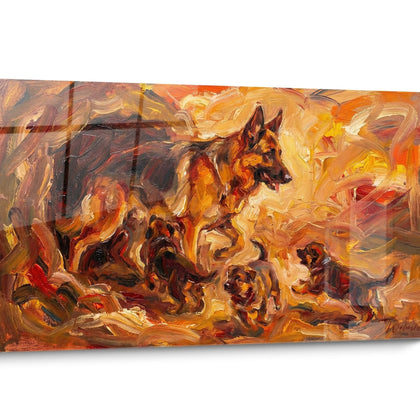
The technique of uniform color blocks constitutes the visual DNA of the German shepherd pop art painting. Each color zone is applied without gradient or subtle shading, creating a simplified but powerful graphic reading. This formal reduction transforms the complex coat of the German shepherd into defined geometric zones that dialogue with each other through their juxtaposition. Large formats amplify this effect by allowing each color block to fully express itself, transforming the work into a true mural statement. This approach differs radically from the expressionist German shepherd painting which favors visible brushstrokes and organic textures.
The psychological impact of artificial colors
The deliberate choice of artificial hues in the German shepherd pop art painting generates a specific emotional reaction. These colors from the industrial and advertising universe create an ironic distance from the natural subject, questioning our relationship to the image and representation. A fluorescent orange or purple German shepherd creates a cognitive dissonance that stimulates the viewer's visual engagement. This chromatic strategy works particularly well in contemporary spaces where it injects a dose of controlled irreverence, transforming a symbol of traditional loyalty into a modern visual manifesto.
The Warhol Legacy Applied to Canine Iconography
The German Shepherd Pop Art painting directly belongs to the conceptual lineage of Andy Warhol, who democratized art by elevating everyday objects and celebrities to the status of visual icons. By applying this methodology to the German Shepherd, the work transforms the animal into a cultural symbol exceeding its simple biological function. Serial repetition, simplified outlines, and the stylized screen printing are the aesthetic markers that directly link this production to Warhol's Factory of the 1960s-1970s.
How does screen printing transform the perception of dogs?
The characteristic screen printing technique of pop art reduces the complex photographic image of the German Shepherd to its essential elements: clear outlines, delimited color areas, suppression of superfluous details. This graphic simplification is not a impoverishment but a distillation that concentrates the visual essence of the breed. Erect ears, elongated muzzle, piercing gaze become immediately identifiable graphic signs, even treated in shocking pink or apple green. This instant readability gives the German Shepherd Pop Art painting a direct communicative effectiveness, ideal for contemporary living spaces seeking immediate visual impact.
Serial multiplication as a decorative concept
Some variations of the German Shepherd Pop Art painting reprise the Warholian principle of repetition by presenting the same canine profile in different color variations on the same composition. This multiplication creates a hypnotic visual rhythm that transforms the work into a true wall installation. Four, six, or nine portraits of the same German Shepherd, each treated in a different color range, generate a dynamic of comparison and internal dialogue. This serial approach is diametrically opposed to the realistic German Shepherd painting which favors uniqueness and photographic fidelity.
The encoded cultural references
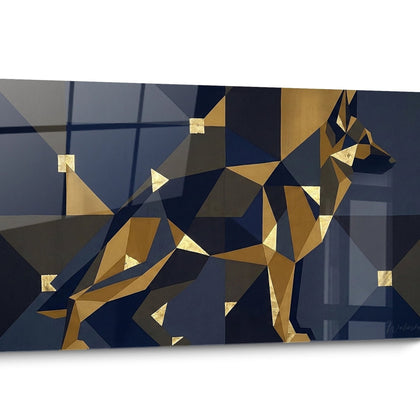
The German Shepherd Pop Art painting works on several levels of simultaneous cultural reading. At the first degree, it celebrates pop art aesthetics and its counter-cultural heritage. At the second level, it questions our relationship with pets in consumer society, elevating the German Shepherd to the status of a cultural product like Campbell’s Soup cans. This semantic stratification considerably enriches the conceptual value of the work, transforming it into a visual conversation about contemporary iconography. Lovers seeking other stylistic interpretations will also appreciate the geometric German Shepherd painting which deconstructs the canine image according to other formal principles.
Maximum Decorative Impact of Canine Pop Art
The German Shepherd Pop Art painting asserts itself as a dominant focal point in any interior space thanks to its chromatic intensity and assumed visual charge. Unlike neutral works that blend discreetly into their environment, this pop variation demands attention and structures the space around it. The available XXL formats literally transform a wall into an aesthetic manifesto, creating a visual anchor that completely redefines the ambiance of the room. This maximalist approach is particularly suitable for urban lofts, rehabilitated industrial spaces, and contemporary interiors that assert a defined visual identity.
Which spaces benefit most from this aesthetic?
The German Shepherd pop art painting thrives particularly in generous volumes with white or anthracite gray walls that serve as a neutral canvas for its chromatic explosion. Creative professional spaces – communication agencies, design studios, trendy coworking spaces – frequently adopt this aesthetic to assert an innovative and unconventional identity. In private residences, open living rooms, mezzanines, and American kitchens are privileged locations where the artwork can dialogue with contemporary architecture. This affirmed presence contrasts with the sober elegance of the gilded German Shepherd painting which favors luxurious refinement.
The association with contemporary furniture
The German Shepherd pop art painting creates remarkable visual synergies with contemporary design furniture. The clean lines of a revisited Chesterfield sofa, exposed metal structures, concrete-effect elements, or glossy lacquered finishes mutually amplify their aesthetic impact. This harmony is based on a common formal language: assumed geometry, frank colors, industrial materials détourned. The artwork also works as a stimulating counterpoint in more classic interiors, injecting a calculated dose of irreverence that energizes the whole. To explore all the decorative possibilities around this breed, the complete German Shepherd painting collection offers an exhaustive stylistic panorama.
The visual conversation with other wall elements
Integrating a German Shepherd pop art painting into an existing wall composition requires a thoughtful approach. Its visual intensity naturally makes it the dominant focal point, with other elements either resonating with its aesthetic (contrasting black and white photographs, graphic typography, geometric abstractions), or creating visual breaths through their sobriety. The rule of odd numbers works particularly well: the central pop art artwork surrounded by two more discreet elements creates a dynamic balance. This compositional strategy transforms the wall into a veritable personal gallery that tells a coherent aesthetic story while celebrating the iconic power of the German Shepherd reinvented by pop art codes.
FAQ: Frequently Asked Questions about the German Shepherd Pop Art Painting
Is a German Shepherd pop art painting suitable for all interior styles?
The German Shepherd pop art painting integrates ideally into contemporary, industrial, urban loft, and minimalist spaces that can absorb its chromatic intensity. It works less well in traditional, rustic, or countryside atmospheres where it would create a stylistic dissonance that is too marked, except for a deliberate search for ironic contrast.
What size should I choose to maximize the impact of a German Shepherd pop art painting?
XXL formats (120x180 cm or larger) fully exploit the visual potential of the German Shepherd pop art painting by allowing the color blocks to express themselves powerfully. On a wall 3 to 4 meters long, a panoramic format creates a monumental presence that truly transforms the space. For smaller surfaces, a vertical 80x120 cm format retains the impact while adapting to spatial constraints.
Does the German Shepherd pop art painting require specific lighting?
Directional cool white LED lighting (5000-6500K) remarkably intensifies the saturated colors of the German Shepherd pop art painting by creating sharp contrasts without chromatic alteration. Adjustable spotlights eliminate reflections while visually sculpting the artwork. Avoid warm yellow lighting which would distort the neon hues and diminish the characteristic visual impact of the pop art aesthetic.


