


German Shepherd Expressionist Wall Art
The German Shepherd Expressionist painting celebrates the majesty of this iconic breed through a bold and colorful artistic vision. This collection captures the intelligence, loyalty, and power of the German Shepherd in a vibrant visual language. The expressionist portraits of German Shepherds reveal the soul of this faithful companion through dynamic touches and striking contrasts. Perfect for dog lovers and fans of modern animal art, this series transforms your interior into a contemporary gallery dedicated to this exceptional dog.
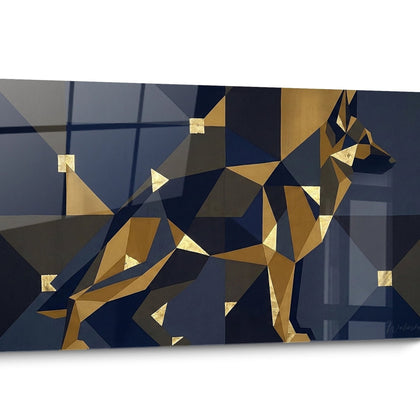
 Expressionist German Shepherd Wall Art with Golden Tones - Canine Emotion - German Shepherd Wall Art Edition273,90 €
 German Shepherd in Action with Handler - Canine Dynamism - German Shepherd Wall Art Edition273,90 €
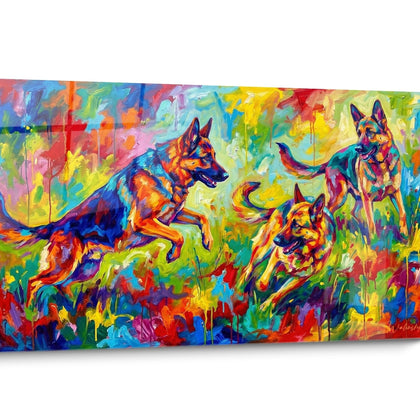
 Multicolor Expressionist German Shepherds Canvas - Vibrant Canine Trio - German Shepherd Canvas Edition273,90 €
 German Shepherd Wall Art in Turquoise and Orange Colors - Expressionist Portrait - German Shepherd Edition228,90 €
Explore further
In German Shepherd Expressionist Wall Art



All about German Shepherd Expressionist Wall Art
- Painting Presentation German Expressionist Shepherd
- Emotions and Artistic Intensity
- Expressionist Color Palette
- Decorative Impact and Wall Presence
The shepherd German painting expressionist transcends the simple canine representation to create a true work of emotional intensity. This artistic variation captures the essence of the German shepherd through vigorous brushstrokes, dramatic contrasts, and a voluntary distortion of proportions that amplifies the animal's psychological presence. Unlike academic approaches, canine expressionism prioritizes the transmission of raw sensations rather than anatomical fidelity, transforming each canine gaze into an existential question. Generous formats of these monumental creations accentuate their communicative power, propelling the German shepherd to the rank of contemporary mythological figure. This tormented aesthetic naturally dialogues with spaces with a strong character, where emotional authenticity takes precedence over conventional decoration.
Canine Expressionism at the Service of Emotional Intensity
The shepherd German painting expressionist is part of a pictorial tradition that favors emotional violence over factual description. Contemporary artists who adopt this approach deliberately distort the musculature of the German shepherd, exaggerate the intensity of his gaze, and work the texture with an almost sculptural materiality. This approach recalls the Germanic masters of the early 20th century who revolutionized the representation of living beings.
How do expressionistic distortions magnify canine psychology?
The characteristic deformations of the expressionist style are not mistakes but deliberate aesthetic choices. By amplifying certain anatomical traits of the German shepherd - the arch of the eyebrows, the depth of the chest, the tension of the limbs - the artist creates a visual translation of the psychic intensity of the breed. This accentuation transforms the animal into an archetype, into a concentrate of loyalty, vigilance and contained power. The visual result generates an immediate emotional connection with the viewer, far beyond what a photograph could achieve.
Compositional tensions and visual dynamism
The expressionist composition breaks with classical balance to create a creative imbalance. The German shepherd can be de-centered, partially cut off by the frame, or projected forward in an exaggerated perspective. These compositional choices keep the viewer's eye constantly in motion, visually reproducing the permanent state of alert characteristic of the breed. For a shepherd German pop art painting, the approach would be radically different with colored blocks and an assumed frontality, while expressionism cultivates visual instability.
Pictorial materiality and physical presence
The characteristic impasto of the shepherd German expressionist painting creates a tormented surface where light catches differently depending on the angle of observation. This visible, almost palpable texture adds a three-dimensional dimension absent from digital reproductions. Large formats available amplify this tactile effect, transforming the wall surface into a sculpted relief. This materiality particularly well dialogues with industrial interiors, lofts with raw walls or spaces where the authenticity of materials constitutes an assumed decorative choice.
Color Palette and Symbolic Expressionist Coloration
The color palette of the German shepherd expressionist painting completely breaks away from the naturalistic colors of the canine coat. Expressionist artists use burnt ochres, muted greens, unsettling purples, or incandescent reds to convey emotional states rather than physical appearances. This colorful freedom transforms each creation into a unique sensory experience, impossible to anticipate.
Why do non-naturalistic colors strengthen the emotional impact?
Abandoning realistic tones frees the work from any documentary pretense and propels it into the realm of subjective interpretation. A German shepherd in greenish hues evokes a primordial, almost prehistoric dimension, while orange tones suggest volcanic energy. This chromatic transgression forces the viewer to move beyond immediate recognition ("that's a dog") to access a deeper symbolic reading. Art lovers seeking a faithful representation will turn to a realistic German shepherd painting, while expressionism is for those seeking an emotional confrontation.
Dramatic contrasts and expressive shadow zones
The German shepherd expressionist painting systematically exploits violent oppositions between light and darkness. These pushed contrasts create dense, almost opaque shadow zones from which bursts of light emerge abruptly. This technique recalls Caravaggio's chiaroscuro but with a contemporary gestural violence. The dark areas are never uniform but worked in transparency, creating an atmospheric depth that draws the eye. This approach is perfect for spaces with directional architectural lighting that amplifies these contrast effects.
Dissonant harmonies and bold chromatic chords
Unlike the soothing harmonies sought in conventional decoration, expressionism cultivates disturbing color associations. Saturated complements (purple and yellow, red and green) clash without mediation, creating a stimulating optical vibration. These bold choices transform the painting into an absolute focal point, incapable of blending into a neutral decor. This assertive presence suits personalities who embrace their aesthetic choices and seek a decoration in their image rather than reassuring conformity. For a more structured approach, a geometric German shepherd painting will offer more predictable color balances.
Architectural Presence and Spatial Impact of Large Format
The monumental dimensions of the German shepherd expressionist painting transform the architectural space that welcomes it. This ambitious scale is not simply a decorative choice but an expressive necessity: the emotional intensity of expressionism requires sufficient surface to deploy its communicative power. A reduced format would dilute the visceral impact of these tormented compositions.
How does the large format amplify the expressionist experience?
On an extended surface, each brushstroke becomes visible, each impasto generates micro-shadows, each accidental drip participates in the controlled chaos of the composition. The observer cannot grasp the whole with a single glance but must traverse the work in fragments, mentally reconstructing the unity of the German shepherd from zones of variable intensity. This sequential reading reproduces the experience of a real encounter with the animal, where attention focuses successively on the gaze, the posture, the muscle tension. Large formats create an immersion impossible to achieve with modest dimensions.
Dialogue with architecture and spatial restructuring
A large-scale German shepherd painting, expressionist in style, doesn't just decorate a wall; it redefines it. Its presence alters the perception of volumes, creates a new visual center of gravity, and restructures the eye's movement within the space. This ability to transform architecture justifies a strategic placement: facing the main entrance for an immediate confrontation, in a vestibule to mark a transition, or in a living room as an absolute focal point. This approach differs radically from a multicolored German shepherd painting which prioritizes joyful celebration over dramatic intensity.
Which contemporary spaces value canine expressionism?
Converted industrial interiors - former factories, lofts, transformed workshops - constitute the ideal setting for the German shepherd painting, expressionist in style. The exposed structures, raw materials (concrete, steel, brick), and generous volumes of these spaces resonate with the raw power of expressionist aesthetics. Contemporary minimalist architectures also offer a productive contrast: the clean simplicity of architectural lines exalts, by opposition, the gestural violence of the artwork. Conversely, classic or cluttered interiors risk visual cacophony. Collectors appreciating a more luxurious aesthetic can turn to a gilded German shepherd painting with more precious connotations.
Perceptual evolution and visual renewal
Unlike decorative artworks that quickly exhaust themselves, the German shepherd painting, expressionist in style, offers an interpretative richness that renews itself over time. The changing moods of the viewer, the diurnal and nocturnal variations in light, the evolution of the surrounding furniture constantly reveal new facets of the artwork. This depth guarantees a lasting emotional investment, transforming acquisition into a permanent dialogue rather than a simple decorative purchase. This living dimension justifies positioning in everyday living spaces rather than in passageways.
What maintenance does a large-scale German shepherd painting, expressionist in style, require?
Expressionist artworks with pronounced impasto accumulate dust progressively in the reliefs of pictorial matter. Gentle dusting with a soft brush with natural bristles every three to six months preserves the chromatic brilliance. Absolutely avoid any wet product that could alter the pigments or dissolve certain mediums. Positioning away from direct heat sources (radiators, fireplaces) prevents premature cracking of the surface.
How to integrate a German shepherd painting, expressionist in style, into an eclectic interior?
Expressionism paradoxically possesses an ability to adapt thanks to its very intensity: rather than seeking harmony, it creates a dominant focal point that visually reorganizes the space. In an eclectic interior, position the artwork on a clear wall, creating a visual breathing space around it. The surrounding decorative elements can then play by contrast (purified furniture) or by thematic echo (objects evoking the canine world or German culture).
Why choose a German shepherd painting, expressionist in style, rather than an artistic photograph?
Photography, even when retouched in post-production, remains captive to a captured moment and a pre-existing reality. Pictorial expressionism constructs a parallel reality where emotion precedes form. Each painting remains a unique piece, even in limited editions, while photography is infinitely reproducible. This uniqueness, combined with the physical materiality of paint, confers a presence and a patrimonial value impossible to obtain with a photographic image. To discover the full range of possible stylistic approaches, explore the complete collection German Shepherd painting.
Further reading
Our articles on this topic
- Blue-eyed Australian Shepherd painting: the original gift for dog lovers
- German Pointer painting for a chic hunting-style living room: the decor guide
- Australian Shepherd Watercolor Painting: The Perfect Decor for a Child's Bedroom
- Weimaraner Hunting Dog Painting in Realistic Style: The Selection Guide
- Australian Shepherd Portrait Painting: The Perfect Gift Idea for an Owner
- German Shorthaired Pointer watercolor painting for an adult bedroom: the decor guide
L'art qui suscite l'envie
Maison belge d'art mural grand format
14 jourspour changer d'avis*
Protection Walenskyincluse
Fabriquéen Italie
FormatXXL
Kit de fixationtoujours fourni
* Hors tableaux personnalisés et tailles personnalisées


