




Geometric Rottweiler Dog Wall Art
The Painting Rottweiler dog Geometric transforms the power of the Rottweiler into a fascinating contemporary work of art. This collection celebrates the perfect alliance between canine nobility and the modern aesthetic of polygonal shapes. Each creation captures the intensity of the gaze and the natural bearing of this iconic breed through a minimalist geometric design. Ideal for dog lovers and contemporary wall art, this collection brings character and sophistication to your interior decoration.
 Abstract Rottweiler Wall Art with Tribal Patterns - Geometric Power - Rottweiler Edition273,90 €
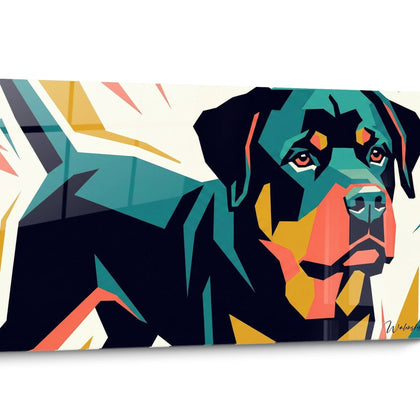
 Black Dog Painting with Turquoise and Orange Reflections - Geometric Portrait - Rottweiler Edition273,90 €
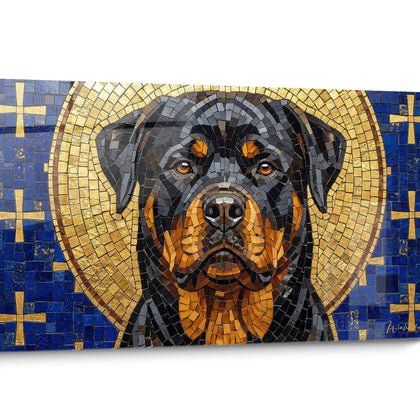
 Stylized Dog Wall Art Art Deco Gold and Black - Geometric Portrait - Rottweiler Edition273,90 €
Explore further
In Geometric Rottweiler Dog Wall Art


All about Geometric Rottweiler Dog Wall Art
- Geometric Rottweiler Wall Art Presentation
- Angular Style & Modernity
- Visual Impact & Architecture
- Symbolism & Interior Design
The geometric Rottweiler dog wall art transforms traditional canine representation into a fractured artistic composition where angular forms and multiple facets reconstruct the powerful anatomy of the mastiff. This fragmented approach sublimes the characteristic musculature of the breed through overlapping polygons that simultaneously capture the raw force and structural elegance of the Rottweiler. The large dimensions of these mural creations amplify the visual fragmentation effect, creating a monumental presence that dialogues with contemporary architecture in modern interiors and professional spaces with strong character.
Fragmented Architecture Serving Canine Power
The geometric Rottweiler dog wall art exploits polygonal deconstruction to reveal the distinctive anatomy of the German mastiff through a completely unprecedented prism. Each triangular or diamond-shaped facet reconstructs the salient muscle masses, the imposing skull angles and the robust bone structure that morphologically define this protection breed. Geometric fragmentation paradoxically accentuates the physical cohesion of the Rottweiler, transforming its portrait into structural cartography where each chromatic segment dialogues with adjacent zones.
How does geometrization amplify the perception of robustness?
Angular forms multiplying edges and planes create visual density that instinctively reinforces the perception of solidity and body mass. This modern geometric Rottweiler wall art representation technique proves particularly effective for monumental formats exceeding 120 centimeters where viewing distance allows the eye to mentally reconstitute the fragmented whole. Chromatic contrasts between adjacent polygons generate fictitious shadows that virtually sculpt volumes, conferring illusory three-dimensionality to the flat surface.
Integration into Spaces with Refined Lines
Minimalist Scandinavian interiors, converted industrial lofts and architects' offices naturally adopt this geometric Rottweiler dog wall art as a controlled breaking element. The fragmented composition establishes formal dialogue with exposed structures, metal beams and glass partitions characteristic of contemporary renovations. For graphic decoration enthusiasts seeking an alternative to metallic motifs, the golden Rottweiler dog wall art collection offers luxurious finishes that capture ambient light differently while maintaining marked canine presence.
Chromatic Palette and Visual Stratification
Monochromatic variations with anthracite gray gradations faithfully reproduce the natural bicolor coat of the Rottweiler while accentuating the depth of overlapping facets. Polychromatic versions integrating electric blues, saturated oranges or deep purples transform the mastiff into a pop culture icon, particularly sought after for specialized commercial spaces, design veterinary clinics and car showrooms highlighting Germanic aesthetics. The juxtaposition of warm and cool chromatic temperatures within the same geometric composition creates optical vibration that maintains visual attention over extended periods.
Geometric Monumentality and Spatial Domination
In generous architectural volumes with ceiling heights exceeding three meters, the XXL geometric Rottweiler dog wall art establishes sculptural presence rivaling three-dimensional installations. Polygonal fragmentation gains in perceptual complexity when wall dimensions allow facet multiplication: compositions exceeding one hundred fifty centimeters frequently integrate several hundred distinct segments whose assembly reveals itself completely only at optimal distance. This characteristic makes these creations particularly suited to enterprise entrance halls of security firms, receptions of professional dog breeding facilities and waiting spaces in cynological centers.
Which professional spaces valorize this fragmented representation?
Law firms specializing in criminal law, close protection companies and martial arts studios exploit the symbolism of vigilance and authority conveyed by the Rottweiler, amplified by geometric treatment that simultaneously evokes surveillance technology and operational precision. Horizontal panoramic formats create wall friezes where the large-format geometric Rottweiler wall art visually structures space by defining distinct functional zones without resorting to physical partitioning.
Perspective Effects and Multiple Viewpoints
The fragmented nature of the composition generates radically different visual experiences depending on viewing angle: frontal view reveals the complete reconstituted canine portrait, while lateral perspectives accentuate certain facets to the detriment of others, creating unprecedented partial configurations. This property transforms the geometric Rottweiler dog wall art into a dynamic work whose reading evolves according to observer movements, particularly valued in circulation corridors, access staircases and high-traffic passage areas.
Complementarity with Architectural Lighting
Directional track lighting systems, orientable spotlights and integrated LED strips radically transform the perception of polygonal edges by creating variable cast shadows depending on intensity and temperature of light sources. Grazing light configurations dramatically accentuate geometric fragmentation by multiplying contrasts between illuminated facets and shadow zones, technique favored in contemporary art galleries and high-end furniture showrooms.
Deconstructed Symbolism and Visual Territoriality
Beyond contemporary aesthetics, the geometric Rottweiler dog wall art conveys reconstructed protection symbolism where fragmentation does not weaken but redistributes the intimidating presence of the mastiff throughout the space. Each polygon functions as a vigilance fragment, a tessellation of authority that collectively composes a permanent visual guardian. This deconstructed approach particularly suits Rottweiler owners wishing to celebrate their companion without reproducing realistic photographic clichés, preferring an intellectualized artistic interpretation that stimulates conversation and testifies to affirmed aesthetic sensitivity.
For which buyer profiles does this aesthetic resonate particularly?
Digital art collectors, parametric design enthusiasts and professionals in technology sectors recognize in this geometric fragmentation an affinity with 3D modeling algorithms, low-poly rendering from early video games and contemporary low-poly aesthetics. The contemporary geometric Rottweiler wall art thus establishes cultural bridges between traditional dog breeding and digital culture, between ancestral guarding and algorithmic surveillance, creating a hybrid object particularly prized by generations Y and Z.
Decorative Associations and Wall Compositions
Installing multiple geometric Rottweiler dog wall art pieces of different formats in asymmetrical composition creates a fragmented pack effect that exponentially multiplies territorial impact. Triptych arrangements with progressive chromatic variations generate abstract narrative sequences evoking movement, evolution or transformation of the mastiff. Associations with decorative elements featuring complementary geometries – beveled mirrors, modular shelving, architectural luminaires – amplify stylistic coherence while avoiding visual saturation.
Perceptual Durability and Resistance to Aesthetic Obsolescence
Unlike ephemeral decorative trends, the geometric approach inscribes itself in a century-old artistic lineage including cubism, futurism and digital art, guaranteeing transgenerational aesthetic relevance. The abstract-figurative nature of the geometric Rottweiler dog wall art confers stylistic versatility allowing successful integration during future renovations or environmental furniture changes, thus representing a lasting decorative investment rather than an impulse purchase destined for rapid replacement.
Is a geometric Rottweiler dog wall art suitable for family residential spaces?
Absolutely, particularly in open living areas overlooking kitchens where geometric fragmentation brings artistic sophistication without the potential aggressiveness of a hyperrealistic mastiff portrait. Formats adapted to main walls create a conversational focal point simultaneously reflecting family attachment to the Rottweiler and contemporary aesthetic sensitivity.
How to maintain a large-dimension geometric Rottweiler dog wall art?
Monumental formats require only occasional dusting with dry microfiber cloth, following the direction of geometric facets to avoid accumulation in chromatic transitions. The absence of physical relief considerably facilitates maintenance compared to textured creations, and professional-quality pigments naturally resist light variations of standard residential spaces.
Can one order a geometric Rottweiler dog wall art in custom dimensions?
Specific dimensions often prove necessary for constrained architectural locations such as wall panels between windows, staircase skirting or angled corner walls. The vector nature of geometric compositions theoretically allows dimensional adaptation without definition loss, guaranteeing optimal sharpness of polygonal edges regardless of final production scale.


