

Geometric Doberman Dog Wall Art
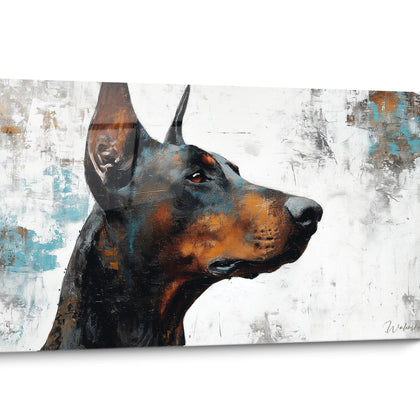
The Painting dog Doberman Geometric embodies the perfect alliance between canine power and contemporary art. This collection celebrates the nobility of the doberman through bold and refined geometric shapes. Each wall decoration doberman transforms the iconic silhouette of this breed into a modern and captivating visual composition. Ideal for lovers of minimalist animal design, this artistic style brings character and sophistication to your interior, creating a striking focal point.
 Geometric Doberman Portrait Canvas in Turquoise-Green Tones - Intense Gaze - Doberman Edition273,90 €
 Geometric Black and Tan Dog Canvas at the Window - Modern Portrait - Doberman Edition273,90 €
 Colorful Doberman Dog Canvas Pop Art Geometric - Multicolor Canine Portrait - Doberman Edition273,90 €
 Black and Fawn Polygonal Doberman Painting with Colorful Flares - Geometric Elegance - Doberman Edition228,90 €
 Polygonal Doberman Painting with Warm Tones - Geometric Portrait - Doberman Edition228,90 €
Explore further
In Geometric Doberman Dog Wall Art


All about Geometric Doberman Dog Wall Art
- Presentation Painting Doberman Geometric
- Geometric Canine Art
- Architectural Aesthetics
- Modern Visual Impact
The Doberman dog painting geometric represents a bold fusion between the power of the Doberman and the sleek aesthetic of polygonal shapes. This fragmented representation transforms the imposing silhouette of the quintessential guard dog into a visual composition where each facet captures and reflects light differently. Angular lines accentuate the breed's characteristic musculature, creating a striking three-dimensional effect even on a flat surface. This contemporary artistic approach sublimates the Doberman's natural elegance while giving it a futuristic and architectural dimension that integrates perfectly into modern and minimalist interiors.
The Geometric Expression of Canine Power
The Doberman dog geometric painting transcends traditional animal representation by breaking down the Doberman's muscular anatomy into a mosaic of precise polygons. This artistic fragmentation does not diminish the breed's intimidating presence, but magnifies it by creating plays of light and perspective that visually amplify its stature. Each geometric facet acts as a visual prism, capturing the ambient lighting differently depending on the time of day and the angle of observation.
How do polygonal shapes reinforce the perception of strength?
The faceted angular structure of the Doberman geometric painting naturally imitates the muscle planes of this athletic breed. The triangles and diamonds that compose the chest, neck and limbs of the dog anatomically reflect the actual muscle definition of the Doberman. This correspondence between artistic form and physical reality creates an instinctive recognition in the observer, who immediately perceives the contained power in this abstract representation. The sharp edges of the polygons also evoke the legendary vigilance and reactivity of this guard breed.
The contrasting color scheme in canine polygonal art
Unlike monochrome representations, some Doberman geometric paintings exploit bold color palettes where ochres, metallic blues and anthracite grays juxtapose. These chromatic contrasts between adjacent facets amplify the relief effect and create exceptional visual depth. For collectors seeking harmony with black and white Doberman dog paintings, the geometric version offers an elegant transition between classicism and modernity, where shades of gray are declined in multiple facets.
The impact of large formats on spatial perception
A large-format Doberman geometric painting radically transforms the architectural environment in which it is installed. Monumental formats allow for a multiplication of polygonal facets, creating a visual complexity impossible to reproduce in small format. Each geometric segment becomes large enough to be appreciated individually, revealing subtle gradations and color transitions that escape reduced dimensions. The imposing scale dialogues directly with the surrounding architecture, establishing the geometric Doberman as an undeniable focal point of the space.
- Multiplication of perspective points creating a kinetic effect when moving
- Optimized interaction with architectural lighting in contemporary spaces
- Visual presence equivalent to a three-dimensional wall sculpture
- Ability to visually structure walls of great height
Architectural Integration of the Polygonal Doberman
The Doberman geometric painting naturally asserts itself in environments where clean lines and raw materials predominate. Its formal language based on angularity and fragmentation perfectly responds to the aesthetic codes of industrial lofts, design offices, and contemporary residential spaces. The geometric rigidity of the work establishes a fascinating visual dialogue with modern architectural structures: exposed beams, suspended staircases, metal greenhouses.
What makes this style compatible with minimalist interiors?
The very essence of the Doberman geometric painting lies in formal purification and reducing the image to its essential components. This artistic philosophy aligns perfectly with the principles of architectural minimalism where each element must justify its presence by its function and visual impact. The absence of superficial details, the clarity of the outlines, and the immediate readability of the canine silhouette satisfy the minimalist requirement of visual efficiency. The Doberman, already recognized for its pure lines and unadorned elegance, finds in geometric representation its most coherent artistic translation.
Enhancing high-end professional spaces
In demanding corporate environments – law firms, architecture agencies, headquarters – the Doberman geometric painting conveys specific professional values. The geometric rigor symbolizes precision and excellence, while the Doberman evokes protection, loyalty, and commitment. This double symbolism makes it a strategic choice for reception areas where brand image is visually constructed. Imposing formats reinforce this impression of institutional solidity without falling into ostentation.
What relationship is established between natural light and polygonal facets?
The orientation of a Doberman geometric painting with respect to natural light sources determines its visual behavior throughout the day. The angular facets create areas of shadow and light that gradually migrate with the solar course, giving the work a unique temporal dimension. Near a bay window or under a skylight, these variations transform the painting into an artistic sundial where the perception of the Doberman constantly evolves. This dynamic interaction contrasts with the usual fixity of wall works.
- Prismatic effect accentuated in the morning or evening sidelight
- Creation of architectural shadows reproducing the geometry of the painting
- Modification of the perceived color palette according to light intensity
- Amplification of virtual relief by contrast between illuminated and shaded facets
Visual Psychology and Contemporary Decorative Impact
The Doberman geometric painting exerts a particular fascination that relies on specific perceptual mechanisms. Our brain, constantly seeking recognition of familiar forms, simultaneously finds in this work the satisfaction of identification (a Doberman) and the stimulation of abstraction (the polygons). This cognitive duality maintains visual attention well beyond the first glance, the observer oscillating between a global vision of the animal and a detailed analysis of the geometric fragments.
Why choose a fragmented representation rather than a realistic one?
The geometric representation of the Doberman transcends the simple animal portrait to achieve the status of a design object in its own right. While a photograph or realistic painting anchors the work in a specific temporality and context, the polygonal version exists in an undefined artistic space-time, neither totally figurative nor fully abstract. This stylistic ambiguity ensures lasting decorative relevance, resisting changes in trends because it fully belongs to none. For buyers seeking a lasting decorative investment, this timelessness represents a decisive argument.
Compatibility with contemporary art collections
Collectors of digital art, contemporary metal sculptures, or design furniture immediately recognize in the geometric Doberman dog painting a familiar visual language. Geometric works share a common philosophy: the celebration of pure form, the elimination of the superfluous, the search for balance between complexity and readability. Integrating a polygonal Doberman alongside industrial design creations or minimalist light installations creates a stylistic coherence that elevates the entire interior design.
The effect of monumentality of large geometric formats
A geometric Doberman dog painting of significant dimensions acquires an almost sculptural presence that physically alters the perception of space. Visitors frequently report a feeling of virtual guardianship, as if the fragmented Doberman were actually watching over the place. This psychological sensation stems from the combination of imposing scale, the dog's often frontal or three-quarter posture, and the depth effect created by the facets. Monumental formats also amplify the chromatic impact, each polygon becoming a significant colored mass that visually structures the environment.
- Transformation of the apparent proportions of the room through scale contrast
- Creation of a visual convergence point guiding circulation in the space
- Establishment of a clear decorative hierarchy with dominance of the painting
- Generation of a memorable stylistic signature for the environment
Is a geometric Doberman dog painting suitable for family residential spaces?
Absolutely, because unlike a hyperrealistic photograph that could intimidate young children, geometric stylization softens the perception of the Doberman while retaining its distinctive character. Children particularly appreciate the colorful and recognizable shapes, transforming the painting into a playful reference point. Parents value the educational dimension of a work that introduces contemporary art while celebrating animal beauty.
Can a geometric Doberman painting be combined with other canine representations?
This association works remarkably well when it creates an intentional stylistic contrast. Juxtaposing a geometric Doberman with photographic portraits of other breeds generates an enriching visual dialogue between different artistic approaches. The thematic canine unity ensures coherence, while the stylistic diversity maintains visual interest and demonstrates the sophistication of the decorative choice.
What aesthetic durability for a geometric Doberman dog painting over time?
Geometric art draws on a century-old tradition initiated by the avant-gardes of the early 20th century, proving its ability to cross the decades without appearing dated. The geometric Doberman painting benefits from this aesthetic heritage while also fitting in with contemporary trends in digital design and 3D modeling. This double anchoring – historical and futuristic – gives it remarkable aesthetic stability, guaranteeing its decorative relevance over the long term.


