


English Pointer Dog Pop Art Canvas
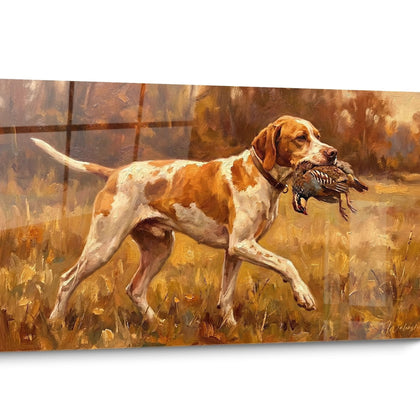
The Painting English Pointer Pop Art celebrates the elegance of this noble breed in an explosive and colorful style. This collection transforms the English Pointer into an artistic icon with vibrant hues and bold contrasts. Perfect for lovers of dog Pop Art wall decoration, it brings dynamism and character to your interior. Each Pointer painting English modern captures the grace and liveliness of this legendary hunting dog in an irresistible contemporary aesthetic.
 Dogs in Motion Painting Colorful Explosion - Vibrant Energy - English Pointer Edition273,90 €
 Dogs in Motion Painting Red-Orange Palette - Pure Energy - English Pointer Edition273,90 €
 White and Orange Dog Painting Color Explosion - Pure Energy - English Pointer Edition273,90 €
 Hunting Dog Painting with Explosive Colors - Chromatic Symphony - English Pointer Edition273,90 €
 Stylized Dogs with Colorful Geometric Shapes - Artistic Duo - English Pointer Edition273,90 €
Explore further
In English Pointer Dog Pop Art Canvas


All about English Pointer Dog Pop Art Canvas
- English Pointer Dog Painting Pop Art Presentation
- Hunting Pop Art Decor
- Vintage Hunting Aesthetic
- Large Format Visual Impact
The English Pointer Dog Pop Art Painting reinvents traditional hunting iconography by merging the aristocratic elegance of the British pointing dog with the chromatic boldness of the Pop Art movement. This modern representation transforms the heritage of field sports into a contemporary artistic statement, where saturated colors and sharp contrasts elevate the emblematic stance of the Pointer on point. Intended for refined hunting enthusiasts seeking a resolutely current alternative to classical still lifes, this large-format visual captures the very essence of this legendary breed while infusing an unexpected graphic dynamism into contemporary interiors.
An Unprecedented Alliance Between Hunting Traditions and Underground Artistic Movement
The English Pointer Dog Pop Art Painting represents far more than a simple stylized canine reproduction: it materializes the meeting of two seemingly antagonistic universes. On one hand, the centuries-old heritage of British field sports with its aristocratic codes and rural aesthetic; on the other, the colorful rebellion of Pop Art born in 1960s New York studios. This hybridization creates a productive visual tension that immediately captivates the eye.
How does Pop Art transform classical hunting imagery?
Unlike academic representations that favor autumnal tones and forest backgrounds, this graphic approach deliberately deconstructs conventions. Blocks of primary colors – electric blues, vermillion reds, brilliant yellows – replace the usual earthy nuances. The characteristic white-orange coat of the Pointer becomes a terrain for chromatic experimentation where each patch transforms into an autonomous geometric cell. This visual fragmentation recalls Warhol-inspired screen printing while preserving the athletic anatomy of the breed. For those appreciating seasonal variations, the English Pointer Dog Autumn Painting offers a complementary interpretation with more organic tones.
The psychological impact of saturated contrasts on spatial perception
Owners of generously sized reception spaces discover that this chromatic saturation acts as a visual magnet capable of architecturally structuring a room. A living room with impressive dimensions finds in these sharp contrasts a focal point that prevents the eye from wandering. The imposing format – essential for faithfully rendering the Pointer's slender silhouette – creates a wall presence equivalent to an open window onto a parallel universe where hunting conjugates with urban culture.
What arrangements enhance this hybrid aesthetic?
Discerning collectors frequently pair these Pop Art representations with pared-down Scandinavian furniture or industrial-style decorative elements. The opposition between the dog's organic lines and the strict geometry of the matte black metal frame amplifies the rendering's modernity. Wall-mounted bookshelves with graphic structures, studio-style pendant lights, or Berber rugs with abstract patterns constitute particularly harmonious associations, creating a dialogue between architectural brutalism and animal elegance.
Contemporary Reappropriation of Sporting Hunting Symbols
The English Pointer Dog Pop Art Painting executes a fascinating semantic mutation: it extracts the hunting symbol from its traditional rural context to propel it into the universe of contemporary design. This displacement is not insignificant for active hunting enthusiasts who aspire to display their passion without falling into rustic cliché or a frozen hunting museum. The stylized representation of the Pointer in point stance – that suspended moment when the dog locates game – becomes a visual metaphor for concentration and sporting excellence.
Why does the English Pointer perfectly embody the Pop Art spirit?
Several morphological characteristics of this breed make it an ideal subject for Pop Art graphic treatment. Its streamlined, almost aerodynamic silhouette lends itself remarkably well to the formal simplification dear to this artistic movement. The refined lines of the athletic body, the dignified head carriage, the perfect tail extension in a straight line during point: so many natural geometric elements that require only chromatic accentuation to shift into pop iconography. Unlike long-haired breeds whose graphic representation becomes confusing, the short coat of the Pointer offers a smooth surface conducive to clean chromatic blocks.
How does this visual approach modernize spaces dedicated to hunting passion?
Kennel owners, hunting clubs, and high-end equestrian establishments are progressively adopting this aesthetic to renew their visual identity. An entrance hall adorned with a large-format English Pointer Dog Pop Art Painting immediately signals a contemporary approach to centuries-old traditions. This graphic modernity reassures a younger clientele sometimes intimidated by classical hunting imagery, while maintaining essential cultural references. The bright colors also create a dynamic atmosphere that pleasantly contrasts with the neutral tones often favored in modern equestrian architecture.
Pop Art visual codes in service of hunting narrative
Each chromatic element tells a facet of the field sports experience: cobalt blue evokes the early opening-day skies, cardinal red recalls the passion animating hunters, lemon yellow symbolizes the energy of a dog at work. These synesthetic associations considerably enrich the artwork's interpretation compared to naturalistic representations. The eye no longer merely identifies a canine breed: it traverses emotional and memorial layers that resonate differently according to each viewer's personal experience. This polysemy transforms a simple wall decoration into a support for memorial projection for seasoned hunters.
Architectural Integration Strategies for Monumental Formats
Acquiring a large-scale English Pointer Dog Pop Art Painting requires in-depth spatial reflection to fully exploit its decorative potential. These imposing formats – often exceeding 120 centimeters in width – do not merely occupy a portion of wall: they redefine the perceptive geometry of the entire room. Interior architects specializing in hunters' secondary residences frequently recommend these creations to visually structure difficult volumes such as double heights or loft-style open spaces.
Which wall configurations maximize the visual impact of a Pop Art large format?
Contrary to preconceptions, these color-saturated works perform remarkably on already-textured walls: whitewashed exposed brick, lambris painted in muted tones, polished concrete. The material friction between the support's roughness and the graphic flatness of the image creates a paradoxical depth particularly prized in contemporary heritage renovations. A hunting manor transformed into a primary residence will find in this stylistic opposition an elegant way to dialogue with its past without museifying it.
How to manage lighting constraints specific to saturated colors?
The characteristic pigments of Pop Art – particularly magentas and cyans – react spectacularly to variations in the color temperature of light sources. Neutral white LED lighting (4000K) faithfully restores the original chromatic intensity, while warm light (2700K) softens contrasts for a more subdued nighttime ambiance. Discerning collectors frequently install modular lighting systems allowing the atmosphere to adapt according to the time of day. Directional ceiling-mounted tracks, positioned at 30 degrees to the wall plane, eliminate unsightly reflections while sculpting the surface.
Thematic associations for creating a coherent visual journey
Rather than isolating this masterpiece, some enthusiasts constitute entire thematic galleries mixing historical black-and-white hunting photographs, vintage equipment (cartridge belts, brass whistles) under display, and multiple graphic representations of different pointing breeds. The English Pointer Dog Pop Art Painting becomes the contemporary catalyzing element that prevents the ensemble from sliding into a dusty cabinet of curiosities. This wall scenography functions particularly well in distribution corridors or stairwells where the viewer's movement progressively reveals different narrative layers.
FAQ - Frequently Asked Questions about the English Pointer Dog Pop Art Painting
Does an English Pointer Dog Pop Art Painting suit minimalist interiors?
Absolutely, minimalist philosophy rests on the rigorous selection of a few high-impact elements. A single large-format Pop Art on an immaculate white wall creates precisely the productive tension between emptiness and saturation that design purists seek. The essential element lies in respecting proportions: the visual surface should occupy approximately one-third of the available wall surface to maintain the breathing room characteristic of minimalist spaces.
How does the English Pointer Dog Pop Art Painting integrate into a professional office?
Liberal professions linked to the rural environment – specialized veterinarians, landscape architects, rural law attorneys – strategically deploy these representations to signal their sector expertise while displaying reassuring modernity. Positioned behind the desk facing visitors, this visual becomes an effective conversation starter, humanizing the professional space without compromising credibility. Vibrant tones also stimulate concentration and energy during long working days.
Can multiple Pop Art paintings of different canine breeds be associated in the same room?
This gallery approach works remarkably well if overall chromatic coherence is maintained. Mixing a Pointer treated in warm tones (oranges, reds, yellows) with a Setter represented in cool range (blues, greens, violets) on opposite walls creates sophisticated spatial dynamics. What matters is maintaining a uniform graphic style – same contour treatment, same degree of stylization – so the ensemble dialogues harmoniously rather than visually competing.


