


English Pointer Dog Canvas Prairie
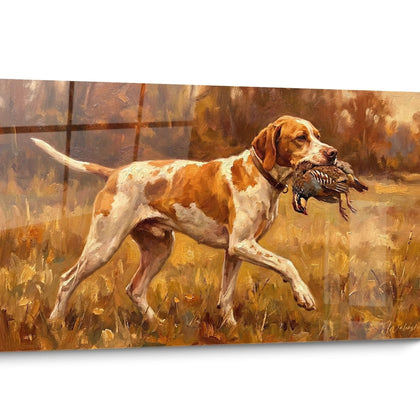
Our Painting English Pointer Dog Meadow captures the natural elegance of this iconic hunting dog in its favorite environment. This artistic collection celebrates the beauty of the English Pointer in the meadow, immortalizing its noble posture and hunting instinct. Each work highlights the athletic grace of this British breed amidst the tall grasses. Perfect for lovers of hunting dog decor, this set transforms your interior into a refined tribute to this faithful and majestic companion.
 Dog in Point Canvas in Golden Prairie - Hunter Silhouette - English Pointer Edition242,90 €
 Red and White Dog with Tongue Out in Golden Meadow - Canine Joy - English Pointer Edition273,90 €
 Dog in Motion on Golden Prairie Painting - Canine Elegance - English Pointer Edition273,90 €
 White and Brown Puppy in Sunny Meadow with Butterfly Canvas - Canine Tenderness - English Pointer Edition273,90 €
Explore further
In English Pointer Dog Canvas Prairie


All about English Pointer Dog Canvas Prairie
- Presentation Painting Pointing English Prairie
- Hunting Décor Prairie
- Prairie Hunting Ambiance
- Pointing Tall Grasses
This painting English Prairie Pointer dog captures the essence of hunting in open country, where a pointing dog thrives in its natural environment. The work highlights the characteristic posture of the Pointer frozen amidst the tall grasses, transforming a hunting moment into a true artistic moment. This specific representation is aimed at enthusiasts seeking a wall decoration evoking vast plains, open hunting grounds, and the natural elegance of this iconic breed in action.
The Hunting Art of Prairie Territories
The painting English Prairie Pointer dog is part of a visual tradition deeply rooted in the culture of hunting in open terrain. Unlike forest compositions, this representation celebrates the vast spaces where game birds find refuge among tall grasses and cultivated areas. The English Pointer appears here in its primary function: that of an indefatigable prospector of vast expanses, capable of covering immense areas while maintaining constant visual contact with the hunter.
Why does the prairie define the identity of the English Pointer?
Prairie terrains constitute an excellent habitat to reveal the exceptional qualities of this breed. In these open spaces, every movement of the dog becomes visible from a distance, allowing one to appreciate its airy gallop and its ability to adjust its pace according to the terrain configuration. The large-scale wall artwork restores this spatial scale, offering a perspective that visually extends the interior space towards imaginary hunting horizons. This visual immersion is particularly suitable for spacious interiors of rural properties, hunting lodges, or equestrian lounges.
The characteristic botanical elements of prairie scenes
The vegetation depicted in an English Prairie Pointer dog painting constitutes a specific visual vocabulary: grasses waving in the wind, tufts of fescue, refusal areas where game is hidden. These botanical details are not merely decorative; they tell a story of terrain, hunting season, and specific hunting conditions. The golden tones of ripe grasses, the shades of pale green of young shoots, or the copper hues of autumnal vegetation create distinct chromatic harmonies. To enrich your collection with a complementary seasonal atmosphere, discover our painting English Prairie Pointer Autumn which captures the magic of late-season hunts.
The pointing gesture in open country
The Pointer's point in the prairie has a unique visual signature: body stretched parallel to the ground, tail rigid in the extension of the dorsal line, head high capturing the scents carried by the prairie wind. This posture, frozen in time on a large-format wall composition, communicates a dramatic tension specific to open spaces where no vertical landmarks fragment the scene. The absence of vertical landmarks accentuates the horizontality of the composition and magnifies the silhouette of the dog in its primary function.
Interior Design and Evocation of Hunting Territories
How to integrate the immensity of the prairie into a residential space?
A painting of an English Pointer dog in a prairie of large dimensions functions as a visual window opening onto hunting landscapes as far as the eye can see. Its installation requires consideration of the depth of field it generates: unlike forest scenes which create vertical intimacy, the prairie imposes a horizontal dynamic that visually expands the space. Preferred locations are facing circulation areas, allowing for appreciation of the composition from several distances. In a reception room, this artwork becomes a natural conversation starter for guests sharing a passion for hunting.
Specific decorative associations for plainland ambiances
The visual universe of the prairie calls for decorative additions evoking agricultural territories and traditional hunting areas: reproductions of old maps of hunting territories, collections of bird calls, displays of pheasant or partridge feathers. The painting then becomes the centerpiece of a coherent thematic staging. Natural materials such as raw linen, woven plant fibers, or light woods extend the rural aesthetic without creating visual competition with the main composition.
Which spaces best enhance a Pointer painting in a prairie?
The architectural volumes of country residences offer the ideal setting to fully deploy the impact of a painting of an English Pointer dog in a prairie of large size. Rooms with high ceilings, continuous walls without interruption, double-height spaces allow for optimal reading of the composition. In properties with views of agricultural landscapes, the artwork creates a fascinating dialogue between the artistic representation and the real landscape visible through the windows. Hunting lodges, lodges and second homes located in rural areas are obvious locations for this type of wall decoration.
Natural light and the reproduction of plainland atmospheres
Prairie scenes are characterized by a particular quality of light: the grazing light of the morning revealing each blade of grass, the zenithal light of midday flattening the reliefs, the golden light of the evening enveloping the landscape in a warm tone. The exposure of the painting must take these subtleties into account to avoid reflections that would neutralize the depth of field. Soft sidelight, reproducing the natural lighting conditions of hunting hours, enhances the plant textures and the modulation of successive planes in the composition.
Hunting Symbolism and the Heritage of Plainland Hunting
The painting of an English Pointer dog in a prairie conveys a hunting imagery deeply rooted in British and continental hunting traditions. The vast grassy expanses have historically been the preferred terrain for bird hunting, before becoming the privileged territories of continental pointing dogs. This wall mural celebrates a demanding hunting practice, where reading the terrain, observing the dog's behavior, and anticipating the game's movements are the foundations of success.
The game breeds associated with prairie landscapes
The prairie is home to specific game fauna that gives meaning to the presence of the Pointer: gray partridges evolving in groups, common pheasants seeking transition zones between crops and cover, wheat quails now rare but historically abundant. Each species imposes distinct hunting strategies that the pointing dog must master. The representation of the Pointer immobilized in the tall grass suggests the proximity of prey, creating a narrative tension that the initiated viewer can decode. This cognitive dimension adds a depth of reading reserved for connoisseurs.
Why choose a monumental format for a prairie painting?
The generous dimensions of an open-field hunting wall composition are not merely an aesthetic choice but respond to a narrative necessity. Prairie scenes require space to unfold their narration: the foreground with the botanical details, the intermediate plane where the dog is in action, the background suggesting the depth of the hunting territory. A reduced format would compress these different planes and impoverish the reading of the scene. The large format restores the real scale of hunting spaces and allows for a visual immersion comparable to the experience lived in the field.
The transmission of hunting values through image
Beyond its decorative function, a painting of an English Pointer in a prairie participates in the transmission of a cultural heritage linked to traditional hunting practices. In hunting families, these visual representations nourish the imagination of younger generations and perpetuate a collective memory of practices, territories, and iconic dog breeds. The work becomes a medium for stories, hunting anecdotes, and the transmission of hunting knowledge that often escapes conventional educational supports.
Is a Pointer painting in a prairie suitable for contemporary interiors?
Absolutely. The purified composition of prairie landscapes, with their dominant horizontal lines and natural color palette, harmoniously integrates into contemporary architectures that favor open volumes and raw materials. The contrast between the modernity of the architectural frame and the timelessness of the hunting scene creates a particularly sought-after aesthetic tension.
What is the best season represented for a painting of an English Pointer in a prairie?
Each season offers a distinct atmosphere. Summer prairies present lush vegetation and deep green tones. Late summer and early autumn representations, with their golden grasses and grazing light, correspond to the periods of hunting season and possess a strong symbolic charge for enthusiasts. Winter reveals the structure of the landscape and accentuates the silhouette of the dog against a minimalist background.
How to authenticate the quality of a painting of an English Pointer in a prairie?
Evaluation criteria include the anatomical accuracy of the represented breed, the consistency of the stopping posture, the plausibility of the vegetation environment, and the quality of the light reproduced. An expert eye will immediately identify approximations in the rendering of the coat, the position of the limbs, or the expression of the dog's gaze. Depth of field and suggestion of space also distinguish a mastered composition from a superficial representation.
Further reading
Our articles on this topic
- Gift idea: English springer spaniel painting for a dog lover
- English Springer Spaniel black and white watercolor painting to elevate your office
- Brown and white English Pointer painting: how does it match your walls?
- Epagneul Breton painting: the original gift for a passionate hunter
- How to Choose an English Pointer Painting for a Country Chic Interior
- Pointer dog painting for a country-style entryway
L'art qui suscite l'envie
Maison belge d'art mural grand format
14 jourspour changer d'avis*
Protection Walenskyincluse
Fabriquéen Italie
FormatXXL
Kit de fixationtoujours fourni
* Hors tableaux personnalisés et tailles personnalisées


