

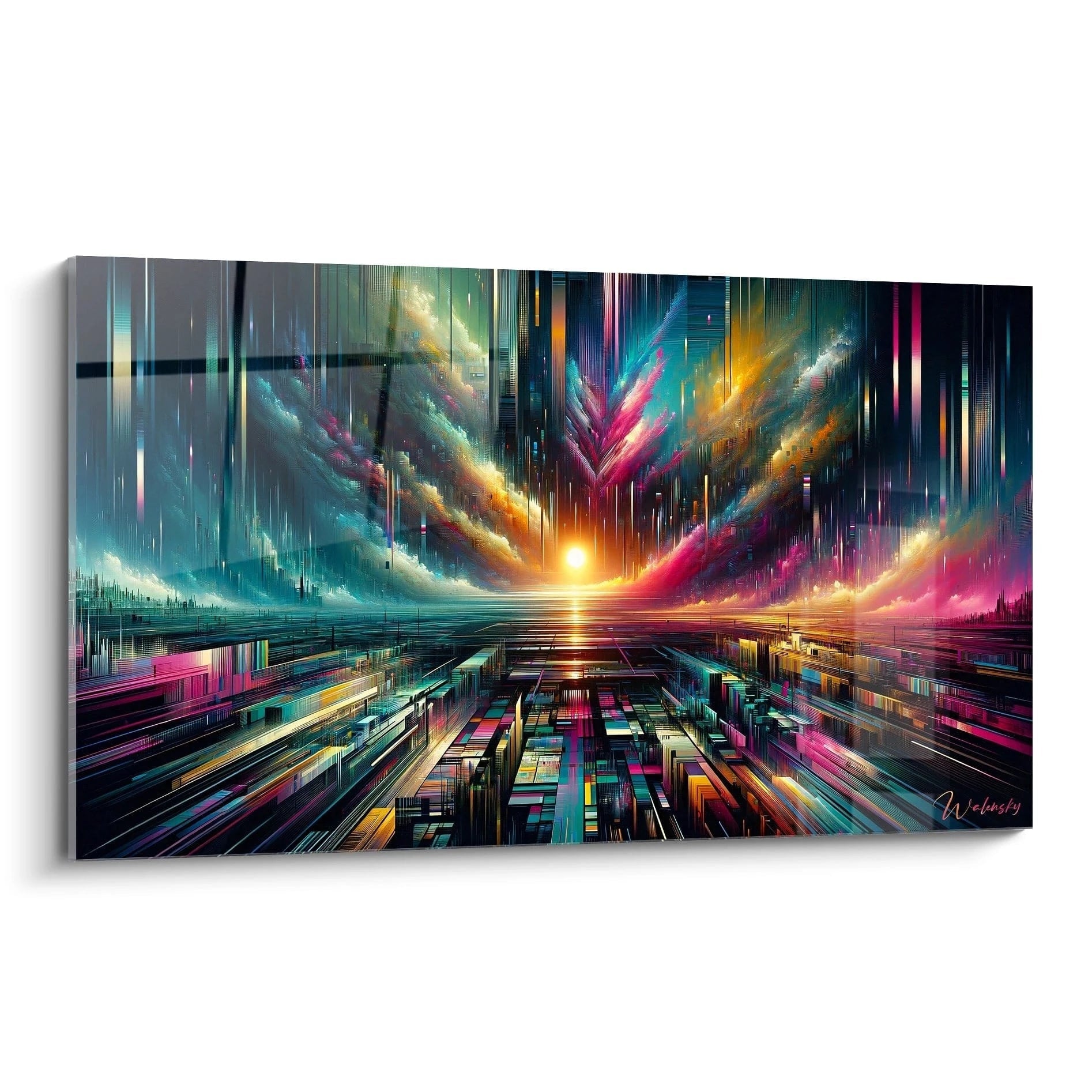


Abstract Spiral Tunnel Wall Art
The Painting spiral abstract Tunnel transports you to a fascinating dimension where infinite curves create a hypnotic depth illusion. This collection explores the art of perpetual motion through swirling compositions that captivate the eye. Each work plays with perspectives to create a striking spiral tunnel effect . Perfect for energizing your interior with a bold contemporary touch, this wall art transforms your spaces into modern and enigmatic galleries.
 Golden wave tunnel painting - Spiral Wave Gold - abstract spiral edition273,90 €
 Luminous Tunnel Couple Painting - Passage to Infinity - Abstract Spiral Edition273,90 €
 Mystical spiraled cave painting - Luminous portal - abstract spiral edition273,90 €
 Digital Colored Tunnel Wall Art - Luminous Vortex - Abstract Spiral Edition273,90 €
 Golden Time Tunnel Wall Art - Cosmic Journey - Abstract Spiral Edition273,90 €
 Colorful Digital Tunnel Painting - Technological Convergence - Abstract Spiral Edition273,90 €
 Blue Infinite Spiral Artwork - Mystical Vortex - Abstract Spiral Edition273,90 €
 Spiral Ocean Wave Painting - Golden Tunnel to the Horizon - Abstract Spiral Edition242,90 €
 Colorful Urban Tunnel Painting - Infinite Perspective - Abstract Spiral Edition228,90 €
 Blue Cosmic Spiral Painting - Celestial Vortex - Abstract Spiral Edition228,90 €
 Golden wave spiral painting - Ocean tunnel - abstract spiral edition228,90 €
 Sunset tunnel painting - Golden Portal - abstract spiral edition228,90 €
Explore further
In Abstract Spiral Tunnel Wall Art
-
 Abstract Spirals Wall Art141
artworks
Abstract Spirals Wall Art141
artworks
-
 Multicolor Abstract Spirals Wall Art21
artworks
Multicolor Abstract Spirals Wall Art21
artworks
-
 Cosmic Abstract Spirals Wall Art24
artworks
Cosmic Abstract Spirals Wall Art24
artworks
-
 Abstract Golden Spirals Wall Art20
artworks
Abstract Golden Spirals Wall Art20
artworks
-
 Abstract Spirals Black and White Wall Art12
artworks
Abstract Spirals Black and White Wall Art12
artworks
-
 Abstract Blue Spirals Canvas12
artworks
Abstract Blue Spirals Canvas12
artworks
-
 Abstract Orange Spirals Canvas13
artworks
Abstract Orange Spirals Canvas13
artworks
-
 Abstract Spiral Geometric Wall Art13
artworks
Abstract Spiral Geometric Wall Art13
artworks
-
 Abstract Spiral Vortex Wall Art22
artworks
Abstract Spiral Vortex Wall Art22
artworks
-
 Abstract Spirals Digital Wall Art4
artworks
Abstract Spirals Digital Wall Art4
artworks


All about Abstract Spiral Tunnel Wall Art
- Abstract Spiral Tunnel Wall Art Presentation
- Depth Dynamics
- Visual Impact in Large Formats
- Immersive Atmospheres
The abstract spiral tunnel wall art represents a contemporary mural artwork that radically transforms the spatial perception of your interior. This artistic creation generates a hypnotic depth effect where concentric curves draw the eye toward a central vanishing point, creating an almost architectural dimension on your walls. Unlike static abstract compositions, this type of visual deploys a kinetic dynamic that suggests perpetual movement and spatial expansion.
The visual architecture of tunnel spirals: creating a dimensional illusion
The abstract spiral tunnel wall art exploits the principles of swirling geometry to generate an immersive visual experience. The curved bands that progressively tighten toward the center recreate the vortex effect, an optical phenomenon that creates the impression of passing through a dimensional passage. This characteristic makes it a decorative element particularly suited to contemporary spaces seeking to push the visual boundaries of their walls.
How do concentric spirals modify spatial perception?
The tunnel structure of abstract spirals functions according to the convergence principle: each circle becomes progressively narrower, naturally drawing the eye toward the central core. This construction generates a sensation of visual suction that mentally expands the available wall space. In narrow corridors or passageways, this optical phenomenon effectively counterbalances the sense of confinement by creating a virtual opening onto a graphical elsewhere.
Radial composition and its hypnotic rhythm
Chromatic variations along the spirals reinforce the tunnel effect by accentuating contrasts between light and dark zones. For a particularly striking rendering, a blue abstract spiral wall art develops a soothing ambiance while maintaining this characteristic swirling dynamic. Blue intensifies the sensation of infinite depth, recalling marine abysses or atmospheric tunnels.
Which size should you choose to maximize the depth effect?
Monumental formats significantly amplify the impression of immersion in the visual tunnel. A generous dimension allows the spirals to deploy their complete progression, from the outer loops to the central vanishing point. The observer can then experience the entirety of the optical journey, an experience impossible to restore in reduced formats that necessarily truncate the spiraled sequence.
Decorative associations with architectural structures
This type of composition dialogues remarkably with circular architectural elements: spiral staircases, vaulted ceilings, or arched bays. The artwork then creates a formal echo that unifies the space by repeating curved motifs. In industrial lofts with clean lines, it introduces an organic complexity that softens the rigor of metal or raw concrete structures.
Psychological and kinetic impact of the spiraled tunnel in wall decoration
Beyond its aesthetic dimension, the abstract spiral tunnel wall art provokes a specific neurological response linked to movement perception. Direction-detecting neurons in the visual cortex react to curved trajectories, generating continuous activation that maintains attention and creates a lasting feeling of fascination. This property makes it a strategic choice for spaces where you want to stimulate creativity or encourage active contemplation.
The vortex effect in creative professional spaces
Design studios, communications agencies or coworking spaces particularly benefit from this visual dynamic. The spiraled tunnel symbolizes the creative process itself: a progressive immersion toward the heart of an idea, a conceptual journey from the periphery toward the essence. Positioned in a brainstorming room, it unconsciously stimulates mental exploration and encourages non-linear thinking.
Which chromatic effects amplify the sensation of movement?
Progressive gradients from edge to center intensify the cinematic illusion. A transition from light to dark suggests a descent into the depths, while an inverse transition evokes emergence from a luminous focal point. Bicolor compositions generate maximum contrast that accentuates optical vibration, particularly effective in minimalist interiors where the artwork becomes the sole point of visual animation.
Controlled disorientation as a decorative experience
Unlike repetitive geometric patterns that structure space, the spiraled tunnel introduces controlled perceptual instability. This slight disorientation captures attention magnetically without causing discomfort. In entrance halls or transition spaces, it psychologically marks the passage from one zone to another, creating a visual airlock that mentally prepares for environmental change.
Can you combine multiple spiral tunnels in the same space?
Multiplying vanishing points creates a network of visual tensions that fragments the space into distinct energetic zones. This approach suits large continuous wall surfaces where a single artwork would appear isolated. The spirals can then dialogue in opposition (clockwise versus counterclockwise) or in echo (synchronized rotations), generating a sophisticated mural choreography that transforms architecture into evolving artistic installation.
Creating immersive atmospheres with the depth of abstract tunnel
The abstract spiral tunnel wall art functions as a visual portal that mentally transports the observer beyond the physical constraints of the wall. This ability to generate perceptual escape makes it a particularly valuable decorative tool in densified urban environments where real space proves limited. The spiral then offers virtual expansion, a visual respiration that psychologically compensates for architectural tightness.
Integration into meditative and wellness spaces
Yoga studios, meditation rooms or therapeutic offices exploit the visual absorption effect of the tunnel to facilitate inner concentration. The eye naturally follows the spiraled progression, creating an attentional anchor that calms dispersed mental flow. This process of progressive entry recalls traditional mandalas, but with a contemporary dynamic that resonates more with current sensibilities.
How does the spiraled tunnel influence perceived acoustics?
Though purely visual, this type of composition surprisingly affects the sound perception of a space. The depth effect suggests a spatial prolongation that unconsciously creates the impression of an enlarged acoustic volume. In home cinemas or listening spaces, this illusion of visual depth harmoniously complements the immersive sound experience, creating multisensory coherence.
Nocturnal variations under targeted lighting
Grazing illumination radically transforms the experience of the spiraled tunnel. Shadows projected according to the angle of incidence accentuate certain bands while attenuating others, creating an illusory three-dimensional depth. This nocturnal metamorphosis doubles the decorative value: the same visual offers two distinct experiences depending on the time of day, fully justifying the investment in a generous format.
Which chromatic atmospheres for contemporary residential spaces?
Monochromatic palettes reinforce the hypnotic effect by eliminating color distractions, concentrating all attention on formal progression. Neutral tones integrate harmoniously into streamlined Scandinavian or Japanese-inspired interiors, where the artwork becomes a contemplative window rather than an animation element. Conversely, polychrome versions energize collective living spaces, transforming the tunnel into a vibrant celebration of perpetual movement.
Strategic positioning facing circulation zones
Installing the artwork in the direct axis of daily trajectories transforms each passage into a micro-aesthetic experience. Peripheral vision captures the spiraled movement even without direct observation, creating a subliminal presence that continuously enriches the lived environment. This accumulation of brief contemplations progressively builds a deeper relationship with the work, far more profound than the punctual observation of static visuals.
Where should you place abstract spiral tunnel wall art to maximize its visual impact?
The ideal position is facing the main sightline from a room's entrance, allowing the spiraled tunnel to immediately capture attention and set the atmospheric tone of the space. Walls perpendicular to natural light sources also benefit from optimal lighting that reveals chromatic nuances throughout the day.
Is abstract spiral tunnel wall art suitable for classical interiors?
Paradoxically, this ultra-contemporary composition creates striking contrast in traditional décors, functioning as a temporal bridge between architectural heritage and current sensitivity. The dialogue between classical moldings and abstract vortex generates creative tension that revitalizes historical interiors without denaturing them, proving that tradition and avant-garde can coexist harmoniously.
Do tunnel spirals cause visual fatigue over time?
Unlike aggressive stroboscopic patterns, the gentle progression of concentric spirals produces a contemplative rather than stimulating effect. The eye naturally follows the curve without effort, creating a relaxing rather than exhausting experience. Owners typically report growing appreciation over time, progressively discovering new subtleties in the spiraled composition.


