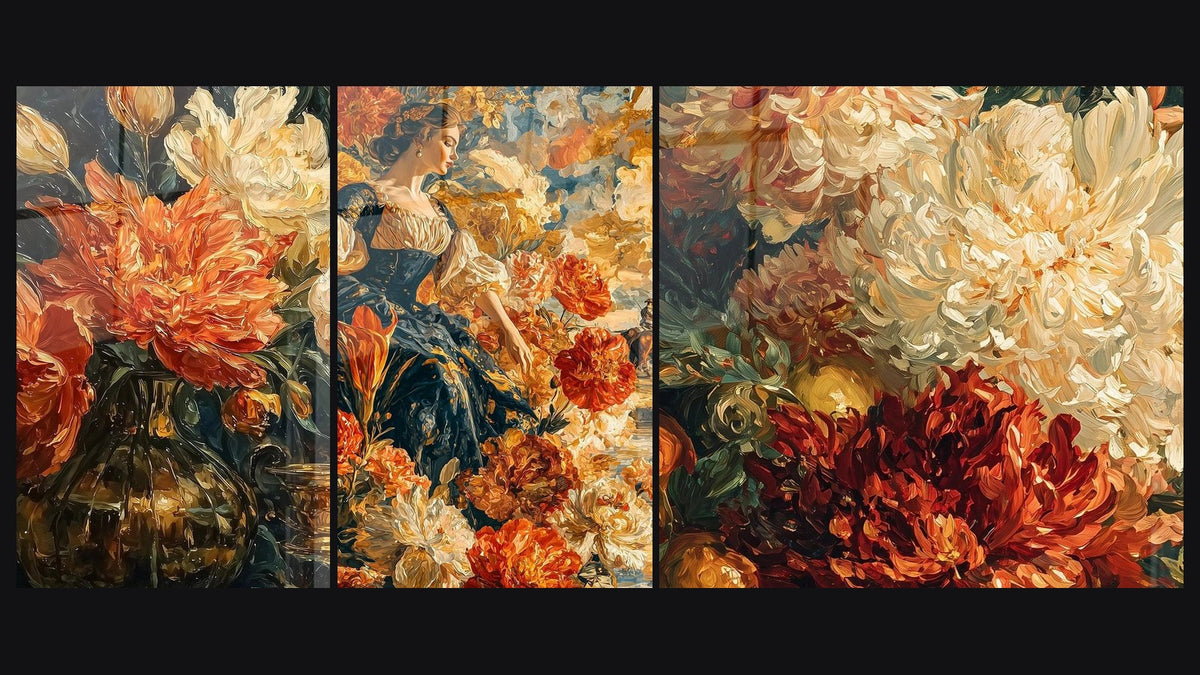
Renaissance floral painting for a modern living room: how to choose the right size
8 min read · by Walensky
RENAISSANCE FLORAL PAINTING
A white wall, a low sofa in raw linen, a light wood coffee table with no frills. And there, hung above it, a bouquet painted in the style of the 16th century, dense, fleshy, almost baroque. The contrast should clash. It doesn't — provided the size is chosen with that in mind, and not picked at random because it "fits nicely on the wall".
The direct answerFor a renaissance floral painting in a modern living room, the size is not calculated only from the width of the wall: it depends above all on the density of the composition. A very busy floral work (tightly packed peonies, deep chiaroscuro) needs a generous size — at least 120x70 cm, often XL or XXL — so that the detail reads without visually overwhelming the clean lines of the rest of the room.- The visual density of the artwork matters more than the surface of the wall when choosing the size.
- A busy renaissance floral composition needs more space than a minimalist abstract piece of the same size.
- In a minimalist living room, a single large floral piece makes more impact than several small scattered ones.
The renaissance floral style, a controlled contrast in a modern living room
Pairing a floral still life inherited from Italian Renaissance painting with a contemporary minimalist living room is by no means a question of poor taste. On the contrary, it is one of the most sought-after combinations among interior decorators right now: an object rich in visual history set within a deliberately bare frame.
Chiaroscuro, this way of making petals emerge from shadow, works precisely because the rest of the room does not compete with it. A white wall, a light floor, furniture with clean lines: all of this acts as a neutral base that lets the eye focus on the dense pictorial composition of the painting.
A renaissance painting in a modern living room should never fight its surroundings. It should breathe there, like a note of antique colour placed on a blank page.
The classic mistake is to try to "soften" the contrast by choosing a small size, out of fear that the work will look too dominant. The opposite happens: too modest a size isolates the painting, which seems to float, lost, without anchoring to the rest of the room.
Visual density: the real criterion for calculating the size
Visual density is the amount of information the eye must process per square metre of canvas. A renaissance bouquet overloaded with peonies, intertwined foliage and play of shadows has nothing visually in common with an abstract block of colour of the same dimensions — and that changes everything when choosing the size.
Busy composition vs airy composition
The denser a composition, the more surface it needs so that each detail finds its place without colliding. Conversely, an airy composition, with large areas of colour and few elements, can fit a smaller size without losing legibility.
- Dense composition (renaissance bouquet, drapery, gilding): favour XL (140x80 cm) or XXL (160x90 cm) to let the detail unfold.
- Airy composition (single motif, plain background): the L size (120x70 cm) is often enough to create the desired impact.
- Dense square composition of the floral portrait type: the square XL 120x120 cm or XXL 140x140 cm sizes provide the necessary viewing distance.
Viewing distance and reading the detail
In a living room, one rarely looks at a painting from up close. The typical viewing distance — between the sofa and the wall — is around two to three metres. At that distance, too small a size turns a rich composition into an indistinct mush of colours.
To test whether a size suits you before buying, step back to the actual distance from the sofa and look at a photo of the painting at scale on your phone, held at arm's length. If the details already blur into a shapeless mass, go up one size.
The Fleurs Symphonie Orangée painting illustrates this logic well: its composition of orange peonies, dense and luminous, is best seen in XL or XXL rather than an entry-level size, otherwise it risks losing the depth of its tones.
Sizes suited to the layout of a modern living room
The right size depends as much on the room itself as on the painting. Two cases come up most often in a contemporary living room: above a sofa, or alone on a large white wall.
Above a minimalist sofa
The most reliable proportion rule remains the two-thirds rule: the painting should occupy 60 to 75% of the width of the sofa. For a three-seater sofa (about 200 cm), this places the ideal painting between 120 and 150 cm wide — that is, an L or XL size depending on the density of the chosen work.
As the centrepiece on a white wall
Without furniture to serve as a reference, the wall itself becomes the benchmark. A wall 3 to 4 metres wide can easily accommodate an XXL size (160x90 cm) or even 2XL (180x100 cm), especially if the dense renaissance floral composition deserves that space to unfold fully.
It is in this setting that our collection of paintings for living rooms truly makes sense: it lets you visualise several scales side by side before deciding.

Favorite
Flowers Natural Exuberance Painting - Renaissance edition
From €228.90
Discover this paintingPairing examples: floral paintings and portrait pieces
A modern living room does not necessarily host a single painting. Combining a floral still life with a renaissance portrait creates an interesting narrative tension, provided the size and palette remain coherent.
The Femme Raffinement Pictural painting, a portrait in red and orange tones, converses naturally with a floral piece in the same colour range, such as the Femme aux Fleurs Passion Incarnée painting, which precisely combines woman and flowers in a single romantic composition. Placed on two separate walls of the same living room, they create a visual thread without copying each other.
When you pair two renaissance works in the same living room, keep the same medium — Acrylic Glass for both, or Alu Dibond for both. Mixing finishes creates a break in sheen that undermines the visual unity you are trying to create.
Common mistakes and expert advice for a harmonious result
Most failures come less from the style than from the size. Here are the traps that most often catch enthusiasts of renaissance floral decoration in a modern interior.
- Size too small for a dense composition : the chiaroscuro details disappear, the work looks dull instead of rich.
- Hanging height miscalculated : a painting hung too high breaks the connection with the furniture below.
- Wrong choice of finish : Acrylic Glass, glossy and deep, suits a room with controlled lighting; matte Alu Dibond is preferable facing a window or in full natural light.
- Too many small scattered sizes : in a sparse living room, one large floral piece has more impact than three small ones hung in a row.
To go further on pairing floral motifs with contemporary graphic style, our article on choosing modern floral acrylic paintings usefully complements this reflection on size.
Frequently asked questions
Which painting size should you choose for a renaissance style in a modern living room?
For a dense floral composition typical of the renaissance style, aim for at least an XL (140x80 cm) or XXL (160x90 cm) size: the richness of the detail needs space so it does not look overwhelmed.
How do you pair a classic floral painting with a minimalist décor?
Let the wall and the furniture remain bare and neutral: it is this emptiness that showcases the density of the painting. Avoid adding other busy decorative elements in its immediate vicinity.
What is the ideal height for hanging a renaissance painting above a sofa?
The centre of the artwork should sit around 1.50 m from the floor, leaving roughly 15 to 20 cm between the top of the sofa back and the bottom of the painting.
Can you mix several sizes of floral paintings in the same living room?
Yes, provided you keep a coherent palette and finish. A large piece as the centrepiece and a more modest size on a secondary wall work well, as long as they do not compete visually head-on.
Conclusion
The right size for a renaissance floral painting in a modern living room is never a matter of centimetres thrown randomly onto a metre of wall. It is a question of balance: letting the richness of the floral motif unfold without overwhelming the simplicity of the surrounding décor. A dense composition wants space; a sparse room wants emptiness around it. The two meet, provided you think about density before you think about dimensions.
To find the piece that matches this logic exactly, the renaissance floral painting collection remains the most natural starting point.
Explore our collections