


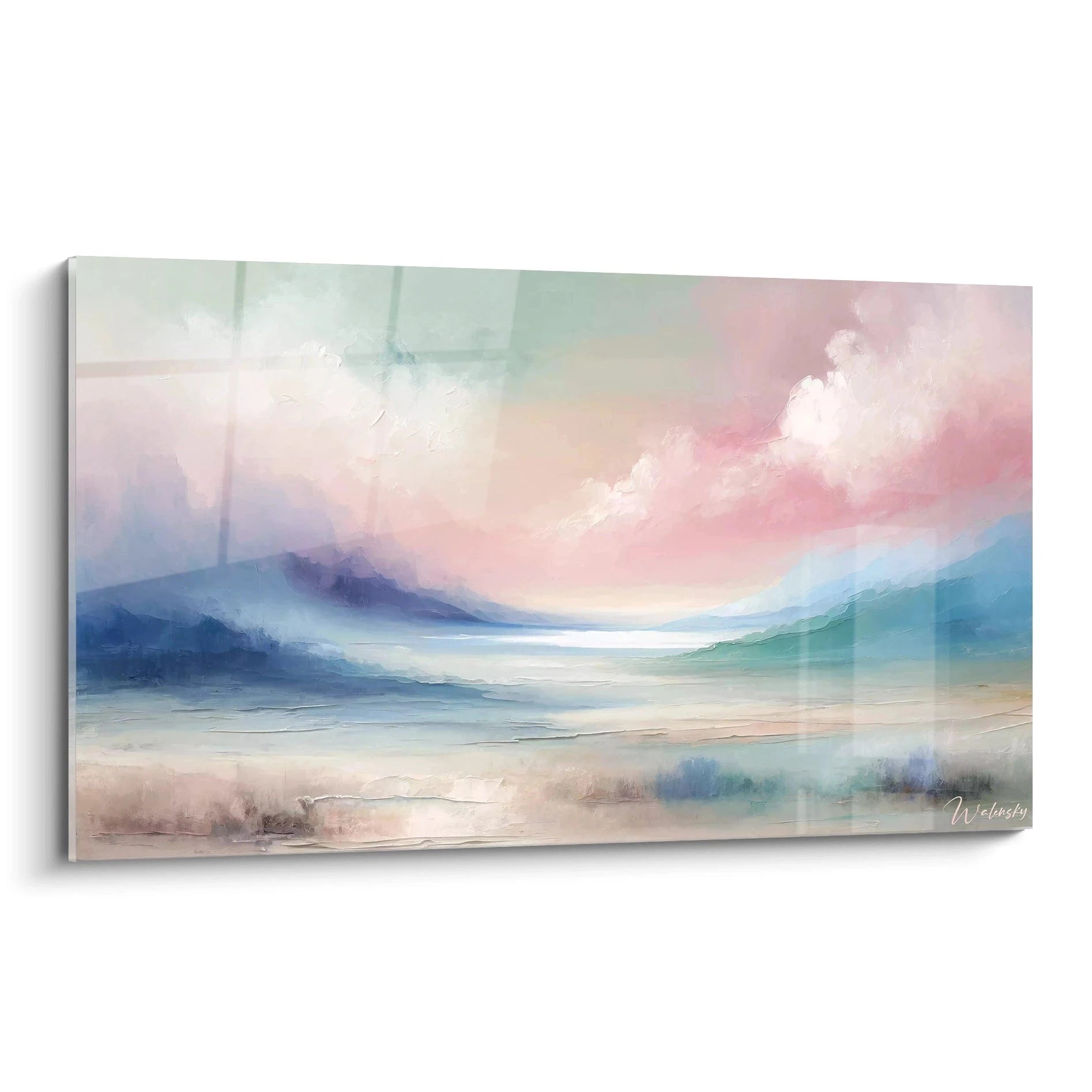

Create a high-end welcoming atmosphere with a single artwork
October 11, 2025 · 17 min read · by Walensky
You are having guests tonight and you feel that familiar anxiety: your entryway is sorely lacking in character. Despite your efforts, the space remains cold, impersonal, as if you just moved in yesterday.
You look at these walls that mock you, this pitiful orphaned console, this atmosphere of a budget hotel that makes you ashamed when loved ones cross the threshold. The impression those first moments give off worries you more than you admit.
You've already tried scented candles, arranged some plants, even invested in an expensive lamp. But nothing works: this feeling of emptiness persists, this lack of soul that makes you doubt your decorating talents.
It’s normal, and it’s absolutely not your fault. The problem isn't your budget or your taste, but a misunderstanding of the true secret of welcoming spaces that mark people's minds: strategically placed wall art.
By the end of this article, you will master the art of transforming your entryway into a memorable welcome space with just one perfectly chosen and positioned artwork - and your guests will never forget that striking first impression.
Why does a painting really change things in your entryway?
First impressions are formed in 7 seconds, and your entryway plays the role of your interior’s business card. Unlike other decorative elements, a well-chosen painting instantly becomes the focal point that guides the eye and visually structures the space. It's like the difference between a melody without a refrain and an unforgettable song: the emotional impact is completely different.
🏡 Customer testimonial: "Sarah, a Parisian interior architect, recently confided to me: 'My clients spend fortunes on furniture, but neglect the walls. When I show them the before/after difference with just one statement painting, they finally understand why their guests remain unimpressed in their entryway.'"
Conversation with a decor expert
The principle of visual anchoring: A painting becomes the element around which all the entrance decoration naturally organizes. Like a conductor setting the tone, it harmonizes colors, textures and atmosphere by creating this coherence that your guests feel unconsciously upon arrival.

Why Your Entrance Still Doesn't Satisfy You
You may recognize yourself in these situations: guests who walk through your entrance without stopping, polite but unenthusiastic compliments on your decor, that persistent frustration despite your successive decorating investments.
The problem is not a lack of taste or budget, but a scattered approach that accumulates decorative elements without creating visual hierarchy. Your entrance suffers from the syndrome of dispersion: a lot of effort, little impact.
It's like trying to captivate an audience by whispering: without a strong element that grabs attention, even the most beautiful details go unnoticed.
Decorative Dispersion: When Everything Competes for Attention
Contrary to popular belief, multiplying decorative elements weakens the overall impact. Your eye gets lost between the console table, the mirror, objects, plants... without ever having a satisfying point of rest.
Imagine a restaurant where all the dishes arrive at once: impossible to savor anything. Your entrance works exactly the same way when each element demands attention simultaneously.
This dispersion creates an unconscious visual fatigue in your visitors. They leave with that vague impression of "pretty but forgettable", while you deserve this warm recognition that values your aesthetic sense.
🔍 Revealing test: Photograph your entrance and then look at the image for 5 seconds. Where does your gaze naturally settle first? If you hesitate or scan everything, your space lacks a dominant focal point.
Your walls remain in the shadows when they represent 70% of the visual surface area of your entrance. This neglect transforms the space into a passageway instead of making it a real welcome vestibule.
It's like having a beautiful book closed on a shelf: the potential exists but remains invisible. Your empty or poorly showcased walls waste this unique opportunity to create wonder from the moment you enter.
Without thoughtful wall enhancement, your entrance remains functional without becoming memorable. Your guests miss that first positive emotion that would have set the tone for the entire evening.
Lack of Continuity with Your General Style
Your entrance seems disconnected from the rest of your interior, like a prologue that doesn't prepare for the story. This stylistic break disorients your visitors instead of welcoming them harmoniously.
You can spot this disconnect when your guests seem surprised to discover your living room after walking through the entrance. The transition should be smooth, obvious, like a melody that unfolds naturally.
This inconsistency weakens the impact of all your interior decoration. Instead of enhancing your style, the entrance undermines it by creating a confusing first impression.
🚨 3 telltale signs :
- Your guests are looking at their phone while taking off their shoes : Your entrance offers nothing captivating enough to naturally hold their attention You receive compliments on your living room but never on your entrance : The space fails its mission of providing a seductive preview of your decorative world You yourself avoid lingering in this area : If the space doesn't inspire you, it can’t move your visitors
The trigger factor: the absence of instant emotion
The real key to your entrance is to create this micro-positive emotion that predisposes your guests to appreciate the rest of your interior. Without a strong visual element, this magic rarely happens. A well-chosen artwork becomes this emotional trigger that transforms a mundane passage into an authentic moment of discovery. You'll recognize it by that slight admiring pause from your visitors, that spontaneous smile signaling that an aesthetic connection has been established.
The 3-second rule : If your entrance doesn't evoke a positive emotion within the first 3 seconds, it fails its welcoming mission. Discreetly observe your next guests: their expression says a lot about the effectiveness of your decoration.
| ❌ Scattered entrance | ✅ Focused entrance | 💡 Mechanism | 🎯 Visible result |
|---|---|---|---|
| Accumulation of decorative objects without hierarchy | A statement artwork that organizes the spaceThe eye immediately finds its anchor pointVisitors' admiring pause|||
| "It’s pretty" without particular emotion | "Wow, I love this atmosphere!"Art provokes a direct emotional reactionSpontaneous and memorable compliments|||
| Quick passage to the living room | Moment of stopping and contemplationThe artwork naturally invites observationConversations that start right at the entrance|||
| Entrance disconnected from the general style | Smooth continuity with the interiorArt announces and harmonizes the decorative worldInstinctively felt coherence

The method to transform your entrance into an unforgettable welcome space
Rest assured: creating this exceptional atmosphere doesn’t require a huge budget or architectural skills. The transformation relies on a progressive method in 3 steps, like the construction of a setting that gradually reveals its jewel. Each step builds upon the previous one to achieve this perfect harmony where your artwork naturally becomes the heart of your entrance.
🗺️ Overview of the transformation: First step: anchor the work in space (choice and positioning). Second step: create the perfect setting (lighting and environment). Third step: orchestrate the overall harmony (coherence and finishing touches). At each stage, you already feel the improvement before moving to the next level.
Step 1: Anchor your work in the perfect space
This first step lays the foundation for your success. Like a photographer framing their subject, you will determine the location and characteristics that will transform a simple wall into a private gallery. Once this solid base is established, everything else will flow naturally.
Essential elements to master
- Strategic location: The wall facing the entrance or slightly offset to the right (natural reading direction of the West). Absolutely avoid the wall immediately to the left of the door: it remains in the blind spot and wastes the impact of the work. Your artwork must naturally assert itself within the field of vision.
- Optimal eye level height: Center of the work at 1.60m from the ground, which is the average eye height. This universal rule of museums guarantees immediate visual comfort and avoids the “painting perched” or “glued to the floor” effect that betrays the amateur.
- Harmonious proportions: The work should represent 60 to 75% of the width of the wall or the furniture it overlooks. This golden proportion instantly creates this impression of perfect balance which reassures the eye and enhances the whole.
Now, let's move on to concrete implementation
Specific actions to succeed in this step
Identify your star wall: Stand within the frame of your entrance door and note where your gaze naturally falls. This wall first captures attention, it is the one that will welcome your work. It must be visible from the very first steps in the entrance, without any furniture obstacles.
⏱️ Time: 5 minutes | ✅ Successful when: You can see the entire wall from the door | ⚠️ Attention: Never choose a wall perpendicular to the entrance, it forces you to turn your head and loses its impact
Mark the ideal height: With a light pencil, draw a horizontal line at 1.60m from the ground (use a meter stick and level). This line guides the center of your future artwork. Step back 2 meters to check that this height seems natural from the entrance.
⏱️ Time: 10 minutes | ✅ Successful when: The line appears "just right" visually | ⚠️ Attention: Many place it too high out of fear of emptiness, resist this temptation
Define the optimal dimensions: Measure the width of your wall or furniture below. Your artwork should measure between 60% and 75% of this width. Mark these dimensions with newspaper to visualize the impact before purchase.
⏱️ Time: 15 minutes | ✅ Successful when: The paper template seems proportionate | ⚠️ Attention: A piece that is too small gets lost, too large overwhelms the space - stay within this range
🎯 Validation of step 1: Your feature wall is identified, height and size markers are marked. When standing from the entrance, the location of the future artwork seems obvious and proportionate. If someone nearby spontaneously notices your markings saying "ah, you're going to put something there?", that's perfect!
— Our selection


OUR RECOMMENDED PRODUCTS
Step 2: Create the perfect luminous frame
Your spatial anchor is in place, now it's time to highlight it. This step transforms your wall into a true showcase that will sublimate your work. This is where the magic happens: lighting and the immediate environment will reveal all the emotional power of your artwork.
Elements for highlighting
- Directional lighting: An adjustable wall lamp or spotlights on a track directed at the work. Warm light (2700K-3000K) reveals colors without dazzling. Avoid general lighting which uniformizes and dulls the visual impact. Neutral and textured background: A wall in a plain tone but with a slight texture (matte paint, subtle wallpaper). This backdrop makes the work stand out without competing with it, like a jeweler's showcase.
- Breathing space: 20 to 30 cm of free space around the artwork, without any other decorative element. This zone of visual silence allows the work to radiate fully and avoids decorative overload.
Implementing perfect lighting
Install dedicated lighting: Position your light source at a 30° angle to the artwork to avoid reflections. The intensity should be 2 to 3 times greater than the ambient lighting to create this visual hierarchy that naturally guides the eye to the work.
⏱️ Time: 45 minutes | ✅ Successful when: The artwork seems "alive" under the light | ⚠️ Attention: Too much contrast is tiring, dose gradually
Prepare the welcoming wall: Wash and paint if necessary in a neutral tone that dialogues with your overall palette. A soft white, pale beige or light gray are universal bases that enhance all works without betraying them.
⏱️ Time: 2 hours | ✅ Successful when: The wall becomes a discreet setting | ⚠️ Attention: Avoid overly personalized colors that limit your future choices of artworks
Clear the surrounding space: Remove or move decorative elements competing within a radius of 50 cm around the location. Only your artwork should attract attention in this privileged area.
⏱️ Time: 20 minutes | ✅ Successful when: The eye naturally rests on the painting area | ⚠️ Attention: The trend is "the more, the better", resist to keep the impact
🌟 Validation of step 2: Your wall is prepared, the lighting enhances the location, the surrounding space is cleared. In the evening with your dedicated lighting on, the area already seems to be waiting for its artwork. The overall ambiance of the entrance has gained sophistication.
Step 3: Orchestrate general harmony and finalizeYour setting is ready, time for the master's touch. This final step synchronizes your painting with the entire decoration to create that perfect coherence which signs memorable interiors. It’s the difference between “pretty” and “exceptional”: your entrance will now tell a coherent story from the first glance.
The finishes that make the difference
- Color recall: Your artwork certainly contains 2-3 shades that you can subtly recall in a cushion, vase or decorative object. This chromatic repetition creates the impression of a globally thought-out decoration. Balancing materials: If your work presents textures (canvas, relief), respond with complementary materials in the entrance. Metal, wood, textile answer each other to enrich the sensory experience. Final framing of space: Console, bench or shelf positioned in dialogue with the artwork, without competing with it. These elements architect the entrance around your artistic focal point.
Finalizing your exceptional entrance
Hang the artwork with precision: Use a level and scrupulously respect your landmarks. A crooked painting instantly breaks the desired effect. Securely fix according to the weight of the work and step back regularly to adjust.
⏱️ Time: 30 minutes | ✅ Successful when: The artwork seems "placed" naturally | ⚠️ Attention: Measure three times, drill once - precision is everything
Harmonize related elements: Arrange 1 to 2 decorative items that echo the colors or spirit of the artwork, without overwhelming. A green plant can soften a painting with warm tones, a metallic object can modernize a classic work.
⏱️ Time: 15 minutes | ✅ Successful when: The whole composition dialogues harmoniously | ⚠️ Attention: Art should remain dominant; accessories only accompany
Test the impact at different times: Observe your entrance in natural and artificial light, day and night. The effect must work under all lighting conditions to welcome your guests at any time.
⏱️ Time: Variable depending on the moments | ✅ Successful when: The impact remains strong at all times | ⚠️ Attention: Adjust the lighting if the artwork fades in daylight
Final validation: Your entrance functions like a small theater where your painting plays the leading role. The overall atmosphere seems fluid, sophisticated, and welcoming. The artwork naturally dialogues with its environment without dominating it aggressively. You feel that quiet pride of owning a successful space.
The rule of natural progression: Each step must satisfy you before moving on to the next. If spatial anchoring leaves you doubtful, don't force it towards lighting. Take the time to refine each level - rushing harms the final harmony.
Your entrance has now reached that level of sophistication that distinguishes memorable interiors. But a few expert subtleties can still sublimate this solid foundation and make you go from the status of enlightened amateur to that of a true connoisseur of art de vivre.
Expert secret - Controlled surprise effect: Position your painting slightly offset from the axis of the entrance door. This subtle asymmetry creates a natural movement of the gaze which invites you to discover the work gradually, as in prestigious galleries. The effect is striking: your guests are naturally drawn to the artwork without understanding why.
Frequent question from our readers
"Am I risking getting tired of a painting if it's so present in the entrance?"
This concern is perfectly normal and even reveals your good taste! In reality, well-chosen entryway artworks evolve with your gaze: they gradually reveal their details, nuances, secrets. Like a favorite melody that always moves you, a quality painting nourishes your daily pleasure instead of depleting it. The secret? Choose a work that intrigues you as much as it pleases you.
💡 Practical tip: Before acquiring your artwork, live with its printed reproduction hung in the intended location for a few days. If it continues to appeal to you after a week, it's the right choice for your exceptional entrance.
— You may also like


The pitfalls that ruin your efforts (and how to avoid them)
Now that you have mastered the method, let's protect your success by identifying common mistakes that sabotage even the best-intentioned projects. These pitfalls are predictable and perfectly avoidable when you know them.
- 🚫 Impulsive purchase without precise measurements: You crack for a work in store without checking its actual dimensions in your entrance. Result: a painting too small that gets lost or too large that overwhelms the space. Always bring your measurements and visualize with newspaper before any purchase. This mistake affects 70% of enthusiastic amateurs!
- 🚫 Choice solely based on "love at first sight" without coherence: You select a magnificent work but totally disconnected from your decorative universe. The entrance then becomes an isolated element instead of harmoniously announcing your interior. Always keep in mind your general palette and dominant style.
- 🚫 Neglected or poorly directed lighting: You install the artwork without adjusting the lighting, or even worse, you place it facing a window. Your artistic investment loses 80% of its impact with inadequate lighting. Art needs light to reveal its beauty.
- 🚫 Compensatory decorative overload: Lacking confidence, you multiply the decorative objects around the painting "to balance". This overload dilutes the impact of the work and recreates the dispersion that you wanted to avoid. A strong painting is sufficient in itself.
- 🚫 Too timid placement for fear of "doing too much": You choose a discreet location or a too neutral artwork not to disturb. This restraint turns your entrance into a bland space that misses its emotional welcome mission. Entrance art must assert its presence.
🛡️ Quality control system: Check that your artwork is visible and impactful from the front door, that it respects the 60-75% proportion of its support, that its lighting enhances it without creating reflections, and that your surroundings spontaneously notice the change. Warning signs : comments like "it's original" (instead of "it's beautiful"), hesitation of visitors in the entrance, or your own tendency to avoid looking at the artwork.
— In the same vein


Frequently Asked Questions about Entryway Wall Art
Your transformed entryway, your daily life sublimated
In a few weeks, you will no longer recognize this entryway that used to disappoint you. Each return home will be punctuated by the discreet pleasure of rediscovering your artwork, the quiet pride of owning a space in your image. Your guests will spontaneously stop, intrigued by this welcoming atmosphere that immediately signifies your refined artistic sensibility.
This transformation goes far beyond simple decoration: you will have acquired that decorative confidence which naturally translates into other spaces in your interior. Your eye has become sharper, your understanding of visual harmony has been refined, and you will approach your future decor projects with the assurance that comes from mastering a first success.
The hardest part was to understand the mechanisms of visual impact - you now master this knowledge. All that remains is to take the plunge: choose your artwork and apply your method. In 48h, your entrance can already begin its metamorphosis towards that exceptional welcome you secretly dreamed of.
🚀 It's your turn now: Your exceptional entrance is waiting for your action. You have all the tools to succeed in this transformation which will permanently mark your daily life and that of your loved ones. The art of welcoming begins today!
Also read: 🎉 Read more articles on event art
</div
Explore our collections


