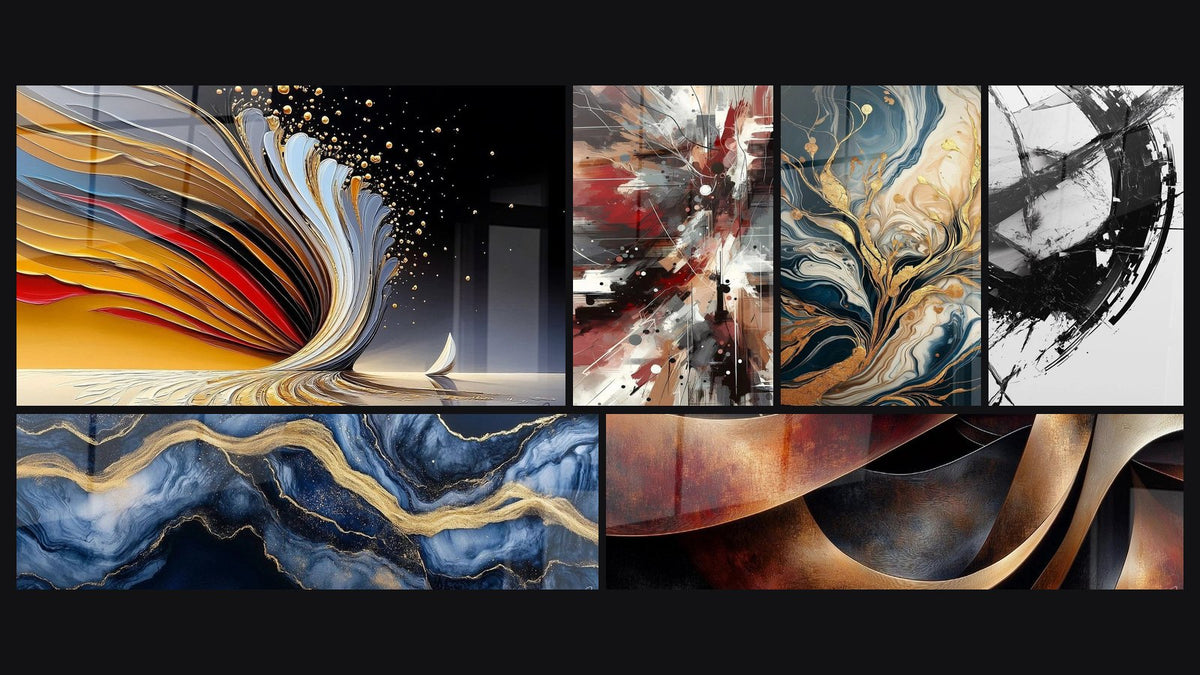

Abstract Art & Personal Interpretation: Unlocking Imagination
October 11, 2025 · 22 min read · by Walensky
You’ve been staring at that blank wall for months, dreaming of hanging something personal that truly reflects your inner world. But every time you browse galleries or decor sites, it's the same disappointment: either it’s too figurative and doesn’t speak to you, or it’s too neutral and impersonal.
You imagine your guests discovering your living room and immediately feeling your personality through your artistic choices. You want that piece that sparks conversations, makes people think, and reveals your sophisticated side without being pretentious.
The problem? You’ve tried reproductions of classic masters (too seen), contemporary art photos (too cold), even those trendy canvases found online (which look like everyone else's). None generates that authentic emotional connection you seek.
It's normal to feel lost when it comes to art - in reality, your brain naturally seeks meaning and familiar visual cues. Figurative classic works leave no room for your personal interpretation, while abstract art opens a unique dialogue between the work and your imagination.
By the end of this article, you’ll understand why abstract paintings are the key to creating a space that tells your inner story, and you'll know exactly how to choose one that reveals your most authentic personality.
Why Your Wall Secretly Awaits an Abstract Work?
Abstract art transforms your space into a mirror of your soul - and unlike what you might think, now is the perfect time to take the plunge. Every day you spend with a bare wall or generic decor, you miss the opportunity to create that emotional resonance that makes the difference between a house and a true home. It’s like having a beautiful piano but never playing it: the potential remains dormant.
🎨 Authentic testimonial : Marie, an interior architect, says: "I bought an abstract canvas with ochre and blue tones for my office six months ago. Since then, my clients systematically ask me who the artist is. This work reveals my creative sensitivity better than any diploma hanging on the wall. It generates immediate trust."
Conversation with a Decor Expert
The magic of abstract art lies in its ability to adapt: like an emotional chameleon, it reveals different facets depending on your mood, the lighting, and even your personal evolution. You will discover new details for years, creating a living relationship with your decor in just a few weeks of daily observation.

Discover what really happens in your brain when facing abstract art
You may feel this slight anxiety when looking at an abstract work: your eye seeks familiar shapes, your mind tries to "decode" the message, and you wonder if your interpretation is "correct". This reaction is perfectly normal and actually reveals the extraordinary power of abstract art.
What's really happening? Your creative brain takes over from your analytical brain. Instead of cataloging recognizable objects, your imagination projects your emotions, memories, aspirations into the work. The "problem" is not you - it’s that no one has explained to you that this confusion is actually the beginning of magic.
It's like looking at clouds in the sky: your mind naturally sees shapes, stories, personal symbols. Abstract art works exactly the same way, but in a more sophisticated and intentional way.
The revelation of colors: your secret emotional language
Contrary to what many think, colors speak directly to your nervous system before your conscious brain has time to analyze. A vibrant red activates your energy, a deep blue calms your mind, a golden yellow stimulates your creativity - and this works even if you are not aware of it.
Imagine your reaction to a sunset: you don't try to "understand" why these oranges and purples move you. Your body feels before your mind analyzes. Abstract art uses the same direct connection between color and emotion.
This discovery changes everything in your approach to decoration: instead of choosing according to "decorating rules", you can select according to your actual emotional needs. An earthy-toned canvas to ground you, electric blues to stimulate your inspiration.
🔬 Immediate test: Close your eyes for 30 seconds, then stare fixedly at a colored area of your screen (the red of this sentence, for example). Observe the first physical sensation that comes up: warmth, tension, soothing? This is your personal color language in action.
The power of shapes: your intuitive compass
Many believe that abstract forms are random or purely decorative. In reality, your primitive brain "reads" instinctively the movement, direction, balance of each composition - just as it unconsciously analyzes a person's body language.
A flowing curve evokes the serenity of a meandering river, while a broken line generates dynamic tension comparable to lightning. Your nervous system reacts to these "visual signatures" even without conscious identification.
Result? You live daily under the subconscious influence of these shapes: they modulate your energy level, your mood, even your creativity. That's why some spaces instantly energize you while others naturally soothe you.
The projection effect: when the artwork becomes your reflection
Here is the secret that few people realize: in an abstract work, you don't just see paint - you unconsciously project your own symbols, your personal archetypes, your unique emotional references. This interaction creates a totally personalized artistic experience.
You can easily notice this by observing the reactions of your loved ones to the same canvas: each sees something different, which mysteriously corresponds to their personality, their history, their current concerns.
This discovery transforms your relationship with art: you no longer buy a simple decoration, but a silent partner who will evolve with you, revealing new facets as you personally transform.
🧠 The 3 signals that your brain processes unconsciously:
- The harmony of proportions: your eye automatically calculates the balance of the composition, generating a feeling of stability or dynamism - like assessing the solidity of an architecture at a glance
- The visual rhythm of the elements: your brain detects repetitions, crescendos, silences in the work - creating a "visual melody" that influences your emotional state
- The symbolic depth of textures: your imaginary touch feels the roughness, fluidity, density of the painted material - activating tactile memories and unconscious associations
The magical moment arrives when you stop analyzing to make way for pure feeling. It is this instant where an abstract work provokes a visceral reaction - accelerated heart rate, involuntary smile, sensation of "mysterious recognition". Like falling in love: your body knows before your mind. This emotional alchemy cannot be forced, only welcomed - and it is what guarantees that your artistic choice will remain meaningful for years.
The golden rule of abstract art: if a work intrigues you for more than 30 seconds without you understanding why, it deserves your attention. Your intuitive brain has detected a resonance that your mind hasn't yet identified - this is often a sign of an authentic and lasting connection.
| ❌ Limiting belief | ✅ Liberating reality | 💡 Simple mechanism | 🎯 Concrete benefit |
|---|---|---|---|
| "I need to understand the artist's message to appreciate it" | Your personal interpretation enriches the work | Abstract art dialogues with your unique imagination | A bespoke artistic experience that evolves with you |
| "Abstract art means nothing, it's just decorative" | It reveals your inner world and influences your mood | Colors and shapes act directly on your emotions | An environment that actively supports your well-being |
| "You need artistic culture to choose correctly" | Your authentic feeling is the best guide | Your primitive brain instinctively recognizes what suits you | Total confidence in your decorative choices |
| "Guests will think I'm pretending to be cultured" | The authenticity of your choice shines through naturally | A work chosen out of passion radiates evidence | Enriching conversations and a strengthened image |

Our favourite
Golden Dynamic Swirl Painting - Cosmic Energy - Modern Abstract Edition
233,90€
Discover this artworkYour 3-step method to reveal your ideal abstract painting
Rest assured: choosing your abstract painting is nothing mysterious once you understand the logic. It's like learning to recognize your signature fragrance: first, you need to identify your favorite notes, then test their harmony with your personality, and finally validate the effect on your daily well-being. In a maximum of 3 weeks, you will have developed a sure eye and total confidence in your artistic choices.
🎯 Your artistic discovery journey: first, you'll map out your personal emotional language (the colors and shapes that really speak to you), then you’ll learn to "read" the energy of a work in 30 seconds, and finally you will master the art of projecting the final rendering into your space. Each step brings you immediate satisfaction and brings you closer to your favorite painting.
Step 1: Mapping your emotional footprint
Starting with this creative introspection is essential because your brain needs personal references before it can objectively evaluate a work. It's like building the foundations of a house: invisible but indispensable. This step will give you a revelation about your own artistic sensitivity - many discover aspects of their personality that they were completely unaware of.
Your inner exploration tools
- A sensory experience journal: choose a small notebook that you enjoy touching, with blank pages and a cover that inspires you. It will become your laboratory of colorful emotions. Avoid mobile applications that filter your natural perception through a screen - your eye needs the truth of physical colors to calibrate your authentic preferences.
- Your daily environment as a mirror: observe with a new look the objects, clothes, spaces that spontaneously bring you well-being. Your brain has already unconsciously selected a personal palette. Identify recurring shades, textures, styles - they reveal your natural "aesthetic signature" without you being aware of it.
- Your spontaneous emotional reactions: pay attention to your micro-reactions to images, landscapes, lighting atmospheres. Your body informs you constantly about your real aesthetic affinities, long before your mind analyzes or judges. This bodily intelligence is your most reliable artistic compass.
Now let's move on to concrete practice
Your personal decoding session
The emotional moodboard exercise: for 3 consecutive days, note in your notebook all the colors that spontaneously attract you - a sky, a garment in a shop window, a photo on social networks. The goal is not to understand why, but to objectively observe your recurring attractions. Your brain reveals its deep preferences, freed from external influences and current trends.
⏱️ Time: 5 minutes per day | ✅ Successful when: you identify 3-4 colors that spontaneously reappear | ⚠️ Attention: do not censor your choices even if they seem "not logical" - it is precisely this spontaneity that reveals your true artistic nature
The visceral reaction test: browse 10-15 images of abstract art online and note your first physical reaction - heart rate acceleration, smile, tension, relaxation. Your body "votes" before your mind and this information is valuable as it indicates the works that will maintain their emotional impact over time. Time yourself: a maximum of 3 seconds per image to avoid mental analysis.
⏱️ Time: 15 minutes | ✅ Successful when: you feel clear and contrasting reactions | ⚠️ Attention: if everything seems "pretty" or "not bad", you are thinking too much - start again faster
The analysis of your personal cocoon: photograph 5 places in your home where you feel particularly good and analyze the common points: lighting, dominant colors, arrangement of objects, textures present. Your space unconsciously reveals your fundamental aesthetic needs - this mapping becomes your reference for choosing a work that will naturally harmonize with your personal energy.
⏱️ Time: 20 minutes | ✅ Successful when: you identify 2-3 recurring patterns in your favorite spaces | ⚠️ Attention: choose only places where you truly feel relaxed - not those that "look good" visually
✨ Validation of your artistic profile: at the end of this step, you should have identified a palette of 3-4 recurring colors, 2-3 types of atmospheres that soothe you, and some abstract works that generate a clear emotional reaction. If you are still unsure, it's normal - your sensitivity sharpens with practice. The important thing is to have started listening to your true preferences rather than those you "should" have.
— Our selection


OUR RECOMMENDED PRODUCTS
Step 2: Mastering the Energetic Reading of a Work
You are now moving to the next level: developing your ability to "scan" the energy of an abstract work in seconds. This is where your artistic confidence truly solidifies, as you learn to trust your intuitive perceptions. This skill will accompany all your future decorative choices - and beyond, in your way of perceiving beauty in general.
Your New Perception Tools
- Emotional analysis grid: create a simple system to rate the impact of a work on 4 dimensions: energy (dynamic/soothing), openness (expansive/intimate), texture (fluid/structured), temperature (warm/cold). This grid objectifies your subjective sensations and helps you justify your choices with precision, even in front of skeptical loved ones.
- Your eye trained to contrasts: develop your ability to perceive subtleties - a work predominantly soft with a touch of dynamism creates a very different effect than a purely harmonious composition. These nuances determine the daily psychological impact on your mood and energy level in the room.
- Your mental simulation of the atmosphere: learn to mentally project the artwork into your space by imagining different moments: energetic morning, relaxing evening, concentration times. A successful work enriches all your states of mind rather than locking you into a single ambiance.
Your Artistic Decoding Training
Visual scanning technique: in front of an abstract work, let your gaze float freely for 10 seconds without trying to identify anything, then note the first emotion that comes up. This method bypasses your analytical mind to access your emotional intelligence directly. Repeat with 10 different works to calibrate your sensitivity.
⏱️ Time: 2 minutes per piece | ✅ Successful when: you clearly feel different emotions depending on the artworks | ⚠️ Warning: if you are looking to "understand" what it represents, you are out of the exercise - refocus on pure feeling
The spatial projection exercise: For each artwork that attracts you, imagine yourself watching it from your sofa in the morning with your coffee, then in the evening in soft lighting. Your brain automatically tests long-term compatibility with your lifestyle. An artwork that enriches your different daily moments is likely to accompany you harmoniously for years.
⏱️ Time: 3 minutes per simulation | ✅ Successful when: you feel the impact of the artwork in your daily routine | ⚠️ Warning: don't just imagine the visual aspect - focus on the emotional effect it would be to live with
The imaginary conversation test: Visualize a guest discovering the artwork at your home and imagine their likely reaction, then the conversation that would follow. This simulation reveals whether you fully embrace your choice or if you still feel unconscious doubts. An artwork that generates enthusiastic exchanges in your imagination is likely to create the same dynamic in reality.
⏱️ Time: 5 minutes per scenario | ✅ Successful when: you feel proud and confident explaining your choice | ⚠️ Warning: if you justify yourself defensively in your simulation, the artwork may not really suit you
🎨 Validation of your perceptive expertise: You master this step when you can assess the emotional impact of an abstract work in less than 30 seconds and clearly project its effect into your daily life. Your artistic confidence naturally solidifies - you begin to trust your perceptions rather than external opinions. If some artworks still leave you perplexed, that's perfect: it means your sensitivity continues to refine.
Step 3: Orchestrating the Perfect Integration into Your Space
You are now reaching the level of mastery where you no longer just choose a work that you like, but a work that optimizes the energy of your space and enriches your daily life. This step transforms your view of all your decoration - you understand how each element dialogues with others to create a consistent visual symphony. The result? An interior that truly resembles you and supports you emotionally every day.
Your Spatial Harmonization Tools
- Light flow analysis: observe how natural light evolves in your room throughout the day and identify areas of shadow and brightness. An abstract work reveals different aspects depending on the lighting - some colors intensify in direct light while others flourish in the gloom. This knowledge guarantees optimal visual impact at all times.
- Your mapping of existing energies: identify the elements of your current decor that bring dynamism (straight lines, bright colors, rough textures) versus those that soothe (curves, muted tones, soft materials). Abstract art can balance or amplify these energies according to your personal needs and the atmosphere you want to create.
- The remote validation system: develop your ability to assess the effect of a work from different points of view in the room - from the entrance, the sofa, the dining table. A successful work enriches the space from all angles and creates visual discoveries according to your position, maintaining your interest over time.
Your spatial harmony composition
The energy diagnosis of your room: spend 15 minutes at different times of the day in the space intended to accommodate the work, noting your spontaneous sensations - where your gaze naturally rests, which corners attract or bother you, how your energy level evolves. Your body instinctively identifies the energetic needs of the space long before your conscious reflection.
⏱️ Time: 45 minutes spread over 3 moments | ✅ Successful when: you clearly identify areas that lack vitality or soothing | ⚠️ Attention: avoid rationalizing your sensations - if a corner makes you uncomfortable for no apparent reason, take this information seriously
The visual integration simulation: use an augmented reality application or simply your imagination to visualize 3-4 potential works in your space, varying formats and locations. Your eye automatically assesses the balance of masses, colors and energies - trust your first impression rather than a complex technical analysis.
⏱️ Time: 10 minutes per simulation | ✅ Successful when: a composition immediately gives you a feeling of evidence and harmony | ⚠️ Attention: if you have to "force" it mentally to work, continue your search
The emotional coherence test: imagine yourself living daily with your choice for a month - working, relaxing, receiving friends in this transformed space. A perfectly integrated work naturally supports all your moods without ever creating fatigue or irritation. Your projection should generate enthusiasm and serenity simultaneously.
⏱️ Time: 15 minutes of deep viewing | ✅ Successful when: you look forward to your future moments in this space with pleasure | ⚠️ Attention: beware of purely aesthetic enthusiasm - check that the emotion remains stable even when imagining moments of fatigue or stress
🏆 Validation of your complete mastery: you have reached excellence when your choice of abstract work simultaneously gives you the excitement of novelty and the evidence of the obvious. The artwork seems to have always belonged to your space while bringing a unique dimension to it. Your confidence is total because every aspect has been validated: emotional resonance, visual balance, long-term projection. Congratulations, you master the art of artistic integration!
The golden rule of artistic progression: you are ready for the next step when the current step seems natural and obvious to you. Never force your learning pace - your aesthetic sensitivity develops like a plant, with patience and attention. The important thing is to maintain curiosity and the pleasure of discovery throughout the process.
Congratulations on this artistic exploration journey! You have developed a reliable method for choosing your abstract works, but here are some expert subtleties that will make the difference between a good choice and an exceptional one. These details give you the advantage of those who truly understand art and avoid costly mistakes even well-intentioned amateurs.
🎭 Secret of experienced collectors: the most successful abstract works always contain an element of "creative tension" - a color that contrasts slightly, a shape that breaks the general harmony, a detail that intrigues the eye. This controlled dissonance maintains visual interest for years where perfect harmony eventually becomes tiresome. Look for this small voluntary "imperfection" that makes up the personality of the work.
Frequent question from passionate amateur
I'm falling for an abstract artwork, but I'm afraid it will be too bold for my living room... How do I know if I won't get tired of it after a few months?
This hesitation reveals great wisdom on your part! Boldness that lasts is the one that truly resembles you, not the one that impresses you from the outside. An excellent test is to imagine this artwork at your best friend's house: if you sincerely envy it, it probably means that the work corresponds to your true nature. If you think "it's good for him but not for me", your intuition protects you from an impulsive purchase. Trust this inner voice that knows your long-term needs better than your excitement of the moment.
💡 Emotional validation test: live with the image of this artwork as your wallpaper for a week and observe your daily reaction. If enthusiasm persists without fatigue, you probably have your future lasting favorite.
— You may also like


The invisible pitfalls that sabotage your artistic choice
Attention: even with the best method, some subtle mistakes can turn your art investment into disappointment. These errors are particularly treacherous because they seem logical at the time, but reveal their negative consequences only after several months of daily life with the artwork.
- ⚠️ The trap of fashion effect: succumbing to a work because it matches current interior design trends. It's tempting because you’ll receive immediate compliments, but your eye will get tired as soon as the trend changes - usually in 1-2 years. Always prioritize your personal emotional resonance over temporary social approval. This mistake even affects seasoned enthusiasts who confuse "fashionable" and "timeless".
- 🎨 The error of perfect coordination: choosing a work that harmonizes too perfectly with your existing decor. Paradoxically, this total harmony creates visual monotony that lulls the eye and makes the artwork disappear into the background instead of enhancing it. Art needs a slight contrast to reveal its personality and maintain your daily interest.
- 💰 The "safe budget" reflex: underinvesting for fear of making a mistake, thinking you can always change later. This logic condemns you to compromise artworks that will never truly satisfy you. It's better to wait and save for the artwork that makes you vibrate than to accumulate “almost perfect” items that clutter your space and your mind.
- 🖼️ The fixation on standard format: automatically looking for a work with "normal" dimensions for your wall without considering the emotional impact of size. A smaller but powerful artwork can transform a space better than a large, bland canvas. The impact doesn't depend on the area covered but on the intensity of the dialogue created with the observer.
- 🏠 The illusion of the obvious location: automatically hanging above the sofa or facing the entrance without testing other positions. Some artworks reveal their full potential in unexpected locations that create visual surprises and energize the space differently. The placement influences the impact of the artwork as much as its colors or shapes.
🛡️ Your error-proofing verification system: Before finalizing your choice, validate these 4 crucial points: Does the artwork still evoke emotion after 5 minutes of observation? Can you simply explain why you like it without referencing trends? Can you imagine still appreciating it in 3 years? Does the artwork add something unique to your space rather than just completing it? If one answer is negative, continue your search - your perfect artwork awaits elsewhere.
— In the same vein


Your most frequently asked questions about abstract art
Share your feelings rather than trying to "explain" the work. Explain how it makes you feel, the emotions it evokes, the atmosphere it creates in your daily life. This personal approach touches much more than technical explanations. Most people respect and admire the authenticity of an assumed choice, even if they do not share the taste. Your sincere conviction becomes contagious and often turns skeptics into curious individuals.
Your artistic transformation: from spectator to connoisseur
In a few weeks, you will look at your new abstract painting with the deep satisfaction of someone who has found their missing piece. Your mornings will start differently: this first glance at your work will immediately connect you to your aesthetic sensitivity, reminding you who you really are beyond daily constraints. Your guests will notice this quiet evidence with which you inhabit your space - this rare coherence between your personality and your environment.
This mastery of abstract art transforms your overall relationship with beauty: you develop an aesthetic confidence that extends far beyond decoration. You learn to trust your sensitivity in all your choices - fashion, architecture, design, even music. This new assurance shines through in the way you inhabit space and naturally impresses those around you.
The best part? You realize that understanding art was ultimately simpler than you imagined. It just took learning to listen to your true reactions rather than looking for the "right" answers. Now you know: your first concrete step is to take this notebook and start the emotional moodboard exercise today. Your perfect work awaits - and you now have the keys to recognize it.
🎨 Your artistic revolution starts now: you possess everything you need to transform your space into an authentic reflection of your creative soul. Trust your sensitivity - it is your best guide towards the work that will illuminate your daily life and reveal the beauty of your inner world to all who enter your universe.
Also read: 🌟 Read more articles on art and well-being
</div
More selected pieces
Sculpted Waves Navy Blue and Ivory Artwork - Flowing, Wavy Layers - Artistic Abstract Edition
233,90€
Discover this artwork →Explore our collections