

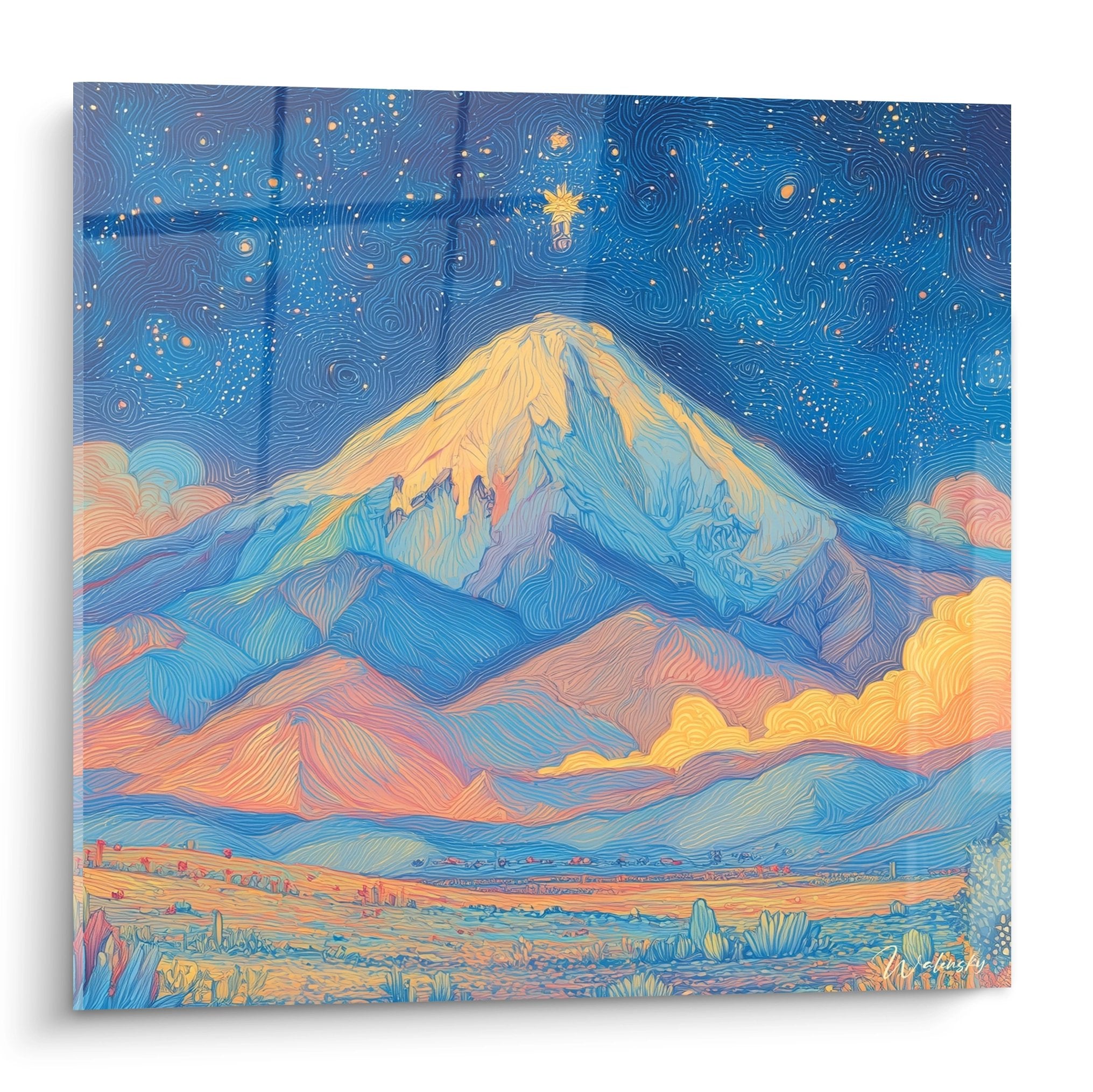






Why did post-revolutionary Mexican muralism rely so heavily on monumental verticality?
February 5, 2026 · 7 min read · by Walensky
Imagine standing before the Palacio Nacional in Mexico City, your gaze drawn upward by Diego Rivera's immense frescoes climbing the walls across three stories. That dizzying sensation, that instinctive need to lift your head ever higher, is no accident. It is a political, social and artistic statement that reshaped twentieth-century art.
Here is what post-revolutionary Mexican muralism offers us: a visceral understanding of the power of monumental scale, a lesson in the democratic accessibility of art, and a timeless model of collective visual storytelling. These immense walls tell the story of a revolution, but also offer a radical method for making art speak to the people.
You may wonder why these artists chose such overwhelming verticality over more conventional formats. How can walls ten, fifteen, or twenty meters high convey a message more powerfully than a museum canvas? And above all, what can these giant frescoes teach us about our contemporary relationship with public art and space?
The answer lies in an explosive period of Mexican history: the years 1920 to 1950, when Rivera, Orozco and Siqueiros transformed entire buildings into vertical manifestos. Their monumental approach to post-revolutionary Mexican muralism was not a mere aesthetic preference but a historical, technical and philosophical necessity.
Let us explore together this vertical adventure that continues to inspire architects, designers and creators today.
When walls become secular cathedrals
Post-revolutionary Mexican muralism was born in 1921 in an explosive context. The Mexican Revolution had just ended after ten years of violence. José Vasconcelos, Minister of Education, launched an ambitious program: transform public buildings into open books for a people of whom 80% could not read.
This is where monumental verticality first found its meaning. Diego Rivera received the walls of the National Preparatory School and immediately understood: to speak to an entire people, one needs a scale that exceeds the human. His frescoes soar two or three stories high, compelling the viewer into an ascending visual pilgrimage.
This strategy of height is not innocent. In a country deeply marked by Catholicism, these gigantic walls instinctively recall the naves of colonial churches. But here there are no saints or angels: there are peasants, workers and revolutionaries. Verticality becomes a sacred détournement, a reappropriation of the codes of spiritual authority in the service of a popular mythology.
Architecture as narrative accomplice
In Orozco's work at the Hospicio Cabañas in Guadalajara, monumental verticality reaches its peak. His principal fresco, Man of Fire, rises twenty-three meters beneath the dome. To see it, you must tilt your head back until you lose your balance.
This physical constraint is deliberate. Post-revolutionary Mexican muralism exploits existing architecture the way a conductor uses instruments. Staircases become ascending narrative spirals. Corridors turn into vertical chronologies where each floor recounts an era.
David Alfaro Siqueiros, the most radical of the three great muralists, theorized this approach in his concept of polyangular perspective. According to him, a monumental mural must be designed to be seen in motion, from multiple viewpoints. Verticality enforces this dynamic reading: you climb the stairs and the story unfolds gradually, like a film projected onto walls.
Vertical time
This temporal dimension is crucial. On a horizontal surface, the eye scans quickly. On a vertical surface fifteen meters tall, the gaze climbs, hesitates, descends, compares. The time spent observing multiplies tenfold. This is exactly what these artists sought: capturing attention in a pre-television era, creating an immersive experience before the word itself existed.

Favorite
Painting The Colors of the Sky - Aurora Borealis Space Edition
€233.90
Discover this paintingTechnique in service of gigantism
But how does one paint a fresco twenty meters high? Post-revolutionary Mexican muralism required fascinating technical innovations that also justified this verticality.
Rivera relearned the Italian buon fresco technique, adapted to Mexican walls. This method requires painting on fresh plaster, in sections of roughly one square meter per day. On a vertical wall, this constraint becomes an advantage: one works from top to bottom, preventing drips of paint or plaster from soiling areas already finished.
Siqueiros, for his part, revolutionized practice by introducing the industrial spray gun and synthetic resins. These tools made it possible to cover immense vertical surfaces in a few hours where the brush once required weeks. His mural at the Polyforum Cultural Siqueiros reaches twelve stories in height thanks to techniques borrowed from the automobile industry.
This technical dimension explains why Mexican muralism favored verticality: upright walls offer better material adhesion, better resistance to weather, and a usable surface with no theoretical limit on height.
— Our selection


The political message of height
Yet the true reason for this monumental verticality is ideological. After the Revolution, Mexico sought to build a new national identity, mestizo and proud. The muralists became the visual architects of this mythology.
By choosing the exterior and interior walls of public buildings (ministries, schools, hospitals) rather than museums, they asserted: art belongs to the people, not to the elite. And to speak to the people, one needs a voice that carries. Monumental verticality becomes that voice.
A fifteen-meter wall visible from the street shouts far louder than a two-meter canvas hung in a bourgeois salon. Post-revolutionary Mexican muralism uses scale as a megaphone. The higher it is, the more visible it is from afar, and the farther the message travels.
Ascent as metaphor
This verticality also carries a powerful symbolic dimension. In the Aztec and Maya cosmovision, which the muralists revived, verticality connects the three worlds : the underworld (roots, the pre-Columbian past), the earthly world (revolution, the present), and the celestial world (the radiant future, the socialist utopia).
Rivera often organized his compositions along this vertical axis: below, stooped peasants and miners in the depths; at the center, workers' and peasants' struggles; above, the vision of a reconciled society. Following the wall with your eyes becomes an initiatory journey from servitude to liberation.

The contemporary legacy of walls that touch the sky
Today, this lesson of post-revolutionary Mexican muralism resonates strangely. In our cities saturated with advertising, monumental urban art reclaims these vertical facades. From Paris to São Paulo, artists paint entire buildings, creating visual landmarks in urban anonymity.
This lineage is no coincidence. Contemporary muralists such as Farid Rueda or Saner in Mexico, or even Shepard Fairey in the United States, explicitly cite Rivera and Siqueiros. They understood that monumental verticality creates a democratic experience of art : free, accessible, impossible to ignore.
In our interiors too, this lesson inspires. Interior designers are rediscovering the narrative power of tall walls. A loft with a vertical fresco running across two levels creates spatial tension, a domestic story. Even in a standard apartment, a wall section treated in height (a panoramic wallpaper, an ascending arrangement of frames) transforms the perception of space.
— Also to discover


How to apply this vertical philosophy at home
You may not have twenty meters of wall at your disposal, but the principles of Mexican muralism adapt to every scale. Here is how to capture this vertical energy in your space:
Make use of the height under the ceiling. Even 2.50 meters offers usable verticality. A visual composition that rises to the top draws the eye, optically enlarges the room and creates that sense of elevation characteristic of muralism.
Create an ascending narrative. Just as Rivera organized his frescoes in thematic strata, organize your walls into zones: a calm base, a dynamic middle, an airy summit. This gradation guides the eye naturally upward.
Dare to go big. A single large vertical element (an imposing painting, a panoramic wallpaper, a floor-to-ceiling bookcase) will have more impact than ten small scattered pieces. This is the fundamental lesson of Mexican muralism: the monumental creates emotion.
Use color as a visual elevator. The muralists played with values to create vertical movement: dark below, luminous above. This technique works wonderfully in an interior to create depth.
Transform your walls into vertical statements
Discover our exclusive collection of space paintings that capture this monumental power and instantly lift your interior toward new visual dimensions.

In the same spirit
Alien planet painting - Cosmic horizon - Diverse space edition
€233.90
Discover this painting →Live vertically
Post-revolutionary Mexican muralism bequeathed us an essential truth: verticality is not only a physical dimension, it is an aspiration. These monumental walls that defy gravity embody the human desire to rise, to transcend, to see farther.
At home, at work, in your neighborhood, look for these vertical opportunities. A bare wall is an invitation to tell an ascending story. Every space holds this potential for elevation that Rivera, Orozco and Siqueiros revealed to the world.
Begin simply: choose a wall and imagine it not as a flat surface but as a narrative ladder. What do you want to say as you climb toward the ceiling? What visual journey will you offer those who enter this room? The answers to these questions will transform your relationship with space as radically as muralism transformed public art in the twentieth century.
Look up. Inspiration, as the Mexican muralists understood, always lies a little higher than our usual gaze.
Frequently asked questions
Why are Mexican frescoes so high?
To speak to an entire people, one needed a scale that exceeds the human. A fifteen-meter wall visible from the street carries farther than a canvas hung in a salon. Rivera, Orozco and Siqueiros made height a megaphone: the higher it is, the farther the message travels.
How did the muralists use the architecture of buildings?
Like a conductor uses his instruments. Staircases become ascending narrative spirals, corridors vertical chronologies where each floor recounts an era. Siqueiros theorized a polyangular perspective: the work is designed to be seen in motion, from several successive viewpoints.
What does verticality symbolize in Diego Rivera's frescoes?
It draws on the axis of the Aztec and Maya cosmovision linking three worlds. Rivera places stooped peasants and miners in the depths below, workers' struggles at the center, and the vision of a reconciled society above. Lifting your eyes along the wall becomes a journey from servitude to liberation.
How was a fresco twenty meters high painted?
Rivera relearned the Italian buon fresco, which requires painting on fresh plaster in small daily sections; one works from top to bottom so as not to soil finished areas. Siqueiros introduced the industrial spray gun and synthetic resins borrowed from the automobile industry.
Explore our collections


