



The Evolution of Forest Representation in Western Art
October 11, 2025 · 5 min read · by Walensky
Imagine a medieval monk hunched over his parchment, brush in hand, adding touches of gold to a miniature oak. Then a romantic painter facing a misty forest, seeking to capture the unspeakable. Finally, a contemporary artist assembling branches in a clearing. Three eras, three visions, one fascination: the forest.
The medieval forest in Western art: symbols and illuminations
In medieval monasteries, the forest was never quite real. Illuminators transformed it into a symbolic theater where knights and saints crossed dragons and miracles. Each tree told a story.
Consider the Très Riches Heures du duc de Berry. The forest appears there as a precious setting, nestled between the elegance of a noble procession and the arrows of a castle. Scribes used lapis-lazuli - this stone from Afghanistan that was worth gold - to paint the forest shadows. A crazy luxury to represent the wildest space.
Oaks symbolized immutable strength. Fir trees evoked the soul that resists storms. Nothing was left to chance in these coded forests, where each leaf carried a spiritual message. The medieval forest remained a border: on one side the city and its laws, on the other mystery and danger.
Techniques for representing forests in modern Western art
Then came the time when artists wanted to see really. No more abstract symbols - place for direct observation. In the 17th century, when Jean-Baptiste Oudry paints his hunting scenes, you can almost feel the humidity of the undergrowth.
The Fontainebleau forest becomes the great laboratory of landscape painting. Painters experiment tirelessly there. How to render the light filtering through the branches? How to show the rough texture of a century-old bark? Oil paint finally offers answers. Glazes create that mysterious depth of the undergrowth, impasto brings gnarled trunks to life.
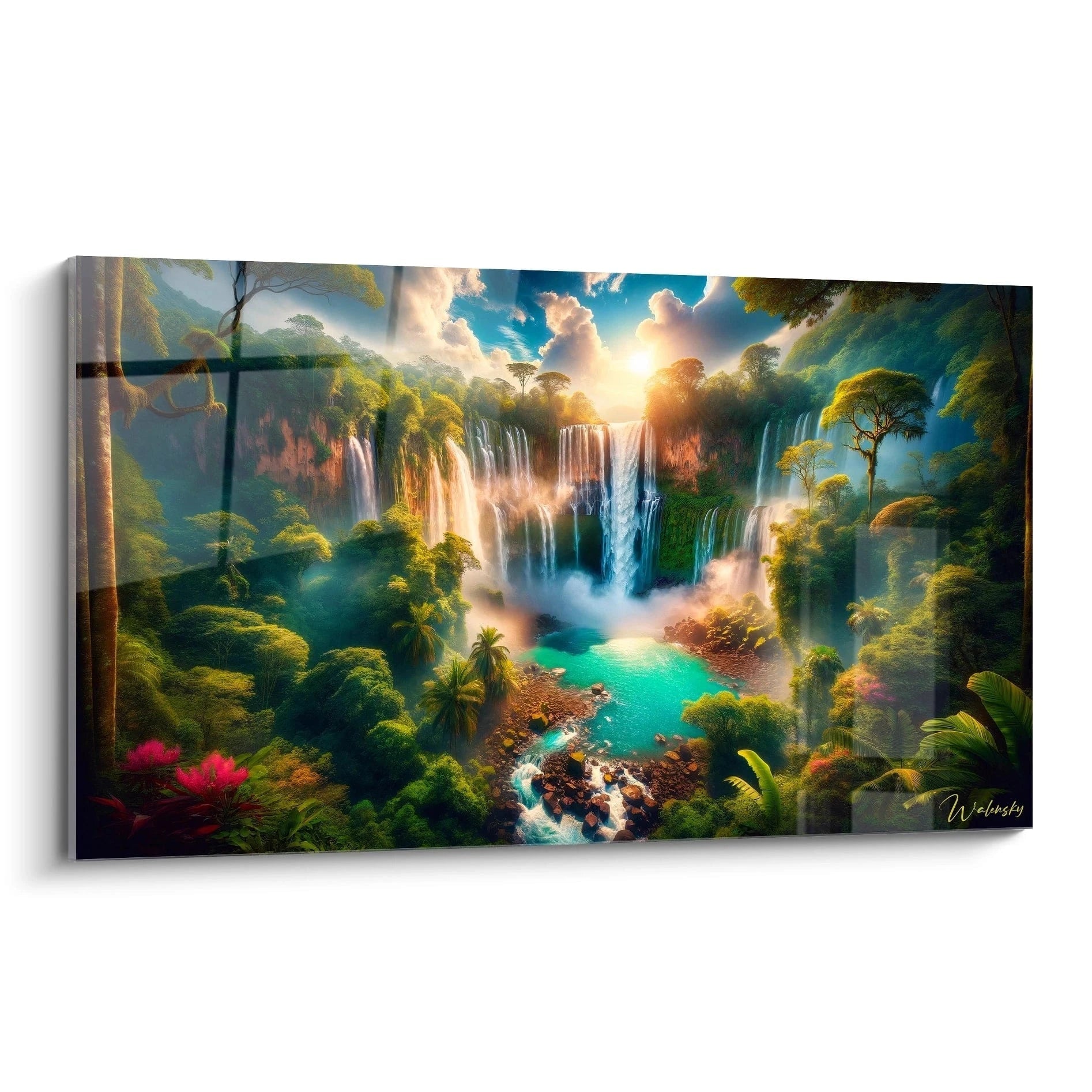
Something fundamental shifts in the history of art: nature is no longer just a backdrop for biblical or mythological scenes. It becomes the main subject. A quiet revolution that will transform all Western art. By the way, this tradition continues today in magnificent wall landscapes that capture the soul of forests.

Our favourite
Autumn Lake Landscape Painting - Golden Reflections - Forest Edition
232,90€
Discover this artworkThe Barbizon school: the forest as a central subject of Western art
1841: a French inventor creates the portable paint tube (Source: History of artistic techniques). This technical detail will change the history of art. Suddenly, painters can go outside.
Théodore Rousseau, Camille Corot, Jean-François Millet: they flee Paris and its dusty academies. Direction Barbizon, a small village nestled against the Fontainebleau forest. There, they set up their easels directly facing the trees. No more studio reconstruction - just the immediate reality, with its changing lights and weather surprises.
Rousseau falls madly in love with these old oaks twisted by centuries. When the forestry administration wants to fell them to "modernize", he fights like a lion. These trees are living masterpieces, he argues, as precious as Rembrandts. And he wins! The first protected trees in France are born thanks to visionary landscape artists.
What characterizes the Barbizon school:
- Working outdoors rather than in a studio
- Direct observation of forest nature
- Ecological fight to preserve forest heritage
- Influence on impressionistic artistic movements
Their influence radiates beyond borders. The Impressionists will take up this torch, pushing the exploration of natural light even further.
— Our selection


The romantic forest in Western art: Caspar David Friedrich
Caspar David Friedrich painted solitude. Born in 1774 in the frozen north of Germany, he had seen his brother drown under the ice. This tragedy will permeate all his work.
Look at The Abbey in a Forest of Oaks (1809-1810). Dead trees like skeletons, a ghostly Gothic ruin, a minuscule funeral procession. You feel the cold, the silence, the immensity that crushes. Friedrich doesn't paint forests - he paints what one feels facing forests.
His characters always turn their backs on us. We watch them watching. This mise en abyme creates a disturbing intimacy. The viewer becomes this solitary traveler contemplating the forest infinity, perhaps seeking God in the morning mists.
German Romanticism makes the forest a mirror of the soul. Friedrich's tormented oaks speak of our own mortality, of our smallness in the face of passing time.
Forests in contemporary Western art: installations and land art
Let's jump into our century. In the Landes de Gascogne, you walk among the pines when suddenly: a monumental head emerges from the ground. Then further on, a luminous sculpture dialogues with the ferns. Welcome to the Contemporary Art Forest, which features 29 works scattered over kilometers (Source: Association Forêt d'Art Contemporain).
Contemporary artists such as Fabrice Hyber or Vincent Laval have changed methods. They no longer represent the forest - they create with it. Vincent Laval describes himself as an "artist-walker-forager". He collects fallen branches, mossy stones, fleeting moments. His sculptures are born from the forest floor and will return to it.
This is the principle of land art: ephemeral works that accept their disappearance. The installations evolve with the seasons. Autumn colors a spiral of leaves differently. Winter frost transforms an assemblage of branches. Spring makes everything grow back.
This approach marks a paradoxical return to the sources in contemporary landscape painting. After centuries of wanting to master, represent, control nature, here is art letting go. Creators humbly collaborate with living things, aware of the ecological stakes weighing on our forests.
From medieval illumination to contemporary land art, the forest remains what it has always been in Western art: a space for projection, questioning, and transformation. A mirror that reflects our fears and hopes, our beliefs and doubts. The forest looks at us as much as we look at it.
Frequently asked questions about the representation of forests in Western art
Why was the forest symbolic in medieval art?
In medieval art, the forest represented the boundary between civilization and wilderness. Illuminators used specific symbols: the oak for strength, the fir tree for spiritual resilience. Each forest element carried a religious or moral message intended for the readers of illuminated manuscripts.
What distinguishes the Barbizon school from other artistic movements?
The Barbizon school (1820-1875) revolutionized landscape painting by working directly outdoors in the Fontainebleau forest. These landscape artists made the forest landscape a subject in its own right rather than just a backdrop, while also becoming the first defenders of France's forest heritage.
How does contemporary land art transform our relationship with forests?
Land art creates ephemeral works integrated into the forest ecosystem, using natural materials that return to the earth. This collaborative approach with nature marks a major evolution in Western art history, moving from representation to respectful interaction with the environment.

Explore our collections


