Medieval illuminations tell a fascinating story: that of time passing through the seasons. Imagine a book open before you, where each page reveals a month of the year with its colors, activities, and landscapes. That's exactly what artists from the Middle Ages created between the 12th and 15th centuries.
Medieval landscape cycles as a representation of the seasons
Medieval landscape cycles mark a turning point in art history. For the first time, artists systematically represent weather and the passage of seasons through seasonal medieval illumination. These sets of illuminations appear in books of hours, personalized prayer collections for the aristocracy. The structure always remains the same: twelve months, twelve zodiac signs, twelve different scenes.
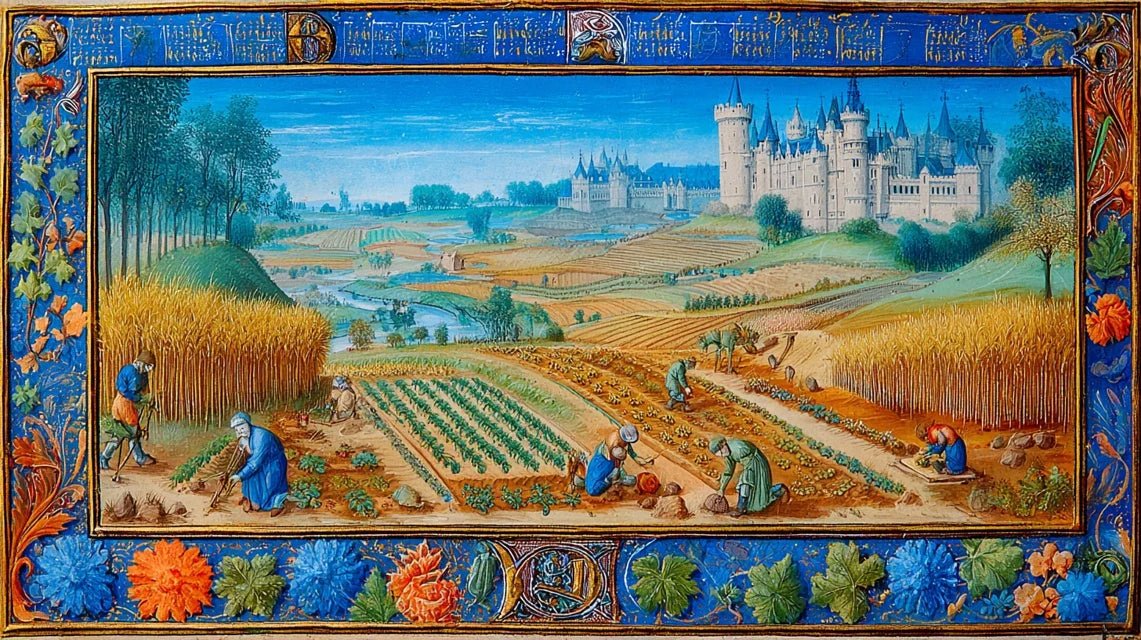
Take the most famous example: The Très Riches Heures du duc de Berry, commissioned around 1411 (Source: Musée Condé Chantilly) from the Limbourg brothers. This exceptional illuminated manuscript unfolds a veritable painting on each page. We see peasants working in the fields in front of Vincennes Castle, lords feasting in January, grape pickers busy in September under Saumur Castle. Each month tells a story, each season has its own personality.
The illustrated liturgical calendar thus becomes a mirror of cyclical time. Spring bursts forth in green tones, summer radiates gold during the harvests, autumn adorns itself with ochre at the grape harvest, winter imposes its icy white. Around 80 landscape cycles have been recorded in France between the 12th and 13th centuries (Source: Perrine Mane, CNRS), proving that this tradition of medieval temporal iconography was firmly established.
Seasonal representation techniques in medieval landscapes
How to recognize winter in a medieval illumination? It's simple: look for bare trees, branches as black as skeletons, snow falling in small white flakes. Curiously, these illuminated winters seem almost pleasant. We rarely see the real misery, the famines documented by chronicles. Enluminators prefer to show peasants cheerfully cutting wood or warming themselves by the fire.
Spring explodes with life. Trees are covered with delicate flowers, meadows are dotted with colorful touches, everything seems reborn. Illuminators multiply tender greens, suggesting renewal after the dormant season.
Summer shines brightly. Golden fields stretch as far as the eye can see, the sky takes luminous hues, harvesters work under a bright sun. Artists use gold and vibrant yellows to convey summer heat. Autumn is recognizable by its warm browns and deep oranges. Vineyards laden with purple grapes become the emblem of September.
This color palette is no accident. It creates an immediate system of recognition. Through landscape paintings from the medieval period, each season has its own visual identity, allowing the viewer to instantly locate the time of year depicted.
Agricultural work as markers of the seasons in landscape cycles
But what really structures these medieval landscape cycles is human activity. At the time, nearly 90% of the population lived off agriculture (Source: BnF Essentials). Illuminated manuscripts document this daily life with surprising precision. Each month corresponds to a specific task, creating a true visual rural calendar.
The rhythm is immutable:
- January-February: one finally rests by the fire, cutting wood to last until spring
- March: return to the fields to prune vines and begin sowing
- April-May: the garden demands care, the meadows must be mowed
- June-July: it's harvest time, armed with his sickle, the peasant cuts the golden ears of wheat
- August: the grain must be threshed on the village threshing floor
- September: place for grape harvesting and pressing
- October: new sowing to prepare for the following year
- November: pigs gorge themselves on acorns in the forest
- December: animals are slaughtered to constitute winter reserves
These works are not mere decorations. They constitute essential temporal markers. In 7 or 8 months out of 12, calendars prioritize agricultural scenes. The tools are represented with care: the curved sickle, the wooden flail, the sharp scythe. These details anchor the landscape cycles in a concrete reality, even if the whole remains idealized.
The evolution of seasonal landscape cycles in late medieval times
The art of representing the seasons changes considerably between the 12th and 15th centuries. At first, the landscape remains abstract. The characters work on gold backgrounds, without real depth. The seasons are expressed only by gestures: one harvests, therefore it is summer. One prunes the vine, therefore it is spring.
Gradually, everything changes. The Little Ice Age (around 1300-1850, Source: Emmanuel Le Roy Ladurie) cools the European climate. Winters become more severe, summers cooler. This climatic transformation sensitizes artists to meteorological phenomena. Illuminators of the 14th century begin to paint nuanced skies, realistic snowfalls, spatial depths suggesting a real three-dimensional space.
In the 15th century, with masters like Simon Bening, landscape cycles reach their perfection. The naturalized landscape becomes a harmonious composition. The Très Riches Heures embody this maturity: we recognize real castles (Vincennes, the Louvre, Saumur), seasonal atmospheres are consistent, light, vegetation and human activities form an organic whole.
This evolution heralds the Renaissance. Medieval seasonal landscapes open a window onto the natural environment. The cyclical time becomes a visual spectacle where each season unfolds its own aesthetic, transforming illuminated calendars into true contemplative works of art through an increasingly sophisticated representation of the cycle of time.
FAQ: The Art of Representing Seasons in Medieval Landscape Cycles
Q1: Why do medieval landscape cycles systematically represent twelve months?
Medieval landscape cycles follow the structure of the liturgical and astrological calendar. Each month corresponds to a zodiac sign and specific religious holidays. This organization into twelve months makes it possible to create a complete representation of the annual cyclical time, essential for books of hours that guided the daily religious practice of lay people.
Q2: Were the seasons represented realistically in medieval illuminations?
No, seasonal representations were largely idealized. Winters, for example, rarely showed the harshness of the actual climate and frequent famines. Illuminators created harmonious images intended for an aristocratic audience, deliberately obscuring the most painful aspects of peasant labor and difficult climatic conditions.
Q3: Which manuscript represents the peak of medieval seasonal landscape cycles?
The Très Riches Heures du duc de Berry, commissioned around 1411 to the Limbourg brothers, is the pinnacle of this art. This exceptional manuscript combines technical perfection, growing naturalism and iconographic richness. Its twelve calendar illuminations have become the most famous seasonal landscapes in medieval art, permanently influencing the representation of time and seasons in Western art.