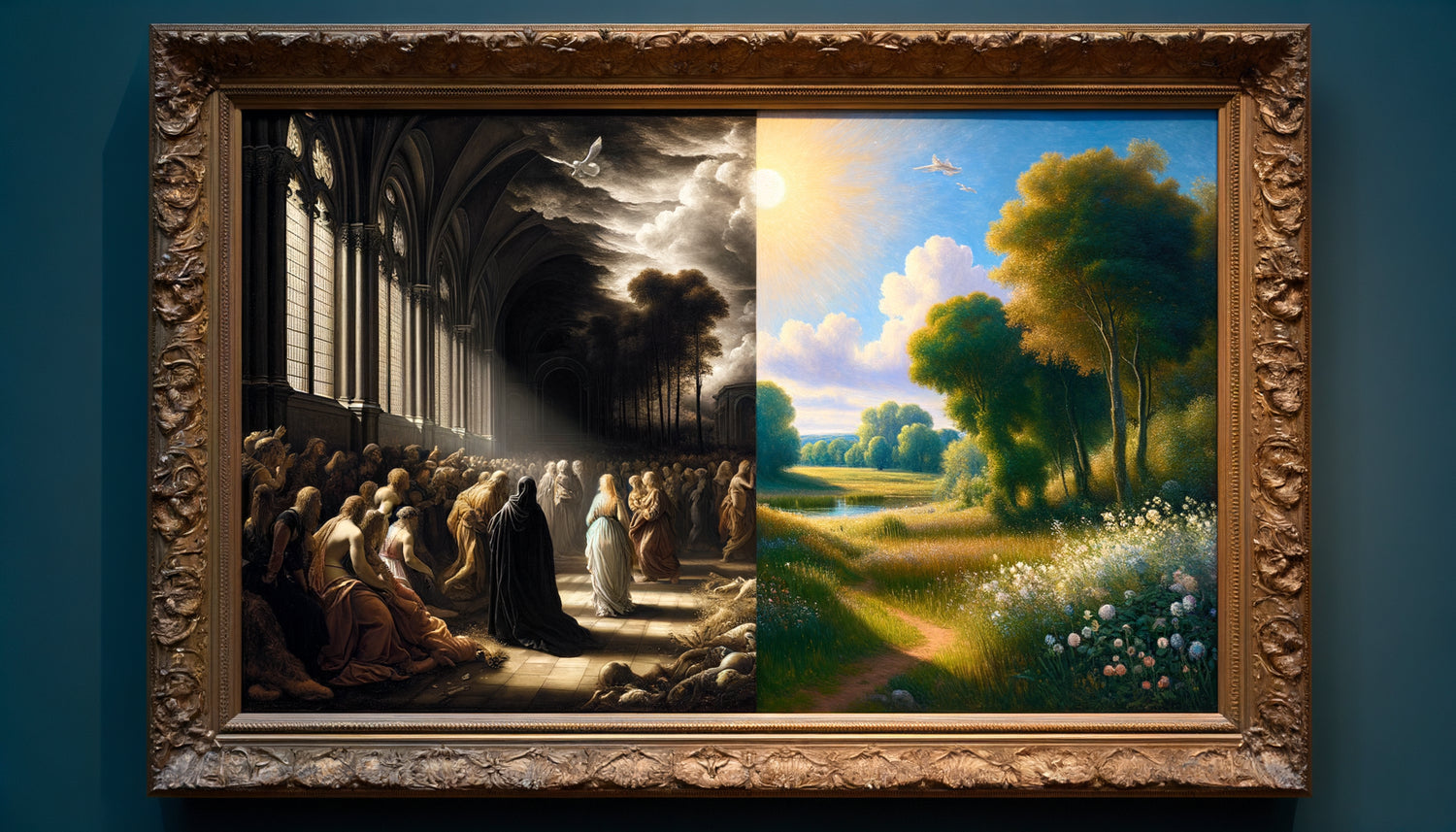
Imagine a moment: you're strolling through a 15th-century museum. On the walls, grandiose biblical scenes, portraits of nobles, epic battles. In the background of these paintings, a verdant hill, a discreet tree, a pale blue sky. Nature is there, but it’s merely supporting a human or divine story. Then, a few centuries later, everything shifts. Artists begin to paint forests without characters, mountains without heroes, rivers for their own beauty. This silent revolution has transformed our way of looking at the world.
Here's what this evolution brings us: a renewed emotional connection with nature, an inexhaustible source of inspiration for our interiors, and a deep understanding of art as a mirror of our relationship with the environment. Perhaps you’ve wondered why certain landscapes touch you so deeply, or when exactly artists dared to make nature their main subject rather than just a backdrop. This question may seem academic, but it holds fascinating keys to understanding the art we choose to hang in our homes. I invite you on a journey through five centuries, where brushes freed nature from its secondary role to make it a star in its own right.
The beginnings: when nature emerged from the shadows
At the beginning of the 16th century, something stirred in European workshops. Flemish and Dutch painters began to pay new attention to natural details. Albrecht Altdorfer paints a revolutionary work in 1520: Danube Landscape, considered one of the first pure landscapes in Western art history. No saint, no mythological scene, just trees, a river, mountains.
Yet, this boldness remains marginal. Nature most often remains a symbolic decor: the Garden of Eden behind a Madonna and Child, the Tuscan countryside framing a religious scene. The commissioners – the Church and aristocracy – don’t pay for rural views. They want narratives, messages, transcendence. Nature alone doesn't yet have enough monetary or spiritual value.
But look closely at these 16th-century backgrounds: trees gain botanical precision, skies fill with credible clouds, lights become more subtle. Artists are discreetly experimenting, preparing the ground for a future liberation.
The Dutch 17th century: nature becomes profitable
Everything changes with the emergence of the Dutch merchant bourgeoisie. These nouveaux riches don’t want large religious paintings for their homes – they want their everyday world sublimated. Jacob van Ruisdael, Meindert Hobbema, Aelbert Cuyp revolutionize landscape painting by making it a genre in its own right.
Windmills stand proudly against dramatic skies. Cows graze peacefully in meadows bathed in golden light. Nature becomes a viable commercial subject, with its codes, specialists, and collectors. This evolution is not just artistic – it reflects a society that begins to see nature not only as a divine creation but as a national heritage, an economic asset.
Claude Lorrain, in France, takes a different but equally revolutionary path. His idealized landscapes, bathed in golden light at dusk, transform the Roman countryside into paradise on earth. He invents landscape as pure emotion, where the few mythological figures are merely pretexts to justify these enchanting visions.
A hierarchy that resists
Despite these advances, the Royal Academy of Painting and Sculpture established in 1669 a hierarchy of genres that places landscape at the bottom, just above still life. Historical painting remains the pinnacle – proof that official recognition is slow to come. Landscape artists are considered skilled artisans rather than true creators.

The 18th century: the beginnings of romantic emotion
The Age of Enlightenment brings a crucial philosophical transformation. Jean-Jacques Rousseau and his return to nature profoundly influence sensibilities. Nature becomes a refuge from urban corruption, a space of truth and authenticity. Artists begin to paint outdoors – not yet systematically, but for sketches that capture the moment.
In England, Thomas Gainsborough and John Constable develop a more intimate and personal approach to landscape. Constable tirelessly paints the Stour Valley, his native land, with a devotion that foreshadows the Impressionists. His stormy skies, wet meadows capture atmospheric variations with unprecedented sensitivity.
Meanwhile, travelers discover Switzerland, and with it, the notion of natural sublime. Mountains, once perceived as hostile obstacles, become grandiose spectacles that inspire terror and admiration. This aesthetic of the sublime prepares the ground for the coming romanticism.
1800-1850: the romantic consecration of pure landscape
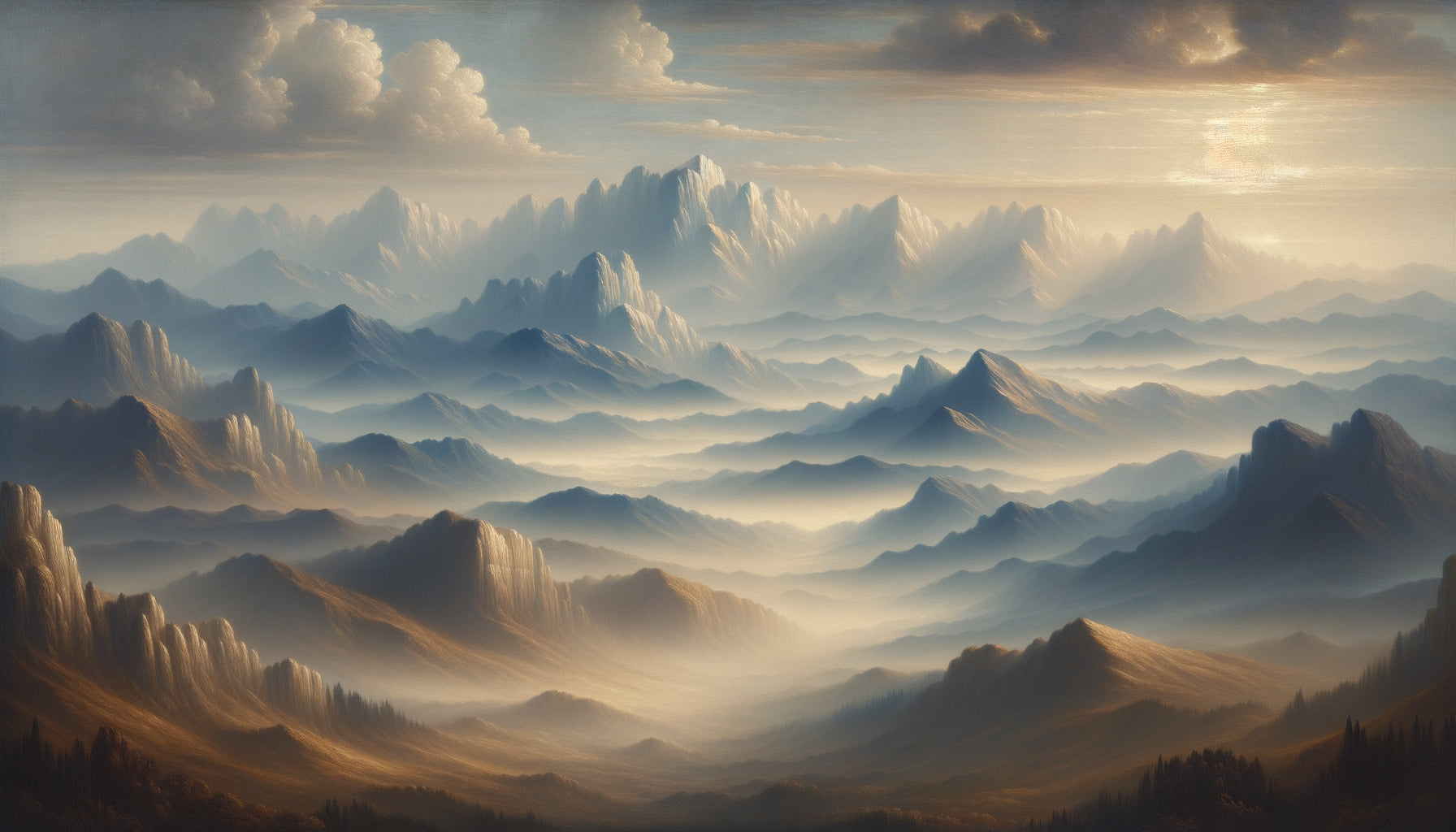
This is the pivotal moment, when nature truly becomes itself, without narrative justification. Caspar David Friedrich in Germany paints mystical mists, solitary monks facing infinite horizons, dead trees standing like natural cathedrals. In his work, the landscape is no longer a backdrop but a direct spiritual experience.
William Turner in England dissolves forms into light and color. His tumultuous seascapes, celestial fires herald abstraction. Nature becomes pure sensation, raw emotion transcribed into swirls of pigments. When he has himself tied to the mast of a ship to observe a storm, Turner is not trying to illustrate a story – he wants to merge with the elements.
In France, the Barbizon School marks a definitive turning point. Théodore Rousseau, Jean-François Millet, Camille Corot settle in the Fontainebleau forest to paint ordinary nature with new fidelity. No more landscapes composed in studios: they want the truth of trees, the modesty of woodland paths, the simplicity of light filtering through foliage.
The invention of the paint tube: a technical revolution
Never underestimate the impact of technological innovation! The invention of the paint tube in 1841 physically frees artists. They can now easily transport their colors, paint outdoors for several hours without their pigments drying out. This small technical revolution accompanies and amplifies the aesthetic revolution.

The Impressionists: the apotheosis of nature for itself
With Claude Monet, the loop is closed. His series – water lilies, haystacks, Rouen Cathedral – tell no story. They capture atmospheric states, luminous vibrations, fleeting moments. Nature is no longer a subject among others: it becomes the laboratory where the artist studies perception, time, light.
Pissarro paints his orchards, Sisley his rivers, Cézanne his Mont Sainte-Victoire with an obstinacy that borders on meditation. Nature becomes an end in itself, a space to explore the infinite possibilities of painting. No more need for mythological or religious pretext: a field of poppies is enough to justify a masterpiece.
This revolution also reflects social transformations. Rapid industrialization and massive urbanization create a new nostalgia for natural spaces. Landscapes become imaginary refuges for a city-dwelling bourgeoisie discovering leisure and tourism. Artists no longer only paint what they see: they paint what their contemporaries dream of seeing.
Want to extend this story to your home?
Discover our exclusive collection of landscape paintings that captures the essence of this artistic revolution – works where nature expresses itself in all its splendor, without artifice.
What this evolution tells us today
This long march towards nature for its own sake is not just a historical curiosity. It reveals how our view of the environment has profoundly changed. When we choose a landscape for our living room today, we inherit five centuries of artistic and philosophical evolution.
A contemporary landscape in your interior is not simply decoration. It's a window into this tradition where artists have gradually given nature the dignity it deserves. It’s a reminder that the beauty of the natural world is sufficient unto itself, without human narration to justify it.
Each era has had its own way of painting nature: idealized in the Dutch style, sublime in the Romantics, fragmented in the Impressionists. Today, we can choose the approach that resonates with our sensitivity, knowing that behind each landscape lies this fundamental question: how do we look at the world around us?
This revolution also invites us to slow down. In a world saturated with images and stimulation, a landscape reminds us of the value of pure contemplation. Looking at a tree for its beauty alone, observing variations in light on a mountain, immersing oneself in the movement of waves – these experiences that artists have dignified remain valuable antidotes to our frenetic era.
Your next look
The next time you admire a landscape – on a wall or through your window – remember this conquest. Nature has not always been entitled to this attention. Generations of artists have had to fight against conventions to establish that yes, a sunset, a forest, a river deserved to be painted for their intrinsic beauty alone. The gaze we naturally cast on the environment today is a precious heritage, built patiently over the centuries.
Frequently Asked Questions
Why wasn't nature considered a worthy subject before the 16th century?
The answer lies in the very function of art in pre-modern societies. Painting primarily served religious, political, or commemorative purposes. Patrons – the Church, monarchy, aristocracy – paid for works that told sacred stories, glorified important figures, or conveyed moral messages. Nature alone did not fulfill any of these functions. It lacked sufficient narrative value. Moreover, medieval and Renaissance philosophy placed man at the center of divine creation: painting nature without human or divine presence seemed almost devoid of meaning. It was only with the emergence of a bourgeois class less dependent on aristocratic codes, and with philosophical evolution towards an intrinsic appreciation of nature, that pure landscape could establish itself as a legitimate genre.
Which country really launched the trend of pure landscapes in the 17th century?
The Netherlands are undoubtedly the pioneers of landscape as an autonomous genre. This primacy is explained by unique economic, social and cultural factors. The Dutch Republic of the 17th century, rich from its maritime trade, developed a numerous bourgeoisie who wanted to decorate their homes with scenes reflecting their daily life rather than monumental religious paintings. The Protestant Reformation also limited the commissioning of religious art. The Dutch, proud of their territory reclaimed from the sea, also developed an attachment to their characteristic landscapes: windmills, canals, cloudy skies, meadows. Finally, professional specialization emerged: some painters focused exclusively on marine paintings, others on winter landscapes, creating a sophisticated market for these genres. This unique combination makes the Netherlands the cradle of modern landscape.
How to choose a landscape for my interior by understanding this history?
Understanding the history of landscape art greatly enriches your decorative choices. First, ask yourself what emotion you are seeking. An idealized landscape in the spirit of the 17th century will bring harmony and classic serenity – perfect for an office or elegant living room. A dramatic romantic landscape, with its stormy skies and sublime compositions, will create a contemplative and intense atmosphere – ideal for a library or space for reflection. A landscape in the Impressionist style, with its touches of color and fragmented light, will energize a space gently – wonderful for a bedroom or relaxed living area. Also consider scale: panoramic landscapes work beautifully above a sofa or bed, while more intimate views are suitable for smaller spaces. Finally, remember that you are not just buying an image, but inviting a certain way of looking at nature into your daily life, inherited from centuries of artistic evolution.