







Which Panoramic Format Should You Choose for a Large White Wall?
8 min read · by Walensky
FRANCE WALL ART
A bare four-meter white wall that has been staring back at you every morning since you moved in. You've thought about wall art, of course. But the moment you open a catalog, the question changes: it's no longer "which one do I like?" but "what size, what ratio, so it holds visually?"
That's the whole challenge of a large white wall: before choosing a subject or a color, you have to solve a proportion problem. A poorly calculated panoramic format can paradoxically amplify the emptiness it's meant to fill.
The Direct AnswerFor a large white wall, the panoramic wall art should cover 60 to 75% of the wall's width, with a ratio that depends on the ceiling height: 2:1 for a standard ceiling (2.50 m), 3:1 or longer if the ceiling exceeds 2.70 m. A 4 m wall therefore calls for a format between 240 and 300 cm wide, available as 120x40, 180x60 or 225x75 cm depending on the ranges offered.- The artwork's width is calculated first from the wall's width (60 to 75%), not from what you feel like at the moment.
- A 2:1 ratio suits standard ceilings, while 3:1 suits taller spaces or long hallways.
- Furniture (sofa, sideboard) and viewing distance refine the final choice after the basic calculation.
Why Does a Large White Wall Pose a Real Proportion Challenge?
An empty large wall is not just "a big surface to fill." It's a space where the eye looks for an anchor point, and where the lack of a reference creates a sense of drift. The wider the wall, the more a small isolated piece looks lost, almost timid, like a sticky note on a warehouse door.
The classic trap is thinking any large panoramic format will "do the job" simply because it's big. A poorly chosen ratio can create the opposite imbalance: a strip that's too thin and too long, slicing across the wall without inhabiting it, or, conversely, a format that's too compact, leaving disproportionate empty zones on either side.
A large white wall isn't filled, it's composed: the artwork's width must relate to the wall's width, not simply occupy it.
The good news is that this problem can be solved with numbers, not intuition alone. This is where panoramic ratios come into play.
The Most Common Panoramic Ratios and Their Uses
Three ratios dominate panoramic wall decor: 2:1, 3:1, and more rarely 21:9, borrowed from cinema. Each produces a different visual effect on a wall.
2:1 vs. 3:1 vs. 21:9: What Are the Visual Differences?
The 2:1 ratio (twice as wide as it is tall) remains the most versatile: it creates a generous band without becoming a simple line. A format like 120x40 cm or 180x60 cm matches this ratio exactly and fits well above a sofa or sideboard.
The 3:1 ratio stretches the composition further. It suits very wide walls and spaces where you want an almost cinematic panoramic effect, a sense of horizon running from one end of the wall to the other. The 21:9, more extreme still, is inherited from widescreen displays: it requires a particularly long wall to avoid looking squashed.
- 2:1: versatile, ideal for living rooms and dining rooms.
- 3:1: very wide walls, hallways, a pronounced panoramic effect.
- 21:9: exceptional spaces, rarer in standard homes.
How Does Ceiling Height Influence Your Choice of Ratio?
A standard ceiling, around 2.50 m, comfortably accommodates a 2:1 ratio: the band stays in proportion to the room's height. Above 2.70 m, the extra vertical space lets you dare a longer 3:1 ratio without the artwork looking dwarfed by the volume above it.
In a room with a low ceiling, it's better to avoid an overly elongated ratio: it visually accentuates the feeling of a crushing ceiling, the opposite of the intended effect.

Favorite Pick
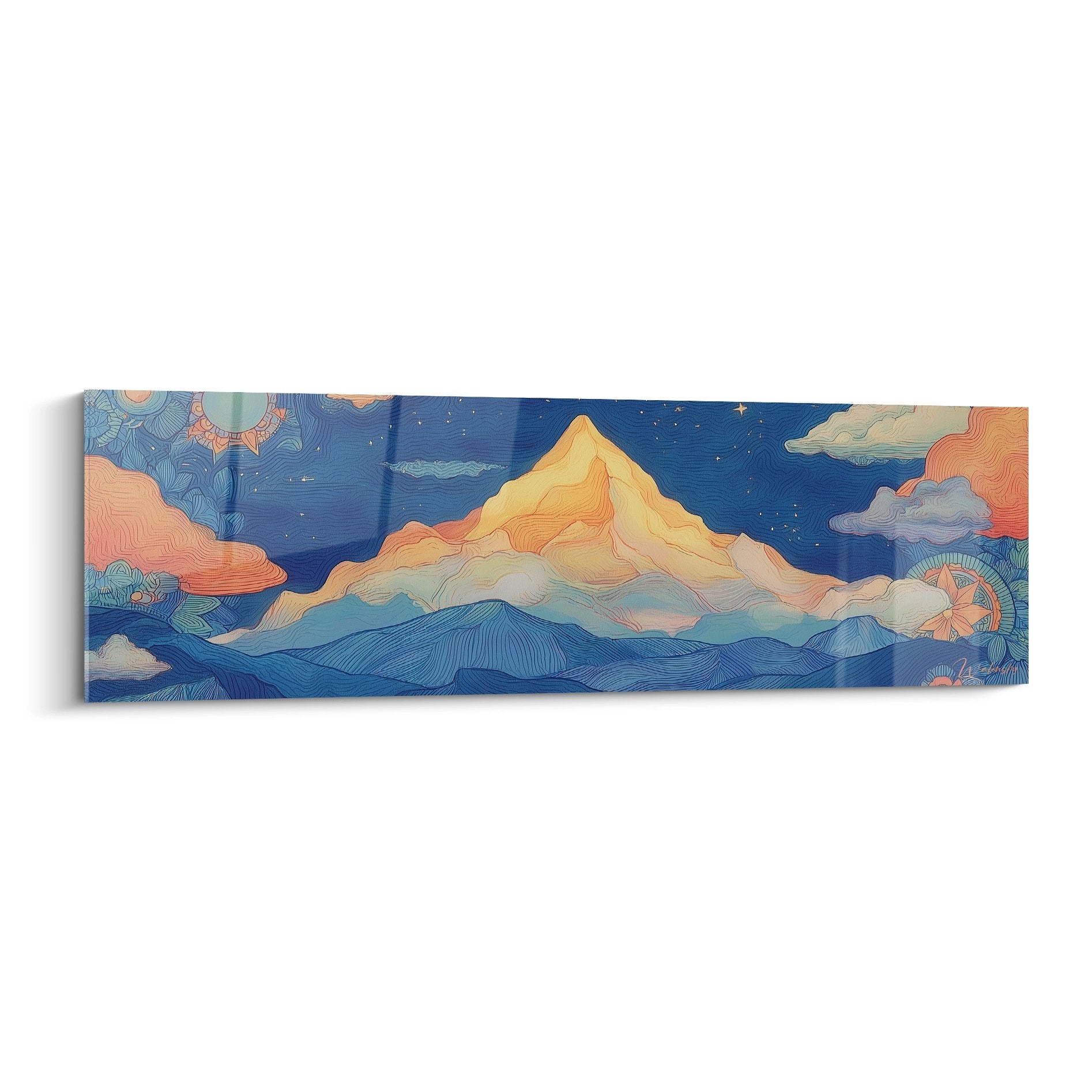
Snow-Covered Mountain Range Panoramic Wall Art in Blue and Ochre - Breath of the Peaks - Saint-Gervais-les-Bains Edition, Auvergne-Rhône-Alpes, France
Starting at €242.90
Discover This ArtworkCalculating the Right Size Based on Your Wall's Width
The most reliable method for sizing a panoramic piece comes down to one simple rule: the artwork's width should represent 60 to 75% of the available wall width, no more.
The Two-Thirds Rule for a White Wall
In practical terms, for a 3-meter-wide wall, the ideal artwork measures between 180 and 225 cm. For a 4-meter wall, aim for 240 to 300 cm. Beyond that, on a 5-meter wall, the range climbs to 300-375 cm, which naturally points toward a custom size.
Calculation Examples for 3 m, 4 m and 5 m Walls
- 3 m wall: aim for a format around 180x60 cm, in a 3:1 ratio.
- 4 m wall: a 225x75 cm in a 3:1 ratio fills the space without overwhelming it.
- 5 m wall: a 255x85 cm, or even a custom size, stays within the right range.
These calculations align exactly with the formats found in today's panoramic ranges, from the L 120x40 cm to the 5XL 255x85 cm, with intermediate sizes (XL, XXL, 3XL, 4XL) that let you fine-tune according to the wall's actual width.
On an Alpine wall like this, in 225x75 cm, a snow-covered mountain landscape creates exactly the kind of horizontal rhythm that structures a large expanse of wall without ever looking randomly placed.
— Our Selection


Factoring Furniture and Viewing Distance into Your Choice
The wall is never alone: there's almost always a sofa, a sideboard, a table below it. And it's often this piece of furniture, not the wall itself, that should dictate the artwork's width.
The standard hanging height places the center of the piece about 1.50 m from the floor, a benchmark that works for most living spaces. Above a sofa, the same proportion logic applies: the artwork should measure between 60 and 75% of the sofa's width, not the entire wall's, if the sofa only occupies part of it.
Viewing distance matters too. In a narrow hallway where you pass within 1 m of the wall, a very wide 3:1 or 21:9 format becomes hard to take in at a glance: the panoramic effect is lost, and you only see fragments. In a living room where you step back 3 or 4 meters, that same panoramic format fully reveals itself.
— You Might Also Like


Recommended Panoramic Formats by Room Type
Each room imposes its own viewing distance and furniture constraints, and therefore its own dominant ratio.
| Room | Recommended Ratio | Suitable Formats |
|---|---|---|
| Living Room | 2:1 or 3:1 | 180x60 cm, 225x75 cm |
| Dining Room | 2:1 | 150x50 cm, 165x55 cm |
| Wide Hallway | 3:1 | 120x40 cm, 180x60 cm |
| Office | 2:1 | 120x40 cm, 150x50 cm |
In a living room with a clear, open wall, a 3XL mountain panorama works particularly well: its width captures the eye as soon as you enter the room. In a hallway, it's better to stick with a more contained format, one that reads clearly even when passing by quickly.
For an interior that embraces monochrome and minimalism, a selection of black and white landscape wall art offers another panoramic ratio option, more graphic and more contrasted, for walls where you want a mood more restrained than natural tones.

Frequently Asked Questions
What Size of Wall Art Works for a Large Wall?
Aim for 60 to 75% of the wall's width or of the furniture beneath the artwork. For a 4 m wall, this gives a format between 240 and 300 cm wide, such as a 225x75 cm or a 255x85 cm depending on the ranges.
At What Height Should You Hang a Panoramic Artwork on a Large Wall?
The center of the piece should sit about 1.50 m from the floor, the standard height that matches eye level when standing. Above a sofa, adjust slightly based on the height of the backrest.
Is One Large Artwork Better Than Several Small Ones on a White Wall?
A single large panoramic format creates a clear focal point and simplifies the composition, especially on a very wide wall where several small pieces risk looking scattered. It's often the safest choice for a white wall without other decorative elements.
Which Panoramic Ratio Should You Choose Based on Wall Length?
The longer the wall, the more a stretched ratio (3:1, or even 21:9) becomes relevant. Under 3 m wide, it's better to stick with a 2:1 ratio, which is more balanced and easier to live with day to day.
Conclusion
The right panoramic format for a large white wall is calculated before being chosen aesthetically. Wall width, ceiling height, furniture, viewing distance: once these figures are settled, all that's left is choosing the subject you love, in the right ratio.
To go further with calculations based on your wall's exact length, our guide on choosing a panoramic format by wall length covers more specific cases. And for a white wall still searching for its subject, our article on the daffodil panoramic wall art may inspire you. Once you have your measurements, head to the panoramic wall art collection to move from calculation to final choice.
Explore Our Collections


