

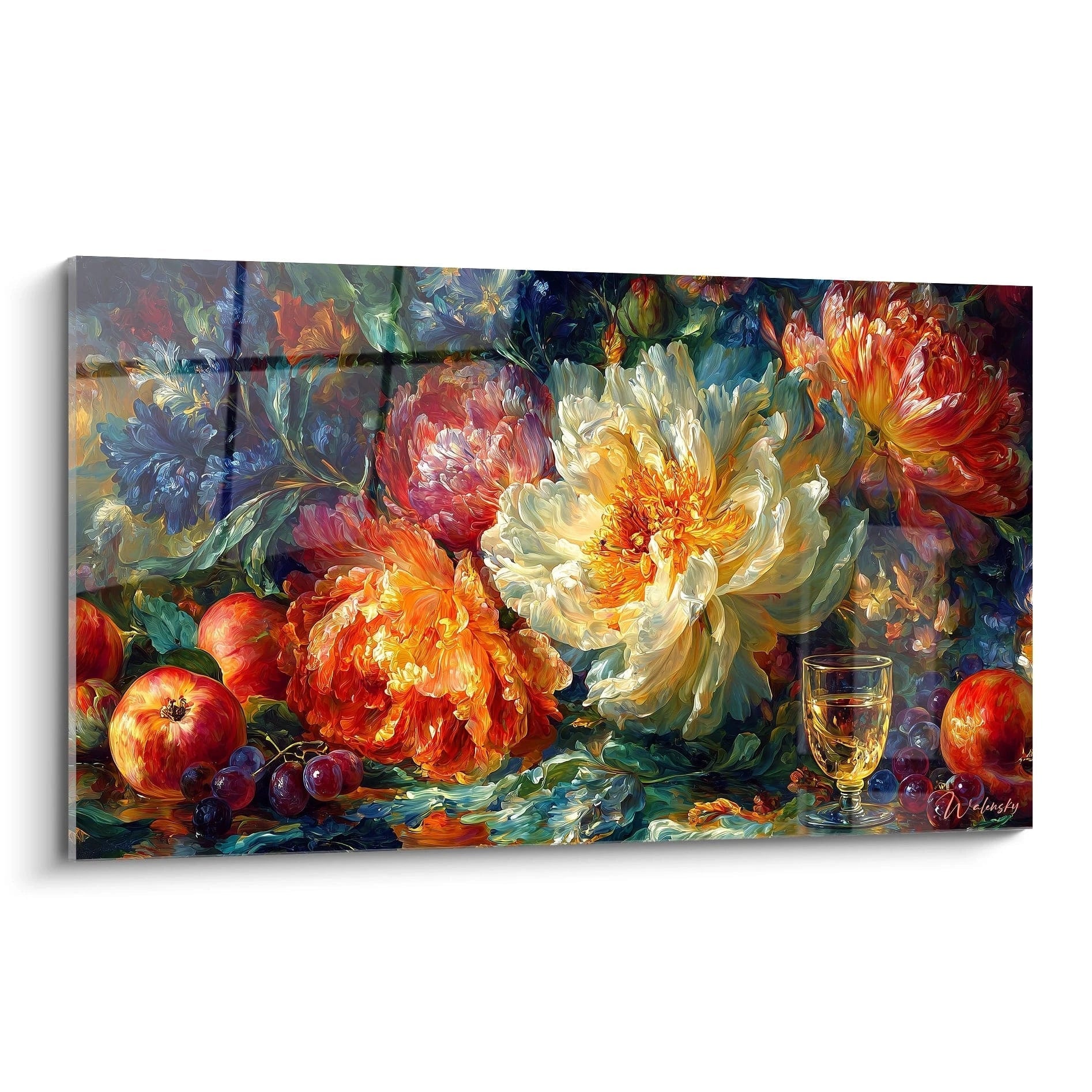






Which panoramic format should you choose based on your wall length?
8 min read · by Walensky
WALL ART MOUNTING HARDWARE
A tape measure, a bare wall, and that question that always comes back: too big, and it overwhelms. Too small, and it floats, lost like a stamp on an envelope. Somewhere in between lies a simple, almost mathematical formula that spares you from relying on chance or an impulsive crush.
The direct answerFor a clear wall, the ideal width of a panoramic artwork is 60 to 75% of the wall's total width. A 3 m (300 cm) wall therefore calls for an artwork 180 to 225 cm wide, and a 4 m wall for one 240 to 300 cm wide. For walls under 2.5 m, it's better to go with an L (120x40 cm) or XL (150x50 cm) format rather than aiming too wide.- The basic rule: the artwork should occupy 60 to 75% of the wall's width, no more, no less.
- A wall cluttered with furniture calls for a tighter ratio, around 50%.
- Beyond 4.5 to 5 m, two panoramic artworks side by side often work better than one giant format.
Why does wall length (almost) determine everything?
The room type is the excuse we give ourselves to justify a choice already made. In reality, a living room 3.20 m wide and an entryway 3.20 m wide call for exactly the same calculation. It's not the wall's function that matters, it's its dimensions.
The classic trap is thinking "living space = large format" and "hallway = small format" without ever pulling out the tape measure. The result: an artwork that's too timid in a generous living room, or an oversized format that nearly bumps into the light switches in a hallway. The wall-to-artwork proportion works everywhere, regardless of the label attached to the room.
A panoramic artwork doesn't decorate a wall, it complements it. And a poorly dosed complement is as noticeable as a missing one.
The proportion rule for calculating the ideal format
The formula fits in one sentence: measure the wall's width, multiply by 0.6 and by 0.75, and you get a range of artwork widths to aim for.
The 2/3 rule for a clear wall
On a wall with no furniture in front, no door or window eating into the space, aim for two-thirds of the available width. It's the most comfortable ratio to the eye: generous enough to hold its own, measured enough to let the wall breathe on either side.
The 1/2 rule for a wall with furniture or passageways
If a sideboard, a sofa, or a doorway reduces the area actually visible, drop back to around 50%. A slightly more modest artwork, well centered on the free space, is better than an imposing format that visually spills onto a piece of furniture.

Our selection
White and Terracotta Daisies Wall Art with Dark Green Crisscrossed Stems - Stretched Panoramic Crop - Daisy Edition
From €242.90
Discover this artworkNumerical examples for different wall lengths
Nothing beats a table of numbers to stop going around in circles with the tape measure in hand.
| Wall length | Recommended width (60-75%) | Closest format in store |
|---|---|---|
| 2 à 2,5 m | 120 to 180 cm | L (120x40 cm) or XL (150x50 cm) |
| 2,5 à 3 m | 150 to 225 cm | XL to 3XL (150x50 to 180x60 cm) |
| 3 à 4 m | 180 to 300 cm | 3XL to 4XL (180x60 to 225x75 cm), or custom size |
| 4 m and more | 240 to 375 cm | 4XL, 5XL (225x75 to 255x85 cm), or custom size up to 2.82 m² |
Wall of 2 to 3 meters
This is the most common setup in apartments: a compact living room, an entryway hallway, a dining room wall between two doors — or even a panoramic artwork for a modern kitchen. An L (120x40 cm) or XL (150x50 cm) format is more than enough to fill the space without overwhelming it.
Wall of 3 to 4 meters
Now we're in the territory of generous living room or dining room walls. The 3XL (180x60 cm) and 4XL (225x75 cm) formats make the most sense here, especially above a sofa or a low sideboard.
Wall of more than 4 meters
Beyond that, custom sizing becomes relevant, with surfaces reaching up to 2.82 m². But before aiming for one immense single format, ask yourself this: one artwork, or several?
On a wall of this scale, a mountain landscape artwork in a very large format already captures attention on its own, with its mountains and valley stretching across the full width. Conversely, a more contemporary room will prefer the golden curves of the bronze blue and beige undulations panoramic artwork, whose bronze blue waves work just as well in 4XL as in a custom version.
— Also worth discovering


One panoramic artwork or several panels?
Beyond 4.5 to 5 meters, a single panoramic artwork, even in a very large format, starts to pose a concrete problem: weight, handling, and sometimes the physical impossibility of printing a piece that wide in one piece. This is where two artworks side by side gain the advantage.
It's rather a matter of placing two distinct panoramic works next to each other, in the same palette or the same spirit, to fill the whole wall with visual breathing room between them.
Two artworks of the same height, spaced 10 to 15 cm apart, create a more natural sense of continuity than a single oversized format hung alone in the center of an overly long wall.
A floral duo works particularly well on this principle: the coral and lilac dahlias on mint background artwork and the white and cream dahlias in a tight row artwork share the same botanical family with slightly different tones, coral on one side, creamy white on the other. The effect evokes a series rather than simply filling a wall.
Common mistakes to avoid when calculating the format
Undersizing is the most common mistake. We're afraid of "taking up too much space," and we end up with an artwork that seems to float, lost in the vastness of the wall.
- Forgetting the ceiling height: a high ceiling visually overwhelms a format that is too low; in that case, favor the largest formats in the calculated range.
- Ignoring floor furniture: a sideboard, a console, or a sofa reduces the wall width actually perceived, not just its physical width.
- Neglecting the hanging height: the center of the artwork should stay close to eye level, around 1.50 m from the floor, regardless of the width format chosen.
- Insisting on centering at all costs: on an asymmetrical wall (a door on one side, a corner on the other), it's better to center on the free area than on the entire wall.
Before validating, also consider the mounting surface. Acrylic glass reflects light slightly and suits a room where lighting is controlled; Alu Dibond, matte and glare-free, is better suited in front of a window or in full natural light, which matters double on a wide panoramic format where reflections are more noticeable. Also note that the photo resolution required for a panoramic print on glass increases with width: it's best to check this before validating your file.

In the same spirit
White and Gray Backlit Tulips Wall Art, Panoramic - Row of Slender Stems - Tulip Edition
From €242.90
Discover this artwork →Frequently asked questions
What is the ideal artwork size for a 3-meter wall?
Between 180 and 225 cm wide, meaning a 3XL format (180x60 cm) in the standard range. If the wall is cluttered with furniture, drop back to around 150 cm (XL format).
How do you calculate the right artwork size relative to a sofa or a piece of furniture?
The logic is the same as with a wall: aim for 60 to 75% of the width of the furniture placed beneath the artwork, sofa or sideboard, rather than the width of the entire wall.
Is it better to have one large artwork or several smaller ones on a long wall?
Beyond 4.5 to 5 m, two panoramic artworks placed side by side often look better visually than a single isolated XXL format, especially if the wall spans several zones of use (a dining area and a living area, for example).
What is the ideal height for hanging a panoramic artwork?
The center of the artwork is placed around 1.50 m from the floor, a standard reference for an adult's eye level while standing. This height adjusts slightly if the artwork is hung above a low piece of furniture, in which case leave 15 to 20 cm between the furniture and the bottom of the frame.
Measuring before buying isn't a constraint, it's the guarantee that you'll never relive the scene of the too-small artwork glaring from the wall. Once the calculation is done, all that's left is to find the panoramic format on the shop that exactly matches your width, whether it's a hallway or a generous living room. To go further, our ratio-based method for a narrow hallway details the same calculation applied to the most constrained spaces, and our article on panoramic artworks suited to long studio walls rounds out the reflection for large open volumes. Once the artwork is hung, one final step remains: learning to fix it without damaging it, which is covered in our guide to hanging a panoramic artwork without nails on acrylic glass.
Explore our collections


