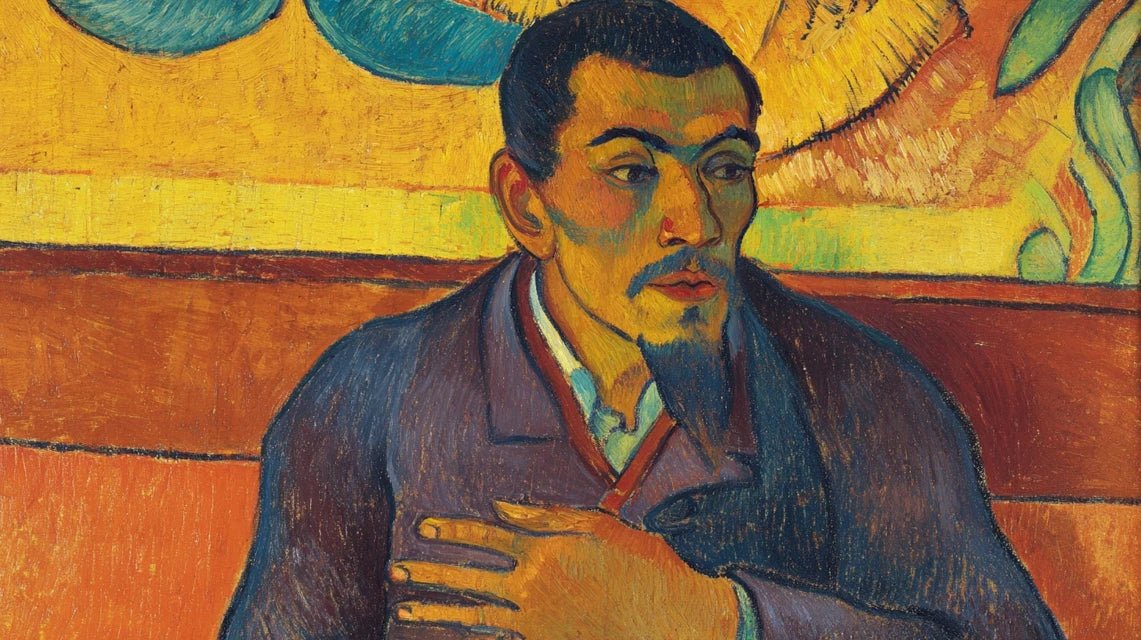
Imagine a Parisian banker who abandons everything - family, career, security - to go paint in the tropics. Paul Gauguin embodies this thirst for absoluteness that drives the artist to seek truth at the end of the world, far from Parisian salons and bourgeois conventions.
In the Marquesas Islands, facing the Pacific Ocean, this 55-year-old man completes his last canvas, exhausted but faithful to his quest for a primitive and authentic art. His brush trembles, but his vision remains intact: to revolutionize painting by rediscovering the very essence of art.
Why does a seemingly established man renounce everything to follow an artistic dream? How does this father become one of the pioneers of modern art? Gauguin's story goes beyond a simple biography: it is the tale of a radical transformation that still shakes our vision of art.
Discover the fascinating journey of Paul Gauguin, from his beginnings as a bourgeois collector to his metamorphosis into a revolutionary painter - an artistic escape that redefines modern beauty
Paul Gauguin : the banker who became a revolutionary of pure color
Knowing the true story of Paul Gauguin helps to understand how an artistic revolution is born. Far from the romantic image of the bohemian painter, Gauguin reveals that one can discover his vocation at 35 years old and shake up Western art in a few decades.
| Biographical highlights | Artistic legacy |
|---|---|
|
Full name : Eugène Henri Paul Gauguin Birth date : June 7, 1848, Paris Death date : May 8, 1903, Atuona (Marquesas Islands) Nationality : French |
Movement : Post-Impressionism, Synthetism Style : Cloisonnism, non-naturalistic pure colors Key work : "Where Do We Come From? What Are We? Where Are We Going?" Innovation : Decorative synthesis and modern primitivism |
This unique trajectory leads us from Parisian exchange offices to the beaches of Tahiti, revealing how a man can reinvent his life and transform the art of his time.
Paul Gauguin as a child : between Parisian bourgeoisie and Peruvian exoticism
The childhood of Paul Gauguin is divided between two worlds: the Parisian bourgeoisie of his journalist father and the South American exoticism of his maternal grandmother Flora Tristan, a socialist activist and writer. This duality shapes his personality as an eternal escapist.
The artistic awakening in Lima: At 3 years old, Paul accompanies his mother to Peru after the death of his father. In the family home in Lima, surrounded by colonial art and Inca textiles, the little boy discovers colors and shapes that will mark his retina forever.
The collector's awakening: Settled as a stockbroker in Paris in 1871, Gauguin discovers contemporary art and begins to collect Impressionist works - already revealing his exceptional artistic eye.
Paul Gauguin and the artistic effervescence of fin-de-siècle Paris
The years 1870-1880 see the birth of modern art in Paris. Impressionism revolutionizes the representation of light, while the industrial revolution transforms French society. Gauguin evolves within this exceptional creative effervescence.
At the Guerbois café and then at the Nouvelle-Athènes, he rubs shoulders with Manet, Renoir, Monet and discovers a new way of conceiving painting. Art must no longer simply imitate reality but express the artist's sensations.
His contemporaries Cézanne, Van Gogh and Toulouse-Lautrec are also seeking to go beyond Impressionism. But Gauguin stands out for his quest for a "synthetic" art that simplifies forms and purifies colors.
The Exposition universelle of 1889 reveals Japanese art and primitive arts to Paris. This discovery confirms Gauguin's conviction that Western art must regenerate through contact with "primitive" cultures.
Gauguin's innovation: Unlike his contemporaries who modernize pictorial technique, Gauguin revolutionizes the very conception of art by seeking the spiritual essence rather than the physical appearance of the world.
Paul Gauguin facing failure: from the stock market crash to artistic vocation
In 1882, the stock market crash ruins Gauguin's financial career. At 34 years old, father of five children, he must choose between family security and his nascent passion for painting. His decision upsets his life.
Mette-Sophie Gad, his Danish wife, doesn’t understand this late career change. Arguments escalate as Paul's paintings fail to find buyers. The family sinks into financial hardship, forcing Mette to move with the children to Denmark.
In 1884, Gauguin joins her in Copenhagen to try and sell tarpaulins as a representative. The humiliation is total: the former Parisian banker fails at selling waxed canvas. But this ordeal strengthens his artistic determination.
Returning to Paris in 1885 with his son Clovis, Gauguin lives in extreme poverty. He sticks up posters to survive while painting relentlessly. This period of "Purgatory" forges his uncompromising artist's character.
These trials reveal the strength of character necessary to transform personal failure into a major artistic revolution.
Paul Gauguin scandalizes Paris: primitivism and artistic provocation
From 1886, Gauguin's paintings shock with their assumed anti-naturalism. His "wild" colors - vermilion red, chrome yellow, ultramarine blue - applied in pure blocks scandalize art lovers accustomed to Impressionist realism.
The Exposition des XX in 1889 in Brussels causes a stir. His painting "The Vision after the Sermon" depicts Breton women praying with a pure red, unrealistic background. Parisian critics denounce this "coloristic barbarism".
Gauguin fully embraces his aesthetic choices. For him, art must express the "spiritual essence" rather than superficial appearance. He advocates a return to the "primitive" sources of art, far from decadent Western sophistication.
The break with Impressionism: "Don't copy too much from nature. Art is an abstraction, draw it from nature while dreaming in front of it" - this sentence summarizes his revolutionary philosophy which still influences contemporary art.
These controversies establish Gauguin as the leader of post-Impressionism, a movement that engenders modern 20th century art.
Far from discouraging him, the incomprehension of the Parisian public pushes Gauguin towards even more radical horizons.
Paul Gauguin invents Synthetism: Pont-Aven and the Breton revolution
In 1886, Gauguin discovers Pont-Aven in Brittany. This artists' village offers him an ideal living and experimentation environment. It is here that he develops his theory of "Synthetism" which revolutionizes modern painting.
Surrounded by disciples such as Émile Bernard and Paul Sérusier, Gauguin theorizes his new approach: simplify forms, purify colors, synthesize emotion rather than describe appearance. The Pont-Aven School becomes the laboratory of modern art.
"The Vision After the Sermon" 1888: A Manifestation of Gauguin's Synthetism
This revolutionary work depicts women in traditional Breton costumes witnessing the vision of Jacob wrestling with the angel. The pure vermilion red background breaks away from all realistic logic to express the spiritual intensity of the scene.
Gauguin applies his technique of "cloisonnism": outlining shapes with black lines as in Breton folk art or Japanese prints. This decorative simplification foreshadows 20th-century art.
Revolutionary Techniques of Paul Gauguin: Cloisonnism and Arbitrary Color
Gauguin abandons traditional perspective and the Impressionist color modulation. He applies color in flat areas delimited by borders, creating a decorative effect inspired by Gothic stained glass windows and folk art.
Paul Gauguin Facing Van Gogh and Cézanne: Three Post-Impressionist Visions
Unlike Van Gogh, who expresses emotion through gesture, or Cézanne, who reconstructs reality through geometry, Gauguin favors decorative synthesis and spiritual evocation.
His disastrous stay with Van Gogh in Arles in 1888 reveals two incompatible artistic temperaments: Dutch expressionism versus French synthetism.
OUR RECOMMENDED PRODUCTS
This aesthetic revolution prepares Gauguin's definitive escape to the southern seas, where he pushes his quest for authenticity to its ultimate consequences.
Paul Gauguin, The Man: Between Solitude and Quest for the Absolute
Gauguin's personality reveals a man proud and uncompromising, incapable of artistic compromises. His egocentrism leads him to sacrifice his family to his art, a painful choice that nourishes his creation but isolates the man.
His correspondence with his wife Mette reveals a man tormented by guilt but unable to renounce his vocation. "I am a great artist and I know it," he writes, assuming his megalomania as a condition of his genius.
In Brittany and then in Polynesia, Gauguin seeks a primitive authenticity that he projects onto the local populations. This Orientalist vision reveals his contradictions: fleeing Western civilization while remaining deeply European.
This obsessive quest for a lost paradise permeates every canvas, giving his art that nostalgic and prophetic dimension which fascinates us still today.
Paul Gauguin and Posthumous Glory: From Misunderstanding to Commercial Triumph
Recognition of Gauguin's work came after his death. During his lifetime, he sold virtually no paintings and survived thanks to sporadic money transfers from friends like Daniel de Monfreid. His first personal exhibition in 1893 at Durand-Ruel’s was a commercial failure.
The turning point came with the 1906 retrospective at the Salon d'Automne, three years after his death. The Fauves - Matisse, Derain, Vlaminck - recognized him as their precursor and popularized his aesthetic.
Value of Paul Gauguin’s works: from oblivion to world records
His price evolution perfectly illustrates the gap between artistic genius and contemporary recognition. Today, his paintings are among the most expensive on the global art market.
| Period | Average value | Record sale |
|---|---|---|
| 1880-1903 (living) | 50-200 francs | 500 francs ("Nevermore", 1897) |
| 1920-1980 | 10,000-100,000 dollars | 1.4 million dollars (1957) |
| 2000-2024 | 5-50 million dollars | 300 million dollars ("When Will You Marry?”, 2015) |
This surge in prices confirms Gauguin's historical importance as a precursor of modern art and spiritual father of contemporary art.
Paul Gauguin and his death in 1903: testament of a revolutionary
In his house in Atuona on the Marquesas Islands, Gauguin continued to paint until the end. His last major work, "Tales of the Barbarians” (1902), synthesizes twenty years of research into primitive art and pure color.
He died on May 8, 1903, at 54 years old, exhausted by illness and isolation. His last words were reportedly: "Am I going to sleep?" - a metaphysical question that sums up his spiritual quest through art.
Influence of Paul Gauguin on contemporary art: Fauvism and Expressionism
Gauguin's legacy permeates all of 20th-century art. The Fauves adopt his pure color, German expressionists his formal simplification, the Nabis his decorative conception of painting.
Picasso acknowledges his debt to Gauguin in his "primitivist” period of the "Demoiselles d'Avignon” (1907). Contemporary art continues to explore his innovations: neo-expressionism, bad painting, postmodern primitivism.
Recognizing the Gauguin legacy: Look for arbitrary, non-naturalistic color, extremely simplified forms, “primitive” inspiration and a spiritual dimension - hallmarks of his persistent influence.
Collections of Paul Gauguin: must-see museums and visiting tips
Paul Gauguin’s masterpieces can be discovered at the Musée d'Orsay (Brittany period), the MoMA in New York (Synthetism), and the Hermitage Museum in Saint Petersburg (Tahitian period). The Gauguin Museum in Pont-Aven offers an intimate look at his artistic revolution.
This worldwide distribution confirms Gauguin’s universal status as a bridge between Western art and world cultures.
🎁 Special offer for readers
Because you took the time to inform yourself, enjoy 10% discount on your first order:
⏰ Valid 72h after reading • Applicable to all our products
Frequently asked questions about Paul Gauguin, post-impressionist painter
Paul Gauguin (1848-1903) was a Parisian stockbroker who discovered painting at the age of 35 after the stock market crash of 1882. Passionate about Impressionist art since the beginning of his professional career, he chose to become a painter despite his family responsibilities. This late career change explains his creative urgency and determination to revolutionize the art of his time.
A self-taught artist, Gauguin learned by frequenting Parisian Impressionists from 1870 and collecting their works. He developed his technique through the School of Pont-Aven in Brittany (1886-1894) where he theorized Synthetism with Émile Bernard. His revolutionary approach is born from this freedom from traditional academic codes.
Cloisonnism consists of outlining shapes with black lines as in popular art, while Synthetism simplifies reality into decorative forms and pure colors. Gauguin revolutionizes painting by prioritizing spiritual expression over natural imitation, a technique that directly influences the Fauves and 20th-century modern art.
Recognition comes after his death in 1903. The retrospective exhibition of 1906 at the Salon d'Automne reveals his importance to the Fauves who recognize him as a precursor. In the 1920s, Surrealists and primitivists definitively consecrate his status as a revolutionary of modern art.
Major Gauguin works reach $50 to 300 million for masterpieces ("When Will You Marry?" sold for $300 million in 2015). Secondary canvases are negotiated between $5 and $50 million. This exceptional valuation reflects his status as a precursor of modern art and the scarcity of his works on the market.
Paul Gauguin today: the eternal modern who still inspires us
A century after his disappearance, Paul Gauguin fascinates with his courage of breaking away35 years old
His artistic message - prioritize authenticityemotionuniversal
Discovering Gauguin means understanding that art can transform a life and that a personal vision can revolutionize the beauty of the world. His voluntary escape
Gauguin inspiration for your daily life: