


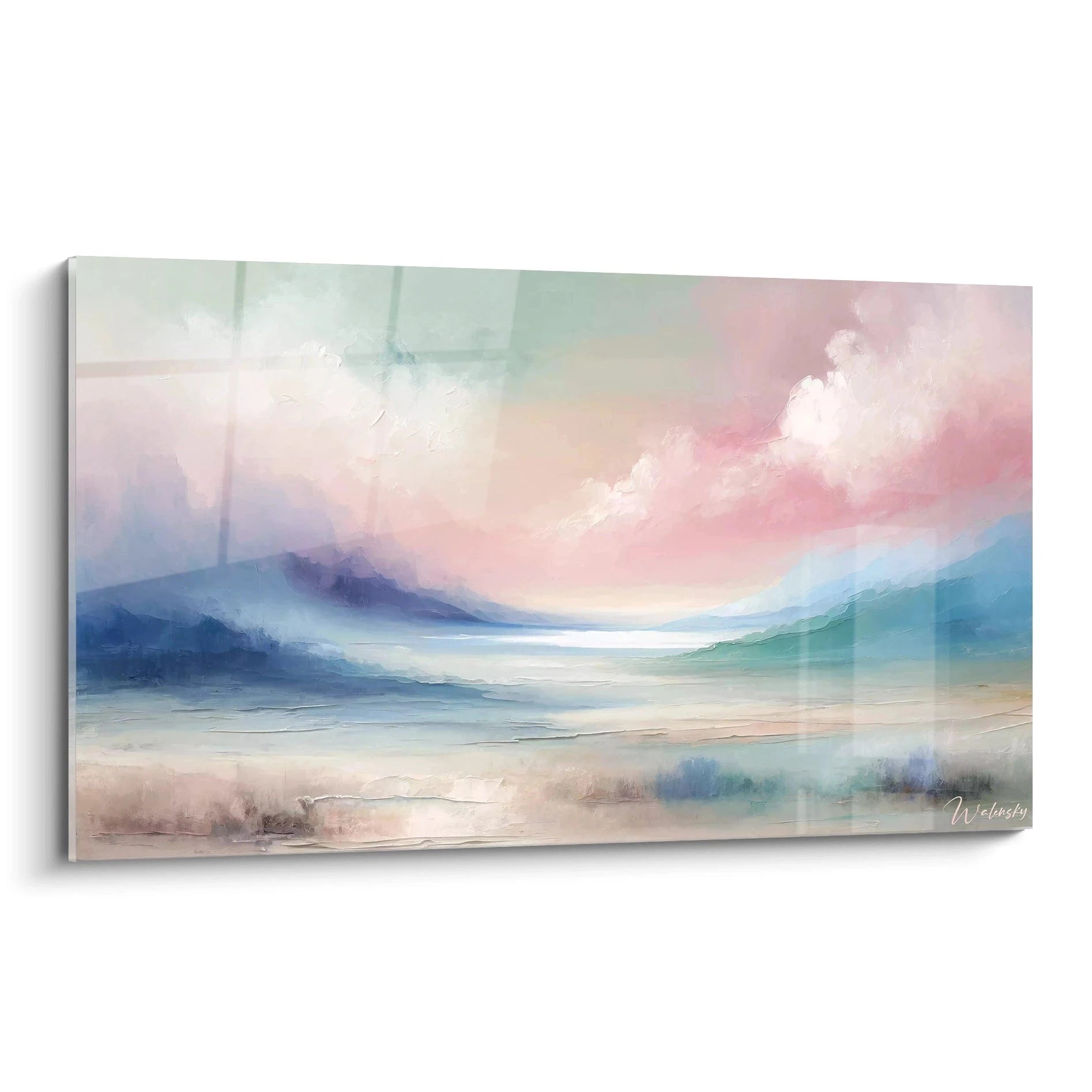

Textured painting: how to create relief on the wall
11 October 2025 · 18 min read · by Walensky
You've just moved into your new living room and you're staring at that sad, blank wall wondering how to give it character. You've scrolled through Pinterest for hours, visited three decor stores, but nothing really excites you.
You can already imagine your guests entering the room and instantly noticing that wall art piece that completely transforms the atmosphere. You dream of that feeling of pride when they ask you "Where did you find that magnificent painting?"
But you've already tried framed posters (too flat), printed canvases (without relief), even an expensive oil painting (that doesn't really reflect your personality). The result? Still that impression that your decor lacks depth and intensity.
It’s perfectly normal! The problem doesn’t come from your artistic taste, but from the fact that you haven't yet discovered the secret of acrylic paintings - textured - these artworks that capture the light and create that sought-after tactile dimension.
By the end of this article, you will know exactly why textured acrylic paint transforms any wall into a true art gallery, and how to choose the work that will reveal the unique personality of your interior.
Why your wall deserves more than just a flat canvas?
Imagine two people entering your living room. The first barely notices your wall decor - their gaze simply slides over it. The second instinctively approaches, drawn by that subtle relief that catches the light and creates fascinating plays of shadows. It's like the difference between looking at a picture of mountains and standing face to face with the Alps: one informs, the other moves and marks the memory.
🎨 Customer testimonial: "I hesitated for a long time between a reproduction of classic art and a textured acrylic painting . Finally, when I saw how the texture captured the light differently depending on the time of day, literally transforming the atmosphere of my room, I realized I had found my decor crush."
Conversation with a decor expert
The golden rule of textured wall art: The more relief and texture a work has, the more it dialogues with its environment and creates that visual depth that instantly transforms the atmosphere of a room. Within 24 hours only, your guests will notice this striking difference.

Our selection
Painting multicolored acrylic canvas - Chromatic Radiance - abstract painting style edition
233.90€
Discover this paintingWhat’s Really Hiding Behind Your Décor Frustration
Do you recognize yourself? You spend hours in stores without ever finding THE artwork that moves you. You finally buy something "that will do the trick", but once hung, you feel that underlying disappointment : your wall remains dull, lacking personality. Your living room looks like all the others.
What you feel has nothing to do with your artistic sense. The real problem? 95% of wall art sold in stores is flat, without relief or texture. Your eye instinctively seeks that tactile dimension that makes a work of art come alive, but never finds it.
It's like choosing between a velvet photo and touching real velvet. Your brain needs this sensory richness to create an emotional connection with art.
First Hidden Cause: The Illusion of "Easy Décor"
You’ve been led to believe that choosing and integrating a beautiful painting is necessarily complicated. As a result? You resort to "safe" solutions - these soulless reproductions that transform your living room into a stylish waiting room. But true elegance is exactly the opposite: daring to choose a piece with character.
Think about your favorite restaurant. What marks you, it’s not the white walls and generic frames, but that unique artwork that gives the place its character, isn't it?
This fear of "making a mistake" deprives you of the emotion that comes from a true artistic crush. Your approach will radically change when you understand that a textured painting naturally adapts to its environment.
✨ Instant Test: Look around you and identify the object that attracts your gaze the most. I bet it has relief, texture, or reflections. Your brain naturally seeks this visual richness!
Second Hidden Cause: The Myth of "Art That Goes Out of Style"
Many believe that investing in an artistically "marked" painting is taking the risk of getting tired of it. This is a misunderstanding of the magic of acrylic texture : the more you look at it, the more subtleties it reveals according to the light, the angle, the time of day.
A textured work of art is like a fireplace: you never get tired of it because it constantly evolves before your eyes. The interplay of light and shadow creates a spectacle that is always renewed.
Instead of fearing boredom, you will discover the joy of rediscovering your own decor at every moment of the day. Your guests will notice this visual richness that is not revealed at first glance.
Third Hidden Cause: Ignorance of the Psychological Impact
Few people realize how much texture influences our well-being in a space. A smooth, uniform surface sends a "clinical" signal to our brain. Conversely, the tactile richness of a textured acrylic creates a feeling of welcome and warmth.
Observe your gestures when you are in a place you like: you instinctively touch the materials, you seek that sensory connection. Your living room deserves the same invitation to touch visually.
This neglect of the tactile dimension explains why so many interiors seem "cold" despite expensive furniture. Texture transforms the atmosphere more effectively than any decorative accessory.
🎯 3 Signs Your Wall Needs Texture:
- The gaze that flees: Your guests look at your painting for 2 seconds then look away - a sign of a lack of visual depth
- The lighting that doesn't "take": Even with beautiful lighting, your wall remains dull - it lacks the material that catches the light
- The feeling of incompleteness: No matter how many accessories you add, your room lacks character - a textured focal point would create that missing unity
The trigger element: understanding art as a sensory experience
What really transforms an amateur into a connoisseur is this revelation: art is not just looked at, it is felt. The acrylic texture creates that extra dimension that takes your decoration from "pretty" to "memorable". It's the domino effect that transforms your entire relationship with your interior: you go from "I live here" to "I love living here".
The 5-second rule: A textured artwork captures attention 5 times longer than a flat surface. Test it by observing the reactions of your loved ones to different types of wall art.
| ❌ Misconception about wall art | ✅ Reality of textured acrylic | 💡 Why this changes everything | 🎯 Concrete benefit |
|---|---|---|---|
| "The more expensive it is, the more beautiful it is" | Beauty comes from the emotion created, not the price | Texture multiplies the visual impact | Gallery effect for the price of a painting |
| "You have to match at all costs" | Subtle contrast creates sophistication | Material games naturally unify | Decoration that evolves with your changes |
| "Modern art is too risky" | Texture reassures and humanizes contemporary art | Relief makes the abstract accessible | Passionate conversations with your guests |
| "A painting quickly goes out of style" | The material reveals new facets every day | The eye constantly discovers new details | Investment that improves with time |
— Also to discover


How to transform your wall into a real art gallery
Rest assured, creating this "contemporary gallery" impact at home is much simpler than you might think. It's like learning to make excellent coffee: once you know the right ingredients and their order, the result becomes reproducible. By following this 3-step method, you will go from "I wish I had" to "this is exactly what I wanted" in a few strategic decisions.
🗺️ Your artistic roadmap: First analyze your space to identify the ideal focal point, then choose the texture that dialogues with your natural light, finally harmonize the whole to create that sophisticated coherence. Each step reinforces the next, like the foundations, walls and roof of a house.
Step 1: Decode your space to reveal its potential
Start by understanding your room, it's like reading the terrain before planting a garden. Your wall already has a hidden personality that just needs to be revealed. This analysis will avoid you 90% of common mistakes and will give you that confidence that makes all the difference in your decor choices.
What you need to identify in your space
- The main light source: Observe where the natural light comes from and how it evolves throughout the day. It is this light that will reveal the texture of your future painting. Avoid the classic mistake of choosing a "decorative" location that ignores natural lighting - texture without light is a diamond in the dark.
- Existing dominant colors: Identify the 2-3 main shades of your furniture and textiles. These are not the colors you need to reproduce, but those that will create a harmonious contrast. A very light room will call for deeper tones to create that magnetic focal point.
- The scale of your wall: Measure not only the width, but also observe the ceiling height and the free space around. A textured painting has more visual impact than a flat work - you can therefore dare to use a more modest size that still has a strong presence.
Now, let's move on to actively observing your space
Real-time light analysis
Observe your wall at 3 key moments: Photograph your candidate wall in the morning around 9 am, in the middle of the afternoon around 3 pm, and in the evening with artificial lighting. Acrylic texture reveals its magic differently depending on these lighting conditions - this observation will help you visualize the final effect.
⏱️ Time: 15 minutes per day | ✅ Success when: You identify the moment when the light is most flattering on this wall | ⚠️ Attention: Do not neglect artificial lighting - it is often in the evening that you will enjoy your new acquisition the most
The magnetic gaze test: Ask a friend to enter the room and observe where their gaze naturally falls. If it's not on your candidate wall, look for what attracts their attention - that's where your painting will have the most impact.
⏱️ Time: 5 minutes | ✅ Success when: You have identified the "natural focal point" of your room | ⚠️ Attention: Our own gaze gets used to our space - the outside eye reveals the real areas of visual attraction
Measure the desired impact: Temporarily place a colored object (cushion, book) on different possible wall locations. This helps you visualize the effect of a colored focal point before the final purchase.
⏱️ Time: 10 minutes | ✅ Successful when: An emplacement seems obvious and harmonious to you | ⚠️ Attention: A textured artwork will have more presence than your test object - anticipate this amplifying effect
🎯 Step 1 validation: You know precisely where to hang your future artwork, at what time of day it will be most beautiful, and what intensity of color/contrast to look for. If you feel this clarity and eagerness to move on, you are ready to choose your texture!
Step 2: Choosing the texture that reveals your personality
Now that your space has no secrets for you, let's move on to choosing the soul of your future artwork: its texture. This is the most exciting moment because you are going to discover how different materials create totally different atmospheres. This step transforms your approach to wall art: you no longer choose a "pretty drawing", but a daily sensory experience.
Acrylic texture families and their effects
- Light relief texture (subtle impasto): Creates micro-shadows that bring color to life without visually dominating. Perfect for minimalist interiors where you want sophistication without ostentation. Obtainable from a specialized gallery or art studio. Check that the reliefs are irregular (sign of handmade work) rather than uniform (industrial reproduction).
- Thick and sculptural texture: Transforms your wall into a true contemporary bas-relief. The artwork becomes decorative architecture and the absolute focal point of the room. Look for the artist's signature in the material itself - every brushstroke or knife gesture should be visible and intentional.
- Mixed texture (reliefs + smooth surfaces): Combines textured areas and fluid passages for a sophisticated dialogue between material and color. The "light-captured" effect is maximum because the eye constantly travels between different visual sensations.
How to "read" a texture before buying
The lighting test: In a gallery or in a photo, imagine different lighting on the artwork. A true acrylic texture reveals new details under every angle of light. If the artwork seems identical under all lighting, the texture lacks depth.
⏱️ Time: 3 minutes per artwork | ✅ Successful when: You identify at least 3 different effects depending on the angle of observation | ⚠️ Attention: Online photos soften the texture - prioritize direct contact or request close-up photos
The artistic signature analysis: Observe whether the texture tells a coherent story - do the reliefs follow the movement of the composition? In quality textured art, material and form dialogue rather than simply overlap.
⏱️ Time: 5 minutes | ✅ Successful when: You feel an artistic logic in the use of texture | ⚠️ Attention: Beware of "plated" textures to look pretty - they quickly lose their visual interest
Step 3: Creating sophisticated harmony
You have your ideal location and your textured favorite? Let's move on to the expert finalization that transforms a "beautiful painting" into a "masterpiece of your decoration. This final step makes the difference between an amateur who decorates and a connoisseur who composes their interior. The effect will be immediately visible: your guests will feel this professional coherence without being able to explain it.
The final orchestration of your space
Strategic placement: Position the center of your artwork at eye level (approximately 1.60m from the floor), but adjust according to your and your family's height. A textured artwork is "read" from closer than a flat work - allow at least 50cm of clearance to fully appreciate the play of light.
⏱️ Time: 20 minutes (with adjustments) | ✅ Successful when: You can admire the texture details without raising or lowering your eyes | ⚠️ Attention: Hanging too high "crushes" the impact of a texture - even a few centimeters make a difference
Revealing lighting: Adjust your existing lighting or add a light source that grazes the texture rather than illuminating it frontally. Side lighting reveals all the reliefs and creates the sought-after sculptural dimension.
⏱️ Time: 15 minutes | ✅ Successful when: The reliefs create subtle shadows that bring the artwork to life | ⚠️ Attention: Too direct lighting "flattens" the texture - look for the light that caresses rather than strikes
Space balancing: Observe your room with your new artwork and remove a decorative element that is less impactful. Your textured artwork will concentrate attention - free up the visual space it deserves by simplifying the surroundings.
⏱️ Time: 10 minutes | ✅ Successful when: Your gaze naturally goes to the artwork without distraction | ⚠️ Attention: The "less is more" rule is crucial with textured art - too many elements dilute its impact
The artistic progression rule: You are ready to enrich your collection when you no longer consciously notice your first artwork - a sign that it is fully part of your world. Then, consider a second piece that dialogues with the first.
Congratulations! You now master the codes of textured wall art. But true connoisseurs know a few expert secrets that take your decor from "very good" to "exceptional". These subtleties give you that edge that makes all the difference.
🔮 Gallery secret: The "3 distance rule" - a quality textured artwork reveals 3 different readings: the overall impact from 3 meters, the compositional richness from 1 meter, and the texture details from 30 centimeters. This is what explains why some artworks "speak" to us instantly and continue to fascinate us months later.
"What if I choose the wrong style for my interior?"
"I love this texture, but I'm afraid it will clash with my rather classic style..."
I perfectly understand this apprehension! It's even a sign that you are making an important decision for your interior. But here's the secret: acrylic texture is a natural bridge between all styles. A subtle relief brings modernity to a classic interior without denaturing it - like a silk scarf that modernizes a timeless outfit. Start with a soft texture and observe how it reveals the beauty of your antique furniture in a new light.
💡Reassuring test: Look for photos of interiors mixing old and contemporary - you will discover that it is often a textured artwork that creates this sophisticated harmony that you admire in professional decorators' homes.
— In the same spirit


Our eye-catcher
Painting blue waves and wood - Marine Fusion - abstract texture edition
232.90€
Discover this painting →The absolutely essential traps to avoid (we've all been there)
Before you start, let me save you from the common mistakes I've seen a thousand times. These mistakes are so common that they seem logical at the moment - that's exactly why you need to know them to avoid them!
- 🚨 Choosing color first, then texture: It's tempting to start with "I want blue," but you miss the magic. An exceptional texture transforms any color into a favorite. The result of a color-first approach: pretty artworks but without relief that end up being tiresome. Let yourself be seduced by a material first, the color will follow naturally.
- 🚨 Underestimating the importance of lighting: "I'll see how it looks once it's hung" - a fatal error! Without proper lighting, even the most beautiful texture remains invisible. Consequence: disappointment and the impression of having "made a bad choice." Think about lighting when choosing the location, not as an afterthought. A textured artwork without light is like a violin without a bow.
- 🚨 Copying Pinterest without adapting to your space: These magazine interiors seem so perfect that you want to reproduce them exactly. But every space has its own light, proportions, and story. Result: a decor that "rings false" despite beautiful elements. Get inspired but adapt - your interior should reflect you, not look like someone else's.
- 🚨 Wanting "everything to match perfectly": This search for absolute harmony paradoxically leads to interiors without personality. A textured artwork actually brings that sophisticated "discordant note" that awakens a too-safe decoration. Dare to contrast skillfully - that's what makes the difference between "pretty" and "memorable".
- 🚨 Buying too small for fear of "too much": The quintessential French mistake! Result: a painting that drowns in the space and loses all its impact. A quality texture deserves to be seen and admired. It's better to have a beautiful piece that asserts its presence than three small ones that go unnoticed.
✅ Your checklist before buying: Does the artwork still attract you after 5 minutes of observation? Can you identify at least 3 different texture details? Have you visualized this artwork in YOUR natural light? Do you feel that impatience to see it at your place? If all the answers are yes, go for it!
— Other selected pieces


Your expert questions about textured acrylic art
Excellent question! Allow 3 to 7 days for your brain to fully integrate your new artwork into its familiar environment. During the first 48 hours, you'll notice it constantly - that's normal and even desirable! To optimize this adaptation: change your viewing angle regularly, admire it at different times of the day. You'll know the integration is successful when your guests immediately notice it while you, you start to "live" it naturally.
For a gallery-quality original artwork (approximately 50x70cm), expect a price range between €200 and €800. This justifies the price: unique manual creation, quality materials, artistic signature. Optimize your budget by prioritizing a medium format with exceptional texture rather than a large format of average quality. Think cost per year of pleasure: over 10 years, even a €500 artwork only costs €50 per year of daily happiness!
Here's the foolproof test: if you feel a positive emotion when looking at the artwork, it will harmonize with your universe. Your artistic instinct reflects your personality, which is already expressed in your decor choices. To reassure yourself completely: identify an element in your interior that gives you the same feeling (an object, a material, a color) - this is your aesthetic guiding principle that guarantees consistency.
On the contrary! The texture naturally protects the color by preventing uniform dust accumulation. A gentle dusting with a soft brush every 3-4 months is sufficient. The reliefs create micro-air circulations that limit deposits. Simply avoid direct exposure to intense sunlight and water splashes. A well-positioned textured acrylic artwork lasts for decades without visible alteration.
Apply the "mastered love-at-first-sight rule": immediate attraction + positive rational analysis = perfect choice. Specifically: Does the artwork attract you at first glance? Do you discover new details with each observation? Can you visualize it precisely in your interior? Are you looking forward to showing it to your loved ones? If these 4 criteria are validated, you've found your next decor crush!
Your new life with textured wall art
In a few weeks, you'll discover this simple and profound joy of coming home and being greeted by this artwork that transforms your everyday life. Your guests will immediately notice that "something extra" that makes your interior so appealing. You'll feel that subtle but real pride of having created a space that truly reflects you.
Beyond beauty, you will have developed a more confident artistic eye, a confidence in your decor choices that will extend to all your future arrangements. This first textured artwork will have taught you to see your interior as a global composition where every element counts.
Now that you understand the magic of acrylic texture, all that remains is to trust your gut feeling. Your future artwork is waiting for you somewhere - it's up to you to recognize it and welcome it into your home!
✨ Your next decisive step: Observe your wall with this new expert eye and imagine this textured artwork revealing the beauty of your space. The hardest part was understanding - now, it's time for emotion and creating your personal gallery!
Also read: 🎨 Explore all artistic styles for paintings
Explore our collections


