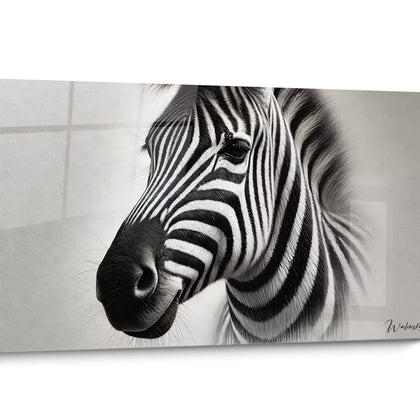
A zebra stripes wall art black and white embodies the quintessence of organic graphic design, offering a spectacular decorative solution to instantly transform the atmosphere of your space. These large-format representations capture the very essence of the most iconic natural pattern in the animal kingdom, one that has fascinated interior architects and contemporary art enthusiasts for decades. The perfect alliance between raw visual force and minimalist sophistication makes this wall decoration a strategic choice for anyone seeking a masterpiece capable of visually structuring a modern interior while bringing timeless organic dimension.
The Visual Impact of Zebra Stripes Contrast in Interior Decoration
The natural architecture of black and white zebra stripes generates an optical dynamism rarely matched in contemporary wall decoration. This natural pattern possesses a unique capacity to fragment and restructure the spatial perception of a room, creating directional lines that guide the eye according to the orientation of contrasted bands. In a refined living room with white walls, this graphic composition becomes a magnetic focal point that eliminates any need for superfluous decorative accumulation.
How do the zebra's naturally vertical stripes transform the perception of ceiling height?
The naturally vertical orientation of zebra stripes wall art exploits a fundamental principle of visual psychology: ascending lines amplify the sensation of vertical volume. In spaces with standard ceilings of 2m40 to 2m60, this optical illusion offers considerable decorative advantage without architectural intervention. The irregular bands characteristic of zebra coat add rhythmic complexity that avoids the monotony of perfectly regular industrial stripes, keeping the eye in constant motion along the surface.
Zebra monochrome as an alternative to saturated color compositions
Facing the current trend of multicolor interiors, the black and white zebra stripes wall art represents a sophisticated counterpoint for spaces demanding visual sobriety without austerity. This binary palette eliminates any chromatic harmony issues with existing furniture, integrating naturally into environments dominated by concrete gray, light Scandinavian woods, or contemporary metallic textures. The apparent neutrality of black and white becomes paradoxically a strong decorative affirmation, particularly in professional offices where balance between personality and neutrality proves delicate.
Strategic exploitation of organic pattern in minimalist spaces
Contemporary minimalist interiors frequently suffer from excessive coldness related to the strict geometry of designer furniture and refined surfaces. The introduction of a zebra stripes wall art black and white brings this essential organic touch without compromising the purified philosophy of the space. The natural irregularities of the zebra pattern – subtle undulations, thickness variations, unpredictable interruptions – inject biological vitality that instantly humanizes the environment without resorting to superfluous decorative elements. This solution proves particularly effective in industrial lofts where the dialogue between architectural rigor and natural spontaneity creates remarkable aesthetic tension.
The Natural Graphics of Zebra Stripes as an Architectural Element
What makes the zebra pattern more dynamic than standard geometric stripes?
Unlike mechanically produced stripes, the pattern of zebra stripes wall art black and white presents organic variability that activates our visual system differently. Each band possesses a unique width, irregular edges, and slightly curved trajectory that follows the animal's muscular volumes. This imperfection calculated by nature generates complex visual rhythm impossible to reproduce through simple geometric alternation, maintaining visual interest during prolonged daily exposure. Neuroscience confirms that our brain processes organic patterns differently from geometric ones, the former triggering more nuanced emotional response.
Stripe orientation as a spatial correction tool
The strategic positioning of a large-format black and white zebra stripes wall art allows counterbalancing common architectural defects in modern spaces. In a narrow and deep room, placement on the short wall with emphasis on vertical stripes visually counteracts the tunnel effect. For square spaces lacking direction, the natural oblique orientation of certain sections of the zebra coat introduces diagonal dynamism that breaks spatial stagnation. This corrective function occurs subtly, without the obviousness of conventional decorative solutions like mirrors or painted stripes.
Modular visual intensity based on stripe density representation
Not all zebra artworks generate the same perceptual intensity. Compositions emphasizing tight stripes – typically observed on flanks and neck – create almost kinetic optical vibration, ideal for dynamizing passage areas like entryways or hallways. Conversely, representations centering on areas with more spaced bands – rump and limbs – offer more serene reading, appropriate for rest spaces like contemporary master bedrooms. This variability enables strategic selection based on desired activation or relaxation in each specific environment.
Visual texture of stripes as tactile substitute
In interiors dominated by smooth surfaces – glass, laminates, polished concrete – the black and white zebra stripes wall art compensates for the absence of physical relief through rich visual texture. The repeated black-white alternation creates perceptual depth that suggests touch without actual tactile dimension, phenomenon particularly effective in spaces where accumulation of three-dimensional decorative objects would harm spatial fluidity. High-end restaurants and conceptual boutiques massively exploit this property to enrich sensoriellement their spaces without physical clutter.
Staging Strategies for a Large-Format Black and White Zebra Wall Art
Focal positioning in contemporary open spaces
Current residential open-space configurations – kitchen-living-dining room fusion – require visual elements capable of subtly segmenting space without physical partitioning. A zebra stripes wall art black and white of generous dimensions positioned on the wall symbolically separating two functional zones acts as visual territorial marker. This soft delimitation proves particularly relevant in renovations of Haussmann apartments converted into lofts, where architectural authenticity requires preserving volumes while creating identifiable sub-spaces. The binary contrast of the pattern asserts itself sufficiently to be perceived from multiple angles simultaneously, paradoxically unifying the space it subdivides.
Association with raw materials and industrial finishes
The aesthetic of black and white zebra stripes wall art finds particular resonance with raw materials prized in contemporary industrial interiors. The opposition between the fluid organicity of natural stripes and mineral rigor of raw concrete, darkened steel, or weathered zinc generates sophisticated decorative tension. This juxtaposition avoids the pitfall of cold all-industrial through injecting biological reference that softens without sweetening. Artist studio spaces, creative agency offices, or architectural residences massively exploit this material dialogue to affirm distinctive visual identity without resorting to conventional decorative codes.
Animal monochrome as a bridge between modernity and timelessness
Unlike ephemeral decorative trends linked to seasonal color palettes, the black and white zebra pattern transcends fashion cycles through its anchoring in immutable biological reality. This permanence reassures interior decoration investors seeking an aesthetic safe haven value that will traverse decades without appearing dated. High-end real estate properties strategically utilize these pieces during sales staging, knowing zebra graphics appeal simultaneously to classical and avant-garde profiles, thus maximizing universal space attractiveness.
Which complementary decorative elements enhance a black and white zebra stripes wall art?
The immediate environment of the artwork largely determines its final impact. Architectural plant compositions – kentia palms, strelitzias, tree ferns – create nature-to-nature dialogue that reinforces organic dimension while maintaining contemporary sophistication. Furniture with refined lines in matte black, brushed chrome, or ebony wood finishes amplify chromatic sobriety without visual redundancy. Directional LED lighting avoids luminous uniformity while sculpting stripe contrast, particularly effective in evening when ambient lighting decreases and the piece becomes absolute visual protagonist of the space.
Does a black and white zebra stripes wall art suit light Scandinavian interiors?
Absolutely, the graphic contrast of the zebra pattern integrates remarkably into Scandinavian interiors dominated by off-whites and light woods. It brings precisely the strong visual punctuation these bright spaces need to avoid blandness, while respecting Nordic minimalist philosophy through its natural monochrome palette.
Which dimension should be prioritized to maximize the impact of a black and white zebra stripes wall art?
Monumental formats of 120x180 cm minimum fully exploit the zebra pattern's potential by enabling total visual immersion. At this scale, stripes acquire quasi-architectural presence that transforms the artwork into a genuine space-structuring element rather than simple decorative accessory.
Does black and white zebra stripes wall art tire the eye visually over time?
Unlike regular geometric patterns that can indeed generate visual fatigue, natural irregularities of the zebra coat maintain renewed perceptual interest. Each observation reveals new subtleties in band alternation, phenomenon amplified by lighting variations throughout the day that constantly modify contrast reading.


 Zebra Portrait Profile Artwork - Intense Gaze - Black and White Animals Edition233,90 €
 Simplicity Striped Canvas - Zebra Animals Edition233,90 €
 Striped Harmony Canvas - Zebra Animals Edition233,90 €
 Striped Elegance Canvas - Animals Edition233,90 €