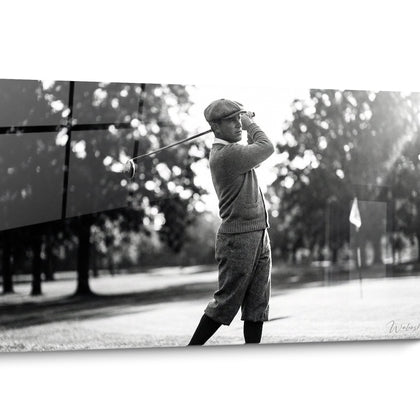
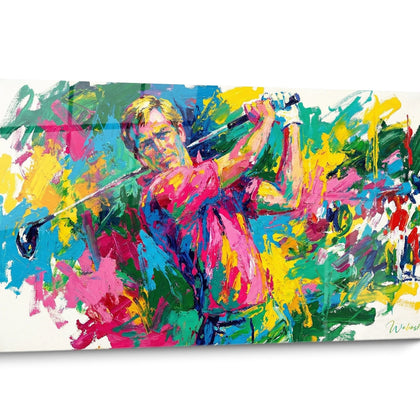
The vintage golf wall art stands as a masterpiece for enthusiasts eager to celebrate the golden age of this aristocratic sport. Far beyond simple wall decoration, these large-scale representations capture the hushed atmosphere of country clubs from yesteryear, the elegant attire of golfers from the 1920s-1950s, and the classic aesthetic of historic courses. Unlike modern interpretations such as abstract golf art, these creations emphasize visual authenticity and faithful recreation of a bygone era. Each composition evokes mythical tournaments, legendary champions, and the timeless elegance that characterized golf in the last century, transforming your space into a true sanctuary dedicated to the history of this refined sport.
The Visual Heritage of Mythical Courses
An authentic vintage golf wall art piece recreates the unique atmosphere of legendary courses that shaped professional golf history. Representations of Saint Andrews with its undulating fairways and centuries-old clubhouse, panoramic views of Augusta National before modern transformations, or wind-swept Scottish links transport the enthusiast on a fascinating journey through time. These large-scale compositions capture the characteristic sepia tones of period photographs, the brownish hues of naturally irrigated turf, and the particular luminosity of British skies.
How to identify an authentically retro visual rendering?
The authenticity of vintage golf wall art rests on several distinctive visual markers: the limited color palette of ochre, beige, dark brown, and anthracite gray tones evoking old printing processes, the representation of period equipment like hickory clubs or gutta-percha balls, and the staging of golfers wearing knickerbockers, flat caps, and jacquard sweaters. Successful compositions also incorporate characteristic architectural elements such as colonial-style clubhouses, triangular flags, and irregularly contoured bunkers.
What atmosphere to create in a professional office?
In a high-end professional environment, a monumental vintage golf wall art immediately establishes a climate of distinction and tradition. Installed behind an executive desk or in a strategic conference room, it communicates values of excellence, patience, and technical mastery. Panoramic formats depicting foursomes in action on classic courses generate natural conversation points with business partners, while scenes of historic tournaments evoke fair competition and respect for rules—principles applicable to the entrepreneurial world.
Enhancing dedicated leisure spaces
Vintage golf wall art finds its most coherent expression in private game rooms, smoking lounges, or lounge spaces where relaxation and masculine refinement blend together. Representations of vintage trophies like the Claret Jug or Havemeyer Trophy, reproductions of championship posters from the 1930s, and scenes of period clubhouses create thematic continuity with aged leather furniture, dark woodwork, and brass accessories. This aesthetic coherence transforms the space into a genuine cabinet of curiosities dedicated to golf history.
The Aesthetic Codes of the Classical Era
The appeal of vintage golf wall art lies in its ability to resurrect the aesthetic conventions of an era when golf embodied social elegance and class distinction. Representations favor balanced compositions inherited from academic painting, with perspectives respecting classical canons and majestic framing that magnifies verdant expanses. Rendering techniques imitate lithographic printing processes or railway travel posters that promoted British and American golfing destinations during the interwar period.
Why privilege representations of historic champions?
Portraits or action scenes featuring golf legends such as Bobby Jones, Walter Hagen, Ben Hogan, or Sam Snead hold particular resonance for connoisseurs. These mythical figures embody the spirit of vintage golf: technical rigor without electronic assistance, stoicism in the face of natural elements, and the gestural elegance of a refined swing. A large-scale vintage golf wall art piece depicting these icons in their characteristic posture becomes a visual manifesto celebrating the original purity of the game before the era of intensive commercialization.
The importance of period costume details
Vintage compositions devote meticulous attention to costumes that serve as essential temporal markers: baggy trousers gathered below the knee, high-collar shirts with ties, virgin wool sweaters with geometric patterns, and two-toned laced shoes. These sartorial details transform the artwork into a sociological document testifying to the strict dress codes that governed access to private clubs. For collectors, these elements authenticate the represented period and reinforce the documentary value of the work.
What typographic elements should you seek?
The most sought-after vintage golf wall art pieces incorporate Art Deco or Victorian typographic elements: hand-lettered titles with pronounced serifs, ornamental cartouches framing tournament mentions, old-style numbering for holes, and careful calligraphy for captions. These textual insertions, far from cluttering the composition, strengthen historical authenticity and create additional visual anchoring points. Mentions of prestigious clubs or historic competitions add a commemorative dimension that particularly resonates with discerning enthusiasts wishing to affirm their in-depth knowledge of golfing heritage.
Building a Thematic Wall Art Collection
The acquisition of vintage golf wall art often fits within a progressive collection strategy aimed at creating a personal gallery documenting golf's evolution through the decades. Discerning collectors favor monumental formats that allow appreciation of detail richness: terrain textures, player expressions, landscape depth. A coherent collection strategy involves focusing on a specific period (the Edwardian era, the Roaring Twenties, the immediate post-war period) or a precise thematic axis (vintage equipment, clubhouse architectures, champion portraits).
How to organize a chronological arrangement?
A museographic approach involves displaying multiple vintage golf wall art pieces according to a chronological progression illustrating the sport's transformations. A sequence beginning with the 18th-century Scottish origins, transitioning through American expansion of the 1920s-1930s, and culminating with the icons of the 1950s-1960s creates a captivating visual narrative. Generous formats allow for clear visual hierarchy, with masterpieces occupying central positions and secondary compositions framing the ensemble to create a continuous narrative.
Enhancing prestigious residential spaces
In prestige residences, a monumental vintage golf wall art naturally finds its place in private libraries, billiards rooms, or themed home theaters. Association with English furniture, patinated brass lighting, and shelving filled with leather-bound volumes on golf history creates a British private club atmosphere. Owners of interior golf simulators also use these vintage representations to historically contextualize their contemporary practice, establishing a visual bridge between tradition and technology.
What criteria define a premium collection piece?
The most prized vintage golf wall art pieces distinguish themselves through documented historical fidelity: reproduction of specific tournaments with identifiable dates and participants, precise representation of courses in their original configuration before modern renovations, or recreation of equipment whose authenticity can be verified. Imposing dimensions also constitute a valorization factor, with panoramic formats exceeding two meters in width creating incomparable visual impact. Limited edition runs and authenticity certification transform these works into lasting decorative investments for affluent enthusiasts.
FAQ
Where should you place vintage golf wall art to maximize visual impact?
Male reception spaces such as private offices, game rooms, or practice facilities constitute privileged locations, where indirect lighting enhances sepia tones without creating annoying reflections on large surfaces.
Is vintage golf wall art suitable for commercial sports spaces?
Absolutely—high-end pro shops, country club lounges, and premium equipment showrooms use these representations to create an atmosphere of exclusivity and tradition that enhances their commercial offering to a demanding clientele.
How to combine multiple vintage golf wall art pieces without visual overload?
Favor a homogeneous color palette by selecting works sharing similar tones, space compositions at least 40 centimeters apart to allow individual appreciation, and create coherent thematic groupings rather than disorderly accumulation.


 Vintage California Golfer Painting - Golf The Golden State - Golf Edition233,90 €
 Vintage Golf Painting - The Golden Age of European Golf - Golf Edition233,90 €
 Vintage Golfer Wall Art - Colorful Pop Art Style - Golf Edition233,90 €
 Gentleman Golfer Wall Art - Portrait of the Distinguished Player - Golf Edition233,90 €
 Vintage Golf Painting - The Perfect Swing - Golf Edition233,90 €
 Vintage Golfer Painting - Classic Swing in Black and White - Golf Edition233,90 €
 Golf Still Life Painting - Vintage Green Elegance - Golf Edition213,90 €