







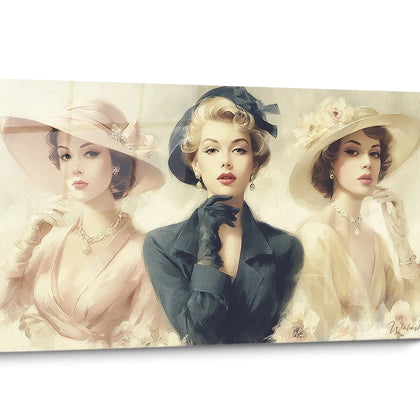
Vintage Expressionist Fashion Wall Art
The Vintage Fashion Expressionist painting celebrates the golden age of haute couture through a bold artistic vision. This collection captures the essence of retro expressionist glamour with portraits of elegant women, iconic silhouettes, and colorful compositions that evoke the roaring twenties. Each fashion vintage art wall painting transforms your interior into a sophisticated gallery, bringing refinement and character to your spaces. Explore this universe where fashion becomes expressionist art.
 Woman Portrait Painting - Expressionist Face - Vintage Fashion Edition273,90 €
 Female Portrait Painting - Abstract Beauty - Vintage Fashion Edition273,90 €
 Vintage Portrait Painting - Sophisticated Man in a Colorful Whirlwind - Vintage Fashion Edition273,90 €
 Female Portrait Painting - Emotional Chromatic Explosion - vintage fashion edition273,90 €
Explore further
In Vintage Expressionist Fashion Wall Art




All about Vintage Expressionist Fashion Wall Art
- Vintage Expressionist Fashion Wall Art Presentation
- Aesthetics and Raw Emotions
- Integration into Living Spaces
- Authenticity and Provenance
The vintage Expressionist fashion wall art embodies a unique encounter between period clothing elegance and the emotional power of artistic expressionism. These large-scale mural creations capture the dramatic essence of retro fashion through intense visual compositions where garments become vectors of heightened emotions. Unlike conventional representations of vintage fashion, these works prioritize expressive distortion, bold chromatic contrasts, and visible painterly gestures that transform each silhouette into a visually charged manifesto laden with psychology. Designed for collectors of bold decoration seeking to invest in imposing mural pieces capable of visually structuring a contemporary living room, an industrial loft, or a high-end commercial space, these vintage expressionist representations offer a spectacular alternative to traditional decorative codes.
The emotional intensity of vintage expressionist fashion
The vintage Expressionist fashion wall art distinguishes itself through its capacity to transform clothing representation into raw emotional territory. The creators of these mural compositions deliberately abandon photographic fidelity in favor of exaggerating traits, expressive distortion of silhouettes, and the use of saturated colors that evoke the psychological tension inherent to the expressionist movement of the early twentieth century. This visual approach visually translates existential anguish, urban melancholy, or feverish exaltation through carefully selected retro clothing codes.
What visual characteristics define these vintage representations?
The large-scale expressionist mural compositions dedicated to vintage fashion exploit violent chromatic contrasts where deep blacks dialogue with incandescent reds, acidic yellows, or sickly greens. The visible pictorial textures, perceptible even from a distance in imposing formats, create a tactile materiality that amplifies emotional impact. Female silhouettes in vintage dresses from the 1920s-1940s undergo angular distortions, stretched proportions, or compositional fragmentations that break classical harmony to generate productive visual tension.
The legacy of expressionist masters applied to fashion
These mural creations stand in the direct line of artists such as Kirchner, Schiele, or Beckmann who used clothing as a psychological revealer. In a contemporary interior, a large-scale vintage Expressionist fashion wall art functions as a radical counterpoint to the streamlined lines of modern furniture, creating stimulating aesthetic friction. The appropriation of retro clothing codes – cloche hats, structured coats, fluid dresses – becomes a pretext for exploring existential themes: urban alienation, identity quest, desire and frustration.
How do these works transform the perception of vintage fashion?
Unlike the vintage Art Deco fashion wall art that celebrates geometric elegance and refined luxury, the expressionist approach systematically deconstructs clothing idealization. The imposing formats reveal troubling details: empty gazes, disarticulated postures, tormented draperies that suggest psychological discomfort beneath the veneer of elegance. This visual desacralization of retro fashion generates contemporary fascination among collectors seeking mural pieces capable of stimulating reflection rather than simply decorating.
Decorative integration strategies for vintage expressionist compositions
The installation of a large-scale vintage Expressionist fashion wall art requires specific architectural consideration given its visual intensity. These mural creations function optimally as dominant focal points in spaces sufficiently vast to absorb their emotional charge without creating visual oppression. Industrial lofts with exposed brick walls, private galleries with high ceilings, or minimalist living rooms with white walls constitute ideal environments where expressionist chromatic violence can fully deploy its impact.
What environments enhance these vintage expressionist compositions?
High-end commercial spaces – conceptual fashion boutiques, art galleries, gastronomic restaurants – frequently exploit these imposing mural representations to assert a bold visual identity. A vintage Expressionist fashion wall art instantly creates an emotionally charged atmosphere that radically distinguishes the space from conventional environments. Discerning collectors also favor installation in private libraries or executive offices where visual tension stimulates creativity and intellectual reflection.
Decorative associations and stylistic counterpoints
Contemporary minimalist furnishings in brushed steel, polished concrete, or black leather constitute the ideal counterpoint to expressionist chromatic exuberance. This juxtaposition creates a temporal dialogue between vintage aesthetics and radical modernity. Interior design professionals recommend maintaining surrounding sobriety to allow the large-scale wall art to visually dominate without decorative competition. Solid dark hardwood flooring or natural stone visually anchors the composition while reinforcing connection with historical authenticity.
How to manage the psychological impact of these works in daily life?
The emotional intensity of a vintage Expressionist fashion wall art requires particular consideration regarding its location. Bedrooms are generally discouraged due to the potential anxiety-inducing charge of certain compositions. Circulation spaces – monumental entrance halls, wide corridors – permit intermittent exposure that preserves impact while avoiding visual saturation. Directional lighting systems with variable intensity offer the possibility to modulate visual aggressiveness according to times of day and activities.
Rotation and evolution of mural art collections
Sophisticated collectors frequently practice seasonal rotation of their large-scale expressionist mural compositions, alternating with more soothing pieces during periods requiring concentration or psychological recovery. This curatorial strategy maintains perceptual freshness while preserving the emotional value of each encounter with the work. The imposing formats paradoxically facilitate this rotation thanks to professional hanging systems allowing changes without wall damage.
Historical authenticity and heritage valorization of expressionist representations
The acquisition of a large-scale vintage Expressionist fashion wall art involves thorough understanding of historical authenticity markers and specific creative contexts. Genuine period productions – particularly those from the 1910s-1930s – present distinctive material characteristics: period-appropriate technical supports, historical pigments with specific aging properties, gestural execution techniques impossible to reproduce mechanically. This material authenticity directly conditions the heritage value and visual impact of these imposing mural creations.
Identification of authentic productions versus contemporary reproductions
Knowledgeable collectors meticulously examine the pictorial stratigraphy – visible superposition of material layers – characteristic of authentic expressionist works where gestural urgency generates impasto, scraping, and visible pentimenti. Contemporary reproductions, even quality ones, present suspicious surface regularity and artificially preserved chromatic intensity. Natural varnish craquelure, specific yellowing of certain whites, or selective pigment discoloration constitute temporal indices authenticating the true age of a vintage Expressionist fashion wall art.
What provenance should be sought for these vintage mural compositions?
Germanic and Austro-Hungarian productions from 1910-1925 represent the historical epicenter of this intersection between vintage fashion and expressionism. Berlin, Vienna, and Munich studios produced series dedicated to the psychologized representation of modern urban femininity, often commissioned by avant-garde fashion houses. Provenance documentation – period exhibition catalogs, artist correspondence, historical gallery stamps – significantly multiplies the heritage and commercial value of these large-scale mural creations.
How to evaluate investment in these expressionist mural works?
The market for expressionist mural compositions dedicated to vintage fashion experiences consistent appreciation over the past two decades, driven by the growing rarity of authentic large-scale pieces and renewed interest in psychological aesthetics. Imposing formats – exceeding 120×80 cm – benefit from substantial premium given their relative rarity and maximum decorative impact. Heritage investors favor identified signatures of historical expressionist movement artists, even secondary ones, whose market value experiences progressive revaluation.
Conservation and preservation of large-scale vintage compositions
Owners of large-scale vintage Expressionist fashion wall art must implement rigorous conservation protocols to preserve material and chromatic integrity. Strict hygrometric control (45-55% relative humidity), protection against direct ultraviolet rays, and maintenance of stable temperature prevent accelerated degradation of historical supports and pigments. Restoration interventions must be entrusted exclusively to expressionist painting specialists capable of respecting original aesthetic intentionality – notably the material roughness and surface irregularities constitutive of expressionist visual language.
FAQ – Frequently Asked Questions about Vintage Expressionist Fashion Wall Art
Does vintage Expressionist fashion wall art suit all interiors?
These imposing mural compositions require sufficiently vast spaces and aesthetic sensitivity open to emotional intensity. They integrate ideally in streamlined contemporary environments, industrial lofts, or commercial spaces seeking an affirmed visual identity. Traditional interiors or reduced spaces risk counterproductive visual saturation.
How to distinguish an authentic piece from a quality modern reproduction?
Examination of pictorial materiality reveals decisive indices: gestural irregularities, natural craquelure of old varnish, differentiated aging of pigments, period-appropriate technical supports. Provenance documentation and specialized expertise remain indispensable for certifying historical authenticity of a vintage Expressionist fashion wall art, particularly for large-scale pieces representing significant heritage investment.
What value evolution can be anticipated for these mural works?
The market for expressionist compositions dedicated to vintage fashion experiences regular appreciation stimulated by growing rarity, renewed museum interest in historical expressionism, and decorative demand for mural pieces with strong visual impact. Large-scale formats with documented provenance constitute particularly solid heritage investments, combining aesthetic, historical, and decorative value in a segment relatively protected from speculative fluctuations.
Further reading
Our articles on this topic
- What was the influence of Cubist painting on the geometric patterns of 1920s fashion?
- Vintage Expressionist Wall Art: Which Artists Are Emerging on the Secondary Market?
- Why Did Balthus' Paintings Captivate Parisian Fashion Art Directors?
- How Did Narrative Figuration Artists Represent the World of Haute Couture Houses?
- Why Did Models Pose in Front of Abstract Paintings in the 1960s?
- Vintage Symbolist Wall Art: An Underrated Market Movement?


