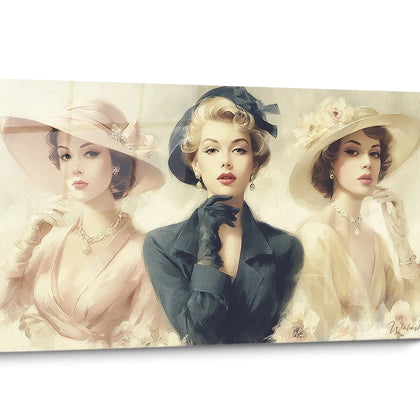
The vintage Art Deco fashion painting embodies the fascinating convergence between the golden age of geometric design from the 1920s-1930s and the refined world of Parisian haute couture. This period marks the apex of an aesthetic where elongated silhouettes, geometric motifs and sophisticated color palettes redefine the standards of feminine elegance. These large-scale wall compositions capture the essence of an era when fashion and artistic movement merged to create a revolutionary visual language, characterized by its clean lines, stylized forms and assumed luxury that transform contemporary interiors today into veritable period galleries.
The Excellence of Art Deco Silhouettes in Retro Fashion Representation
Vintage Art Deco fashion paintings stand out through their characteristic representation of the tubular feminine silhouette, emblematic of the Roaring Twenties. This elongated morphology, with effaced hips and lowered waistline, breaks radically with the corseted forms of the Belle Époque. Fashion illustrations from this period favor extreme verticality, often accentuated by geometric architectural perspectives that frame feminine figures within symmetrical compositions reminiscent of New York skyscrapers or ornate Parisian facades.
What are the Art Deco dress codes represented on these wall paintings?
Art Deco wall compositions immortalize specific clothing elements: fringe dresses in motion, evening coats with contrasting linings, ornate turbans and ostrich feather boas. Accessories occupy a preponderant place with long cigarette holders, oversized pearl sautoirs and front bands adorned with rhinestones. These representations also capture typical attitudes of the era: angular poses, theatrical gestures and sophisticated expressions that evoke nascent feminine emancipation.
The importance of geometric motifs in visual composition
The Art Deco graphic vocabulary radically transforms fashion representation with its chevrons, zigzags, concentric circles and fan-shaped forms. These motifs serve not only as decorative background but structure the entire composition, creating harmony between the central figure and its environment. Stylized sun rays, pyramidal forms and logarithmic spirals impart particular visual dynamism to these paintings, reinforced by bold color contrasts between gold, black, silver and saturated colors such as vermillion red or cobalt blue.
How do these illustrations reflect the spirit of modernity of the 1920s?
These wall creations testify to a society undergoing complete technological and cultural transformation. Frequent references to luxury automobiles, nascent aviation and modern architecture appear throughout. Backgrounds often evoke nocturnal urban settings, jazz clubs or fashionable salons illuminated by geometric lighting fixtures. This aesthetic perfectly captures the optimism and hedonism of a period when fashion becomes a vector for social expression and symbol of progress, particularly suited to contemporary spaces seeking an atmosphere of timeless refinement. To complete this sophisticated retro ambiance, exploring also a colored vintage fashion painting enriches the decorative palette while preserving this period elegance.
Iconic References and Artistic Influences of the Vintage Art Deco Fashion Painting
What are the influences of Art Deco master illustrators?
The vintage Art Deco fashion painting draws directly from the work of legendary illustrators like Georges Lepape, Erté and George Barbier who revolutionized fashion presentation in Vogue, Gazette du Bon Ton and Harper's Bazaar. Their techniques combined stencil, watercolor and gouache to create images with clean color blocks and precise outlines. These contemporary wall compositions faithfully reproduce this distinctive graphic style characterized by pushed formal simplification, expressive use of negative space and extreme stylization of features that transforms the human figure into aesthetic archetype rather than realistic portrait.
Sophisticated color palette and its symbolic meanings
The color harmonies of Art Deco paintings obey precise codes that transcend simple aesthetic consideration. Black and gold evoke absolute luxury and nocturnal elegance, while silver and navy blue combinations suggest technological modernity. Touches of carmine red or emerald introduce a controlled passionate dimension, always balanced by neutral surfaces. This structured chromatic approach enables harmonious integration into contemporary interiors where these wall pieces become focal points without creating dissonance, particularly effective in spaces with streamlined furniture where their visual richness expresses itself fully.
How to identify crossed cultural influences in these compositions?
Art Deco fashion iconography subtly integrates references to Egyptomania following the discovery of Tutankhamun's tomb in 1922, with stylized hieroglyphic motifs and hieratic poses. Japanizing influences persist in asymmetrical composition and use of empty space as an active element. Exoticism is also present through references to Diaghilev's Ballets Russes, with orientalist costumes and sets inspired by Persian and Chinese arts reinterpreted according to Western geometric vocabulary, thus creating a visual syncretism characteristic of this period of intense cultural exchanges that fascinates contemporary collectors.
The contribution of vintage printing techniques to visual authenticity
Current museum-quality reproductions faithfully reproduce the characteristics of period printing processes: slightly granular stencil texture, subtle variations in color blocks and presence of golden or silvered details that capture light. These technical nuances confer great wall compositions a visual depth absent from standard digital prints, reinforcing their decorative impact in generous spaces where their imposing format allows them to fully deploy their richness of detail and original graphic sophistication.
Decorative Valorization and Strategic Positioning of the Vintage Art Deco Fashion Painting
In what architectural spaces do these paintings express their full potential?
The vintage Art Deco fashion painting finds optimal expression in spaces with generous volumes and marked architecture. Spacious dressing rooms benefit particularly from these compositions that establish natural dialogue with the wardrobe universe while bringing historical and artistic dimension. High-ceilinged living rooms, particularly those featuring moldings or period architectural elements, create stylistic resonance that amplifies visual impact. Bedrooms with minimalist contemporary furniture find in these wall pieces the decorative counterpoint that introduces warmth and personality without cluttering the space.
How to create coherent wall scenography around these works?
Arrangement around an Art Deco fashion painting requires thoughtful curatorial approach. Association with mirrors featuring geometric frames in gold or chrome amplifies period aesthetic while creating spatial depth. Wall sconces with angular lines and aged brass finishes extend formal vocabulary without creating visual redundancy. For more contemporary composition, contrast with raw industrial elements – matte black metal, polished concrete – generates dynamic aesthetic tension that underscores the graphic sophistication of the central piece. Monochrome environments particularly enhance color richness and pattern complexity.
What criteria define the decorative and collectible value of these reproductions?
The quality of an Art Deco reproduction is measured by several precise technical indicators: resolution fineness allowing sharp reading of ornamental details even at close range, chromatic fidelity to period palettes with metallic nuance reproduction, and rendering of textures evoking vintage printing techniques. The generous format constitutes a determining criterion as it respects the original intention of these compositions designed to impress and structure space. Editions incorporating premium finishing elements – selective varnish, metallic enhancements – offer superior wall presence that justifies their positioning as decorative investment pieces rather than simple temporary ornamentation.
The evolution of Art Deco aesthetic perception in current interiors
Contemporary renewed interest in Art Deco aesthetics in interior decoration is explained by several converging factors. The return to artisanal expertise and execution quality finds resonance in these compositions celebrating technical excellence. The search for authenticity and singularity in a context of global standardization values these documented historical references. The aspiration toward discreet and cultivated luxury, opposed to gaudy ostentation, perfectly embodies itself in the measured sophistication of these fashion representations. These paintings thus respond to the expectations of a demanding clientele seeking narrative decorative elements bearing history and cultural significance.
Why choose a vintage Art Deco fashion painting for your interior?
This type of wall composition simultaneously brings authentic historical dimension, timeless graphic sophistication and cultural connection with the golden age of design. Its geometric aesthetic naturally harmonizes with contemporary architectural codes while introducing ornamental richness and narrative depth often absent from modern minimalist interiors.
How to maintain and preserve a large-format Art Deco painting?
Optimal preservation involves positioning away from prolonged direct light sources that could alter pigments, particularly sensitive metallic nuances. Regular dusting with antistatic microfiber suffices for routine maintenance. For museum-quality reproductions, avoiding exposure to excessive humidity and brutal thermal variations guarantees dimensional and chromatic stability long-term.
Can multiple Art Deco fashion paintings be combined in the same space?
Multiple wall composition requires rigorous chromatic and thematic coherence to avoid visual saturation. Favor complementary rather than identical formats, space pieces sufficiently for each to breathe visually, and maintain stylistic unity in framing. A gallery approach with maximum three compositions in a spacious reception room creates mastered curatorial impact without slipping into disorderly accumulation.


 Feminine Elegance Painting - Tropical Luxury Art Deco - Vintage Fashion Edition233,90 €
 Aristocrat Woman Painting - Bourgeois Charm of Yesteryear - Vintage Fashion Edition233,90 €
 Couple Cocktail Painting - Retro Elegance at Aperitif Time - Vintage Fashion Edition233,90 €
 Lady with Earrings Painting - Art Deco Refinement - vintage fashion edition233,90 €
 Women Portrait Wall Art - Colorful Modern Art Deco - Vintage Fashion Edition233,90 €