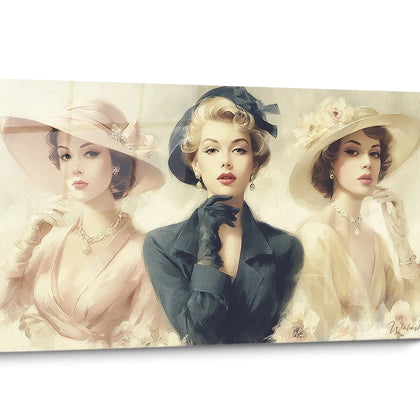
The vintage Pop Art fashion wall art celebrates the creative explosion of the 1960s-1970s, a period when fashion and graphic art merged to create an iconoclastic aesthetic. These large-scale wall compositions capture the revolutionary spirit of an era when fashion designers like André Courrèges and Paco Rabanne reinvented the feminine silhouette through geometric forms and futuristic materials. Each visual composition transposes the contestatory energy of British and American Pop Art into the world of haute couture, transforming models, stylized silhouettes and iconic accessories into visual manifestos saturated with primary colors.
The Chromatic and Graphic Explosion of Pop Art Applied to Fashion
The vintage Pop Art fashion wall art follows an artistic tradition where industrial silkscreen printing meets the elite world of haute couture. Flat areas of fluorescent colors – shocking pink, lemon yellow, electric blue – create striking contrast with the elongated silhouettes of 1960s models. This aesthetic collision faithfully reproduces the transgressive spirit of Andy Warhol applying his image multiplication techniques to mass consumption icons.
The Visual Codes of the Sixties Reinterpreted
These large-format wall compositions exploit emblematic geometric patterns: psychedelic concentric circles, op art checkerboards, contrasting stripes that adorned collections by Mary Quant and Pierre Cardin. The multiplication of frames within a single artwork, a technique dear to Roy Lichtenstein, allows a single fashion silhouette to be presented in infinite chromatic variations. The characteristic Ben-Day dots of offset printing from Vogue and Harper's Bazaar magazines become graphic signature, recalling the media origins of these fashion images.
Which fashion icons dominate vintage Pop Art imagery?
Oversized 1960s accessories – XXL butterfly sunglasses, geometric earrings, structured hats – frequently occupy the center of compositions. Vidal Sassoon's architecturally cut hairstyles, particularly the geometric bob with straight fringe, become graphic elements in their own right. Voluptuous lips highlighted in white, smoky eyes Twiggy-style, drawn lower lashes transform the female face into stylized cartography. This aesthetic naturally dialogues with compositions of vintage Art Deco fashion wall art, although Pop Art privileges colorful provocation where Art Deco favored linear elegance.
The Legacy of Magazine Culture and Advertising
These wall creations capitalize on the editorial explosion of international women's magazines that documented the London and Paris clothing revolution. Condensed and bold typography, catchy slogans borrowed from advertising language integrate into compositions. Stylized fashion sketches, with their exaggerated proportions (endless legs, impossibly thin waists), reflect the body idealization characteristic of fashion illustrations from this revolutionary decade.
When Counterculture Meets the Fashion Industry
The Revolutionary Silhouettes of the Sixties and Seventies
The vintage Pop Art fashion wall art immortalizes the radical transformation of the female wardrobe: scandalous miniskirts rising to mid-thigh, trapeze dresses freeing the body from corsetry, space-age vinyl and PVC jumpsuits reflecting obsession with lunar conquest. These large-scale wall compositions also capture the emergence of bell-bottom pants, vertiginous platform shoes and psychedelic prints that transformed every outing into a political body statement.
How to integrate the rebellious Pop spirit into a contemporary interior?
These monumental works function as visual anchoring points in spaces with streamlined furnishings, creating productive tension between architectural minimalism and chromatic maximalism. In an industrial loft with raw surfaces, the contrast between gray concrete and saturated Pop Art colors generates spatial dynamism comparable to Leo Castelli's New York galleries. For Scandinavian interiors dominated by light woods, color energy injection through these fashion-centered compositions breaks Nordic monotony without compromising ambient luminosity.
The Muses and Icons of the Pop Era
The long-legged models from Jean Shrimpton agency – Veruschka, Penelope Tree, Marisa Berenson – appear stylized in these compositions, their nonchalant attitudes and provocative poses contrasting with 1950s rigidity. The vintage Pop Art fashion wall art also celebrates the emergence of first media supermodels whose faces adorned Vogue covers and contemporary art gallery walls simultaneously. This unprecedented fusion between model celebrity and artistic icon status defines the originality of this period.
The Influence of Social Movements on Fashion Imagery
These wall creations reflect the impact of sexual liberation, emerging feminism and youth culture contestation on bodily representations. Androgynous poses, boyish cuts, unisex outfits visually translate the upheaval of gendered codes. References to flower power, pacifist demonstrations and California psychedelic culture permeate the backgrounds and decorative motifs, transforming each composition into sociological testimony as much as decorative object.
Creating an Architectural Focal Point with Pop Art Fashion Imagery
Display Strategies for Monumental Formats
The vintage Pop Art fashion wall art in large format requires a wall freed from any competing visual clutter. In high-end commercial spaces – ready-to-wear boutiques, creative showrooms, fashion communication agencies – these compositions function as instant identity signatures. Association with 1960s-1970s furniture (Arne Jacobsen Egg chairs, Michel Ducaroy Togo sofas) creates cohesive environments where each element reinforces temporal narrative.
Which professional spaces benefit from this aesthetic?
Photography studios specializing in fashion editorial exploit these compositions as conceptual backdrops during shoots, establishing visual dialogue between contemporary model and iconic heritage. Coworking spaces targeting creative industries use these works to assert a trendy and historically informed identity. Concept stores merging vintage and contemporary design find in these compositions the perfect link between nostalgia and modernity.
The Art of Chromatic Juxtaposition
These wall creations impose their bold palettes on the architectural environment. Against immaculate white walls, they generate maximum impact, each fluorescent shade vibrating with intensity. In interiors with colored walls – duck blue, emerald green, terracotta – the challenge lies in orchestrating intentional harmonies or contrasts rather than visual cacophony. Upholstery textiles can echo nuances present in the composition to create coherent chromatic circulation throughout the inhabited space.
Why choose a vintage Pop Art fashion wall art instead of authentic fashion photography?
Pop Art graphic stylization offers timelessness that perishable fashion photography doesn't guarantee. Flat colors, simplified outlines and purified compositions resist decorative trend fluctuations better. Claimed artistic dimension – explicit reference to Warhol, Lichtenstein, Blake masters – confers superior cultural legitimacy over simple photographic reproduction. The monumental format available for these compositions creates architectural presence impossible to obtain with authentic vintage photographic prints limited in dimensions by era-specific technical constraints.
Does a vintage Pop Art fashion wall art suit classical interiors?
Integration into traditional environments generates productive aesthetic tension, the shock between Haussmannian moldings and counterculture imagery creating controlled eclecticism. This juxtaposition works particularly well in Parisian apartments where historic architecture welcomes contemporary furniture and art, a decorating philosophy popularized by international design magazines.
Which room best showcases a large-scale vintage Pop Art fashion wall art?
The living room is the privileged location, offering necessary visual distance for appreciating monumental works and maximum social visibility. Master bedrooms with sophisticated ambiances welcome these compositions as statement headboards. Spacious walk-in closets and dressing rooms establish obvious thematic coherence between functional content and wall decoration.
How to maintain a vintage Pop Art fashion wall art to preserve its chromatic impact?
Distance from direct UV radiation sources prevents pigment degradation, particularly critical for the fluorescent hues characteristic of Pop Art. Gentle monthly dusting with dry microfiber cloth suffices to maintain surface vibrancy. Avoid any exposure to excessive humidity that would compromise the structural integrity of large-format supports.


 Afro Woman Painting - Fashion Icon 1980s - Vintage Fashion Edition233,90 €
 Trend Painting - The Alternative Gentleman - Vintage Fashion Edition233,90 €
 80s Aesthetic Painting - Madonna of Street Culture - Vintage Fashion Edition233,90 €
 Portrait Painting - Lady Pop Art - Vintage Fashion Edition233,90 €
 Fashion Portrait Painting - Elegant Pop Art Chic - Vintage Fashion Edition233,90 €
 Female Painting - Street Queen Attitude - Vintage Fashion Edition233,90 €
 Gentleman Modern Painting - Rainbow Palette - Vintage Fashion Edition233,90 €
 Female Portrait Painting - Chic Street Art Style - Vintage Fashion Edition233,90 €
 Vintage Woman Painting - Elegant Pop Art Sixties - vintage fashion edition233,90 €
 Women Portrait Wall Art - Colorful Modern Art Deco - Vintage Fashion Edition233,90 €
 Feminine Beauty Wall Art - Warm Tone Graphic Art - Vintage Fashion Edition233,90 €
 Modern Art Wall Art - Hip Women - Vintage Fashion Edition233,90 €
 Women's Sunglasses Wall Art - Colorful 80s Beauty - Vintage Fashion Edition233,90 €
 Glamorous Women Painting - Mysterious Triptych with Sunglasses - Vintage Fashion Edition233,90 €
 African Woman Painting - Street Chic Attitude - Vintage Fashion Edition213,90 €
 Fashion Portrait Painting - Chic African American Style - Vintage Fashion Edition213,90 €
 Man in Suit Painting - The Gentleman of Street Art - Vintage Fashion Edition213,90 €
 Fashion Pop Painting - Vibrant Urban Elegance - Vintage Fashion Edition213,90 €
 Female Portrait Painting - Iconic Roaring Twenties Style - Vintage Fashion Edition213,90 €
 Female Portrait Painting - Vibrant Urban Art - Vintage Fashion Edition213,90 €
 Male Portrait Painting - Pop Art Elegance - Vintage Fashion Edition213,90 €