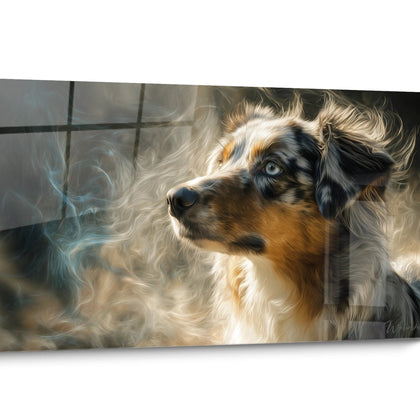
- Tricolor Australian Shepherd Painting Presentation
- Tricolor Characteristics
- Decorative Integration
- Buying Guide
The tricolor Australian Shepherd painting celebrates the distinctive elegance of this emblematic coat combining black, white, and tan. This naturally harmonious color palette offers incomparable visual richness for your wall art, capturing the intensity of the gaze and the nobility of the pelage characteristic of this prized variety. The copper nuances contrast harmoniously with the dark areas and white markings, creating a balanced composition particularly suited to large wall formats. Discover how this specific rendering of the tricolor Australian Shepherd transforms your space into a genuine contemporary canine gallery.
The Visual Expression of Tricolor in Wall Art
How do tan markings structure the tricolor composition?
The tricolor Australian Shepherd painting stands out through the strategic distribution of copper tan markings that naturally frame the viewer's gaze. These russet zones above the eyes, on the cheeks and under the tail create essential visual anchor points in a large-dimension wall composition. Unlike bicolor coats, this third hue brings chromatic depth that avoids monotony and captures attention across multiple zones simultaneously.
Artists specializing in tricolor Australian Shepherd representation particularly exploit these warm-cool contrasts: the deep black of the main coat, the luminous white accents of the collar and muzzle, and the copper touches that warm the entire composition. This natural combination integrates perfectly into modern interiors favoring neutral palettes enhanced with earthy tones. For a more artistic approach, consult our collection of watercolor Australian Shepherd paintings that elevate these chromatic transitions.
The decorative impact of standard and red tricolor variations
Enthusiasts distinguish standard tricolor (black-white-tan) from red tricolor (chocolate-white-tan), each generating a distinct decorative ambiance. Black tricolor offers maximum contrast, ideal for minimalist spaces where the painting becomes the dramatic focal element. Red tricolor, with its chocolate and caramel tones, naturally harmonizes with warm interiors incorporating woodwork and organic materials.
This distinction becomes crucial when acquiring a large-scale tricolor Australian Shepherd painting: a 120x80 cm format in black tricolor imposes itself visually in a minimalist white and gray living room, while an equivalent red tricolor version subtly complements a space in beige and wood tones. The extended white zones of the collar and paws also provide visual breathing room preventing saturation, even on imposing formats exceeding one hundred fifty centimeters.
Capturing temperament in tricolor portraits
Beyond simple anatomical representation, a successful tricolor Australian Shepherd painting transmits the vivid and intelligent temperament characteristic of the breed. The tan markings around the eyes naturally intensify the expression, creating the illusion of a penetrating gaze that follows the observer. This anatomical particularity explains why tight portraits function exceptionally well with this coat: the head-focused framing maximizes the emotional impact of the three colors concentrated on the face.
Collectors particularly seek representations capturing the semi-erect ear typical of the breed, whose light inner surface contrasts with the dark exterior, creating sophisticated play of shadows and light. Our range of Australian Shepherd portrait paintings explores precisely these expressive details that make all the difference in an authentic tricolor rendering.Spatial Enhancement of Tricolor in Contemporary Interiors
Which spaces benefit most from an imposing tricolor painting?
The tricolor Australian Shepherd painting finds its ideal place in open volumes requiring a chromatically balanced focal point. Modern kitchen-living room layouts with central island particularly benefit from a vertical 80x120 cm format positioned on the main wall: the three colors naturally dialogue with functional zones (dark appliances, light work surface, copper accessories).
Home offices constitute another strategic location for this canine iconography. The presence of a large-dimension tricolor Australian Shepherd stimulates visually without disrupting concentration, unlike saturated multicolor compositions. The natural tricolor coat avoids artificiality while maintaining constant visual dynamism. Animal industry professionals (veterinarians, trainers, breeders) favor this decorative choice that affirms their expertise while humanizing the workspace.
Amplifying decorative associations for tricolor rendering
The association of a tricolor Australian Shepherd painting with complementary decorative elements multiplies its impact without creating visual cacophony. Metal frames in bronze or copper finish echo the tan markings, creating subtle chromatic continuity. Textiles (cushions, throws) in anthracite and cream tones replicate the main nuances without literal duplication.
For collectors wishing to create a coherent wall gallery, adding related works requires precise chromatic thinking. A geometric Australian Shepherd painting in similar tones can harmoniously complement a realistic tricolor, angular forms contrasting with naturalistic rendering while sharing the same trichomatic base. Spacing between paintings should respect the 10-15 cm rule to avoid visual competition.
The influence of lighting on the perception of tricolor nuances
Contrary to common assumptions, lighting a tricolor Australian Shepherd painting requires a nuanced approach to preserve the balance between the three hues. Cool white LED lighting (5000-6500K) excessively accentuates white and hardens black, flattening tan markings. Conversely, warm white (2700-3000K) enriches copper tones but can yellow pure white zones.
The optimal solution rests on neutral white lighting (3500-4000K) positioned in grazing light if the support presents relief, or in diffuse lighting for large-format flat prints. Formats exceeding 150 cm require two spaced light sources to avoid central shadow zones that would visually fragment the tricolor coat. This attention to lighting uniformity particularly values blue-eyed Australian Shepherd paintings in tricolor version, where clear iris-dark coat contrast constitutes the very essence of the work.Strategic Selection of Premium Tricolor Painting
What technical criteria differentiate premium tricolor renderings?
Acquiring a tricolor Australian Shepherd painting requires evaluating technical criteria specific to this coat. The chromatic fidelity of tan markings constitutes the first indicator: these zones must present authentic copper-rust coloring, neither orangish (frequent flaw in low-end printing) nor brownish (color underexposure). Formats exceeding 100 cm amplify these flaws, making sample verification essential before ordering.
The definition of black-tan transitions represents the second distinctive criterion. On a real tricolor Australian Shepherd, these zones present subtle gradation, not brutal demarcation. High-resolution prints (minimum 300 DPI for large formats) reproduce this progressivity, while budget renderings display artificially sharp boundaries betraying approximate digital processing. Informed collectors systematically examine the eyebrow and cheek areas where this transition proves most visible.
Strategic dimensions according to tricolor spatial configuration
Choosing the dimensional format of a tricolor Australian Shepherd painting obeys rules distinct from monochrome or abstract works. For a portrait format (vertical), the minimum height of 80 cm allows valorizing the natural color distribution from head to paws. Versions of 100x70 cm or 120x80 cm suit the main walls of standard living rooms (15-25 m²), with verticality accentuating the silhouette's elegance.
Horizontal panoramic formats (for example 150x60 cm) work remarkably well for movement representations or compositions including multiple tricolor Australian Shepherds. This orientation particularly suits spaces above long couches or sideboards, where extended width creates horizontal visual continuity. Our general collection offers various orientations allowing identification of the optimal format according to your wall configuration.
Investment and long-term decorative value
Acquiring a large-dimension tricolor Australian Shepherd painting represents a decorative investment whose relevance transcends ephemeral trends. Unlike artificial palettes (neons, synthetic gradients) rapidly dated, the black-white-tan combination remains timeless, guaranteeing decorative coherence over a minimum decade. This aesthetic stability justifies allocating substantial budget toward durable printing processes (pigmentary UV-resistant inks, anti-glare supports).
Tricolor Australian Shepherd owners constitute the buyer segment prioritizing exact photographic resemblance, willing to invest in customized reproduction respecting their companion's specific markings. Imposing formats (140+ cm) then allow remarkable anatomical fidelity, with every pelage detail becoming identifiable. This commemorative approach transforms the painting into genuine family heritage, transmissible and emotionally irreplaceable.
Does a tricolor painting suit monochrome minimalist interiors?
Absolutely, the tricolor Australian Shepherd painting integrates perfectly into minimalist interiors thanks to its naturally restricted and balanced palette. The three colors provide just enough dynamism to avoid austerity without overwhelming the visual space, unlike saturated multicolor compositions.
What visual difference between standard and red tricolor in large format?
Standard tricolor (black base) offers maximum contrast creating dramatic impact, ideal as a statement piece. Red tricolor (chocolate brown base) generates warmer, earthier ambiance, naturally harmonizing with interiors featuring wood tones and organic materials.
How to position an XXL tricolor Australian Shepherd painting in an open space?
In an open volume, prioritize the wall perpendicular to the main entrance to maximize immediate visibility. A vertical 120-140 cm format centered at eye height (painting center at 145-160 cm from floor) structures the space visually while creating a natural focal point that subtly delineates functional zones without physical partitioning.


 Tricolour Australian Shepherd Contemplating the Horizon - Majestic Gaze - Australian Shepherd Canvas Edition233,90 €
 Australian Shepherd Painting with Blue Eyes - Captivating Canine Portrait - Australian Shepherd Painting Edition233,90 €
 Australian Shepherd with Blue Eyes Extended - Tender Gaze - Australian Shepherd Canvas Edition233,90 €
 Australian Shepherd Tricolor Extended - Soft Artistic Portrait - Australian Shepherd Canvas Edition233,90 €
 Australian Shepherd Portrait Side Profile Luminous Gaze - Contemplative Look - Australian Shepherd Wall Art Edition233,90 €
 Tricolor Australian Shepherd Sitting in Autumn Forest - Warm Canine Portrait - Australian Shepherd Canvas Edition233,90 €
 Australian Shepherd with Amber Eyes under Blooming Cherry Blossoms - Spring Portrait - Australian Shepherd Canvas Edition233,90 €
 Australian Shepherd Tricolor Portrait Artistic Canvas - Canine Elegance - Australian Shepherd Canvas Edition233,90 €
 Australian Shepherd with Blue Eyes in a Field of Daisies - Spring Joy - Australian Shepherd Canvas Edition233,90 €
 Tricolor Australian Shepherd Sitting Position Painting - Modern Canine Portrait - Australian Shepherd Painting Edition233,90 €
 Tricolor Australian Shepherd on Rock Wall Art - Majestic Portrait - Australian Shepherd Edition233,90 €
 Australian Shepherd Howling at Sunset - Wild Call - Australian Shepherd Wall Art Edition233,90 €
 Tricolor Australian Shepherd with Amber Eyes - Noble Portrait - Australian Shepherd Canvas Edition233,90 €
 Australian Shepherd Tricolor Portrait Autumn Warmth - Warm Gaze - Australian Shepherd Wall Art Edition213,90 €
 Australian Shepherd Watercolor Sitting Tricolor - Artistic Canine Portrait - Australian Shepherd Artwork Edition213,90 €
 Australian Shepherd Contemplative Portrait Canvas - Gaze Toward the Horizon - Edition Australian Shepherd Canvas213,90 €
 Australian Shepherd with Golden Eyes on Pink Floral Background - Romantic Dog Portrait Canvas - Australian Shepherd Painting Edition213,90 €