


Planet Painting
Here, each canvas opens a window onto the infinity of cosmos. The Tableau Planète collection brings together celestial spheres, cratered moons, and cosmic spirals, where earthy colors blend with the deep blues of the starry night. These Planète paintings transform a wall into a silent observatory, between space exploration and intimate contemplation. An invitation to travel, without ever leaving your living room.
 Painting White and Black Sphere with Ink Splashes - Distant Mast Silhouettes - Planète Edition273,90 €
 Framed Print Spiral Yellow and Blue Ringed Planet - Small Neighboring Satellite Moons - Planet Edition273,90 €
 Painting Red and Golden Planet with Mosaicked Rings - Small Turquoise Moon - Planet Edition273,90 €
 Pink Planet and Sage Green on Rolling Dunes Painting - Distant Little Moon - Planet Edition273,90 €
 Pink and Turquoise Planet Painting on Marine Horizon - Celestial Sunrise - Planet Edition273,90 €
 Multicolored Moon Painting on Turquoise and Violet Mountains - Celestial Reverie - Planet Edition273,90 €
 Painting Blue Planet Night and Fuchsia Pink with Flowing Trails - Transparent Grid Overlay - Planet Edition273,90 €
 Pink and Yellow Planet on Dark Rocks Painting - Distant Horizon - Planet Edition273,90 €
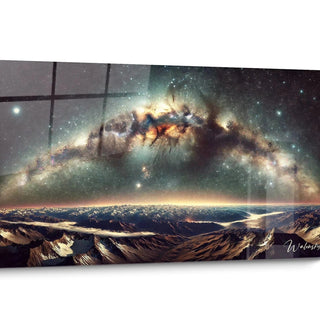
 Blue and Purple Planet Painting on Snowy Peaks - Frosty Open Window - Planet Edition273,90 €
 Painting Yellow and Red Sphere Above a City - Incandescent Solar Radiance - Planet Edition273,90 €
 Painting Two Blue and Orange Planets with Intertwined Swirls - Frosted Bare Trees - Planet Edition273,90 €
 Space Shuttle Painting Blue and Orange Overflying Earth - Brilliant Return - Planet Edition273,90 €
 Twin Spheres Blue and Orange Tableau in Diagonal Streak - Incandescent Reflection on Water - Planet Edition273,90 €
 Blue and Orange Globe Earth Painting - Incandescent Birth - Planet Edition273,90 €
 Blue and Pink Globe Painting with Multicolor Splatters - Black Ink Flows - Planet Edition273,90 €
 Swirling Planets Painting Red and Gold on Fantastic River - Cosmic Convergence - Planet Edition273,90 €
 Golden and Green Ringed Planet Painting with Small Moons - Purple Nebula and Vaporous Clouds - Planet Edition273,90 €
 Planet Painting Cream and Pink on Frozen Lake - Distant Little Moon - Planet Edition273,90 €
 Ringed Planet Painting Navy Blue and Orange in Swirls - Ornamental Spiral Motifs - Planet Edition273,90 €
 Cosmic Spirals Navy Blue and Orange Painting - Nocturnal Vertigo - Planet Edition273,90 €
 Painting Giant Red and Yellow Planet with Anthracite Mountains - Dawn of an Unknown World - Planet Edition273,90 €
 Black and Gold Globe Earth Painting with Smoke Swirls - Sculpted Relief Continents - Planet Edition273,90 €
 Black Hole with Black and Ocher Rings - Stellar Vertigo - Planet Edition273,90 €
 Ringed Planet Painting in Orange and Turquoise Tones - Cosmic Journey - Planet Edition273,90 €
In the same family
Also explore the theme Space


All about Planet Painting
- Artwork Description Planet
- Colors from Elsewhere
- Vertigo of Scales
- Celestial Matter
The Planet Artwork collection brings together works where celestial spheres, cratered moons, and cosmic swirls dialogue with familiar terrestrial landscapes. These are not simple astronomical representations: each composition blends the soil, the silhouettes of trees or hills, with the immensity of a sky inhabited by immense stars. It is this tension between the near and the far that gives these Planet artworks their unique strength.
What unites these works is a palette that refuses the absolute black of space as we imagine it: terracotta, ochre, navy blue, and sage green warm subjects that are otherwise cold and distant. Granular, cracked, or striated textures evoke the very matter of the stars, while compositions play on vanishing points that draw the gaze towards elsewhere. Each Planet artwork thus becomes a threshold, a suspended moment between two worlds.
This collection is for those who seek to install in their interior an escape to infinity, without abandoning the warmth of a lived-in decor. It is suitable for both an office and a living room where one wants a wall to tell something other than the everyday. Those who love dreamlike universes, between science and reverie, will find here a way to hang cosmic vertigo without leaving their armchair.
The Unusual Palette of Planet Artworks
Why are these stars never gray?
On these canvases, celestial spheres borrow hues that one would not expect in the void: terracotta, olive green, terracotta orange. This chromatic freedom is explained by the way space observation has long been filtered by the pictorial imagination rather than scientific photography. Planet artworks draw on this tradition where the artist colors space according to an emotion rather than a measured data. Hung in one's home, such a work warms a theme that is otherwise associated with absolute cold, and installs a warm presence rather than an intimidating one.
Where does this navy blue come from that structures so many compositions?
The deep navy blue that dominates several of these works is not chosen at random: it recalls old celestial charts, where orbits were traced in dark ink on a night background. This graphic convention, inherited from 19th-century astronomy atlases, gives Planet artworks an almost scholarly look, between scientific engraving and reverie. In a room, this shade brings a depth that does not close the space but opens it, like a sky one would look at from a window rather than a full wall.
What do the explosions of violet and orange tell?
Some canvases make the sphere explode in streaks of light, as if the celestial matter were transforming into pure energy. This aesthetic of impact owes much to the way astrophysicists describe cosmic collisions and the birth of stars, translated here into pictorial gestures rather than equations. Planet artworks that adopt this visual language are suitable for those who like interiors where color takes precedence over faithful representation, for a wall that vibrates rather than contemplates wisely.
The Play of Proportions in Planet Artworks
Why do these stars seem so close?
In many of these compositions, the celestial sphere occupies a disproportionate place compared to the terrestrial elements around it, trees, hills, or human silhouettes. This framing choice reverses the real experience of astronomical observation, where the moon or a planet is nothing more than a distant point in the sky. Planet artworks play on this reversal to create a sense of proximity that is almost tactile, as if one could touch the star from one's own garden. This vertigo of scales makes these works particularly effective in rooms where one seeks to visually enlarge the space.
What does this dialogue between tree and sphere mean?
Many of these paintings associate plant silhouettes, tormented trees, or conifers with gigantic stars in the background. This composition recalls an ancient pictorial tradition where the tree symbolizes the terrestrial anchor facing the celestial infinity, a motif present since the romantic landscapes to exploration illustrations. In these Planet paintings, this contrast between the familiar vegetation and the unknown astral space establishes a human reference point at the heart of the immensity, which makes contemplation less intimidating and more accessible to anyone looking at the artwork from their living room.
Why do some human silhouettes seem so small?
When a human figure appears facing a gigantic star, it is almost always reduced to a simple silhouette, without traits or details. This visual choice is inspired by the classic representations of space exploration, where man is shown as an observer rather than an actor of the cosmos. This voluntary disproportion gives these works a meditative dimension: it invites the viewer to project themselves into this smallness facing the immensity, a sensation sought by those who like their interior to bear the mark of contemplative vertigo.
The texture of the stars in the Planet paintings
Why do these surfaces seem cracked or striated?
Many of the spheres represented here bear textures that evoke dried earth, fractured rock, or a deep crater. This materiality owes much to the scientific images brought back by lunar and Martian exploration missions, which revealed surfaces far more tormented than the smooth roundness long imagined. The Planet paintings that adopt this grainy texture give the star a geological presence, like a fragment of soil torn from the sky to be hung on the wall.
What do the fine hatching of the lunar reliefs tell us?
Some works treat craters and mountain ridges in a style close to engraving, made of tight hatching in gray and white. This technique directly refers to the scientific illustrations of the nineteenth century, where the lunar surface was documented in ink before the arrival of photography. This graphic heritage gives the Planet paintings the look of a precious archive, between exploration document and reverie object, particularly suitable for those who like interiors where graphic rigor and scientific imagination blend.
Why do some planets look like pixelated fragments?
Some compositions make the sphere disintegrate into small geometric blocks, like a digital image that would be corrupted. This motif recalls the way spatial data reaches us today, sensors, pixels, and transmissions, rather than through direct observation. This contemporary choice distinguishes these Planet paintings from more classic representations, by introducing a tension between ancient matter and current technology, a contrast that speaks particularly to those who live surrounded by screens and still seek a share of cosmic mystery in their homes.
FAQ about Planet paintings
Why are the colors of these planets so different from what we see in a telescope?
These works do not seek scientific accuracy but a pictorial emotion: terracotta, green, or blue hues translate an atmosphere rather than a measured data. This chromatic freedom allows each painting to dialogue with the colors already present in a room, which a faithful astronomical image could not do as easily.
Are these paintings suitable for someone with no knowledge of astronomy?
Yes, these works are primarily aimed at the imagination and not scientific knowledge. They seduce as much curious people of the cosmos as those who simply like large, dreamlike compositions, without needing to know the difference between a moon and a planet to be carried away by the vertigo of the represented scales.
What is the difference with a simple representation of a starry sky or a galaxy?
A starry sky remains diffuse, without a focal point; these compositions, on the contrary, impose a massive and textured sphere as a central subject, often in dialogue with a recognizable terrestrial element. This confrontation between the close star and the familiar landscape creates a visual tension that more abstract galactic representations do not offer.
Further reading
Our articles on this topic
- Cosmos and transcendence wall art, connecting to infinity through image
- Exoplanets in Art: Imagining the Visual Unknown
- Educational Planets Artwork: A Complete Learning Guide
- Auroras of Other Planets: New Palettes for Space Art
- Spatial Wall Composition: The Art of Arranging Multiple Paintings to Create a Cosmic Gallery


