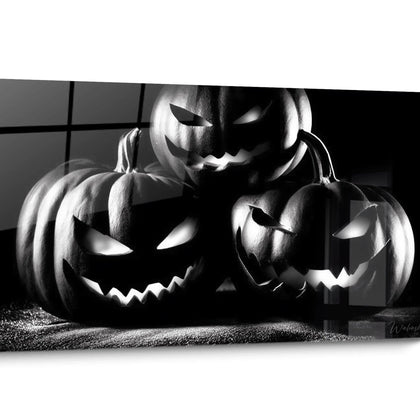
The black and white Halloween wall art represents a sophisticated approach to autumn decoration, far removed from traditional ornaments with bright colors. This monochrome aesthetic offers a contemporary and minimalist interpretation of the Halloween universe, where dramatic contrasts replace conventional orange hues. Unlike colorful compositions, this restricted color palette creates a refined gothic atmosphere particularly suited to modern interiors and professional spaces that want to mark the season without compromising their visual identity. The large dimensions of these wall artworks accentuate the visual impact of shadows and light play, transforming each silhouette, each motif into a powerful graphic element capable of dominating an entire wall without creating color overload.
The Art of Monochrome Contrast for Halloween
The black and white Halloween wall art exploits the fundamental principles of contrast to generate exceptional visual tension. This chromatic restriction amplifies every graphic detail: skeletal silhouettes stand out with surgical sharpness against clear backgrounds, while deep shadows sculpt imaginary reliefs that evoke the atmosphere of German Expressionist films. This monochrome approach fits perfectly with contemporary decorative trends favoring minimalism and sophistication.
Why choose a monochrome palette for Halloween decoration?
The absence of color allows for harmonious integration into already established decorative environments. Unlike traditional seasonal decorations that disrupt the color balance of a space, the black and white Halloween wall art naturally blends into minimalist, Scandinavian or industrial interiors. This chromatic neutrality ensures exceptional versatility: the same visual adapts equally well to a light-toned living room or a library with dark woodwork. The monumental formats reinforce this graphic presence without ever creating visual cacophony.
Gothic motifs in monochrome aesthetics
Black and white representations magnify Halloween's gothic archetypes: ornamental skulls engraved with precise anatomical details, stylized spiders with geometric legs, Victorian mansions with illuminated windows. This chromatic restraint confers an artistic dimension comparable to old engravings or medieval manuscript illustrations. For those who also appreciate colorful representations, the Halloween pumpkin wall art offers a complementary alternative with traditional autumn tones.
How does monochrome amplify the mysterious atmosphere?
The elimination of color forces the eye to focus on shapes, suggested textures and tonal gradations. This economy of means paradoxically generates increased perceptual richness: each shadow zone becomes a source of questioning, each white surface evokes spectral light. Large-scale compositions transform this dynamic into an immersive experience, where the gaze continuously explores new details in subtle variations between deep grays and brilliant whites. This approach is particularly suited to commercial spaces seeking elegant seasonal decoration.
- Maximal visual contrast creating imposing wall presence
- Universal chromatic compatibility with all decorative styles
- Timeless aesthetic transcending seasonal trends
- Artistic dimension evoking classical engraving and illustration
Gothic Sophistication and Minimalist Modernity
The black and white Halloween wall art embodies the fusion between traditional gothic imagery and contemporary aesthetic requirements. This synthesis allows evoking the Halloween universe without resorting to childish visual codes or caricatural representations. Large dimensions reinforce this decorative legitimacy, transforming what might be perceived as temporary ornamentation into a genuine architectural element capable of structuring a space visually.
Monochrome elegance in professional spaces
Commercial environments, professional offices or reception areas find in the black and white Halloween wall art a solution to mark the season without compromising their brand image. A fine dining restaurant, fashion boutique or design studio can install these monumental compositions that celebrate Halloween while maintaining sophisticated visual coherence. This chromatic neutrality eliminates the risk of discordance with existing graphic charter while signaling attention to seasonal events.
What atmosphere do skeletal motifs in black and white create?
Stylized anatomical representations in monochrome evoke nineteenth-century scientific plates rather than conventional festive decorations. This visual reference cultivates an atmosphere of curiosity cabinet, ancient library or natural history museum. The imposing formats amplify this museum dimension, transforming the wall into a window open to a parallel universe where death becomes a subject for aesthetic contemplation rather than superficial fright.
Shadow play in monochrome Halloween decoration
The black and white Halloween wall art masterfully exploits gradations to suggest depth and movement. The cast shadows of silhouettes create overlapping effects that enrich the composition without adding chromatic complexity. This visual economy generates optimal legibility even from a distance, an essential quality for large-format artworks meant to be appreciated from different viewpoints in an extended space. The absence of distracting colors maintains attention on compositional structure and formal relationships between elements.
- Adaptability to demanding professional environments
- Sophisticated cultural references to curiosity cabinets
- Optimal visual legibility through frank contrasts
- Museum dimension conferring artistic legitimacy
Timelessness and Decorative Versatility of Monochrome
Unlike seasonal decorations with saturated palettes that explicitly mark a limited calendar period, the black and white Halloween wall art benefits from extended temporality. This chromatic restraint allows for display that far exceeds the strict framework of late October: installed from September, it can remain relevant through winter celebrations without creating seasonal discord. This display longevity optimizes decorative investment, particularly for monumental formats.
How to extend the presence of Halloween decoration?
Monochrome aesthetics transcend seasonal color associations. While an orange composition immediately signals October, black and white simultaneously evoke gothic elegance, Victorian aesthetics and contemporary minimalism. This multiple referentiality authorizes early installation from early autumn and late preservation that can extend through winter, a period when interiors naturally favor pared-down palettes. Large dimensions reinforce this legitimacy as permanent decoration rather than temporary accessory.
Integration into permanent decoration
Some space owners cultivating gothic, industrial or minimalist aesthetics choose to maintain their black and white Halloween wall art year-round. This decision rests on the intrinsic graphic quality of compositions which, stripped of their strict calendar associations, function as genuine wall artworks. Anatomical, architectural or natural motifs (bare branches, spectral moons) possess visual validity independent of Halloween celebration, particularly when they occupy substantial wall surfaces.
Which spaces benefit most from monochrome Halloween?
Environments with strict chromatic constraints derive the most benefit from this approach: industrial lofts with raw surfaces, commercial galleries with minimalist visual identities, multi-purpose event spaces requiring adaptable decoration. Contemporary bedrooms adopting a black-white-gray palette naturally welcome these compositions that enrich the atmosphere without disturbing established balance. Generous dimensions allow creating a dramatic focal point even in spacious volumes where reduced formats would be visually lost.
- Extended display period from September to December
- Possibility of permanent integration into certain decorative styles
- Adaptability to spaces with strict chromatic constraints
- Creation of dramatic focal points in large volumes
Does black and white Halloween wall art suit colorful interiors?
Absolutely. Monochrome functions as a visual balance element in chromatically charged environments, offering a visual rest zone that valorizes surrounding colors by contrast without competing with them.
Can multiple black and white Halloween wall artworks be combined?
Monochrome compositions lend themselves particularly well to multiple wall installations. Chromatic uniformity guarantees visual coherence even with varied motifs, allowing creation of sophisticated thematic galleries on large wall surfaces.
Does black and white Halloween wall art work in bright spaces?
Highly illuminated environments amplify monochrome contrasts, reinforcing silhouette sharpness and compositional dramatic intensity. This interaction with natural lighting creates visual dynamics that evolve throughout the day.


 Pumpkins Sinister Smiles Painting - halloween edition233,90 €
 Pumpkin Painting Ancient Curse - Halloween Edition233,90 €
 Skull Painting Vapors from Beyond - Halloween Edition233,90 €