


Modern Frog Wall Art
Our Modern Frog Painting collection celebrates the perfect union of nature and contemporary art. These original works transform the iconic amphibian into a symbol of design wall decoration, bringing a touch of freshness and boldness to your interior. Each creation reveals a contemporary artistic style unique, playing with vibrant colors and innovative graphic compositions. Ideal for lovers of nature art and trendy decor, these paintings bring dynamism and character to all your living spaces.
 Frog Painting N°3 - Animals Edition273,90 €
 Frog Wall Art No. 2 - Animals Edition273,90 €
 Frog Painting No.1 - Animal Edition273,90 €
Explore further
In Modern Frog Wall Art


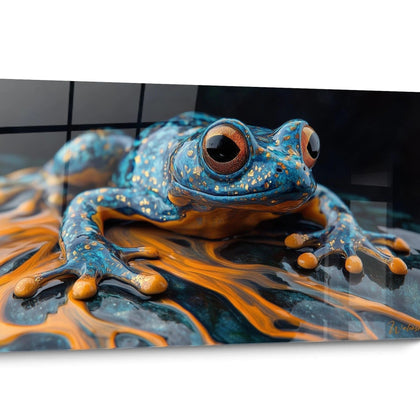
All about Modern Frog Wall Art
- Presentation Frog Painting Modern
- Contemporary Design and Aesthetics
- Integration into Current Habitat
- Selection and Expert Advice
The frog painting modern represents a bold fusion between animal art and contemporary aesthetic codes. These large-scale wall creations transform traditional naturalist iconography into a true urban decorative manifesto. Unlike classic representations focused on botanical realism, these compositions exploit clean lines, graphic blocks, and geometric recompositions to celebrate the amphibian in a resolutely current light. Designed for minimalist living spaces, industrial lofts, and architectural interiors, these large-format works stand out as focal points capable of visually structuring space while infusing an unexpected organic dimension. Their monumental presence dialogues with designer furniture and contemporary volumes to create a stimulating decorative tension that values both fauna and innovative artistic approach.
The Visual Language of the Modern Frog Painting
The aesthetics of the modern frog painting are distinguished by a radical reinterpretation of traditional animal representation. Contemporary artists deconstruct amphibian morphology to extract its graphic essence: globular eyes transformed into perfect circles, silhouette simplified into geometric shapes, skin texture translated into abstract patterns. This minimalist approach paradoxically reinforces the visual impact of these large-format wall compositions.
What graphic techniques define the modern frog style?
Current creations widely exploit flat design, subtle gradients, and layer overlaps to generate depth without falling into hyperrealism. Clean outlines, sometimes emphasized by affirmed black lines, recall pop art imagery while maintaining a sophistication suitable for high-end interiors. Asymmetrical compositions create a dynamism that captures the eye and generates movement in the static space.
Color Palettes and Architectural Contrasts
If you are looking for bold chromatic explosions, the colorful frog painting offers a complementary alternative. However, the modern approach often favors more restricted harmonies: sophisticated monochromes declining charcoal gray and off-white, contrasting black-gold or navy blue-copper two-colors, mastered triads associating emerald greens, deep blacks and metallic accents. These refined color choices naturally integrate into Scandinavian, industrial or neoclassical environments.
Monumental Formats and Sculptural Presence
The generous dimensions characteristic of these wall creations — often beyond 120 centimeters in width — give them a quasi-sculptural presence. This imposing scale transforms the modern frog painting into a true artistic installation capable of redefining the proportions of a room. The enlarged amphibian acquires an unexpected majesty, inverting the usual dominance relationships between nature and domestic architecture.
Integrating the Modern Frog Painting into Contemporary Habitat
The successful implementation of a modern frog painting in a living space relies on a fine understanding of the interactions between monumental work and interior architecture. These stylized animal compositions excel particularly in environments where raw materials predominate — polished concrete, brushed steel, tempered glass — bringing an organic touch that humanizes without sweetening contemporary rigor.
Privileged Spaces for an Amphibian Artistic Statement
Double-height living rooms and mezzanines are ideal locations for these large-format artworks. The eye is naturally drawn upwards, fully capitalizing on their potential verticality, while the space offered by generous volumes allows for appreciation of the overall composition. Forward-thinking professional spaces – creative agencies, architecture firms, design showrooms – also adopt these representations to assert a bold and memorable visual identity.
How does the modern frog painting structure the visual space?
Beyond its decorative function, this wall creation acts as a spatial organizer. Strategically placed, it visually defines zones in open plans without resorting to physical partitions. Its color scheme and graphic intensity create an attraction point that naturally orients circulation and mentally structures the space. In ultra-modern open-plan kitchens, it marks the transition between a functional culinary area and a convivial space.
Material associations and textural dialogues
The decorative effectiveness of the modern frog painting is multiplied when it dialogues with contrasting materials. Against a brick wall, it generates a fertile tension between industrial roughness and graphic sophistication. Facing light Scandinavian wood panels, it injects a dose of controlled eccentricity. Paired with living vegetation – stabilized vertical garden, XXL tropical plants – it creates a coherent ecosystem narrative that symbolically connects interior and natural biotope.
Scenographic lighting to amplify the visual impact
The imposing formats of these compositions greatly benefit from directional lighting. Track-mounted spotlights allow sculpting of any possible reliefs and intensifying chromatic contrasts at dusk. Indirect lateral lighting generates atmospheric halos that visually detach the artwork from the supporting wall, reinforcing its three-dimensional presence and its status as an autonomous artistic object rather than a simple wall covering.
Selection Criteria for an Impactful Modern Frog Painting
Acquiring a modern frog painting intended to visually dominate a space requires a rigorous selection methodology. Beyond immediate aesthetic affinity, several technical and conceptual parameters determine the long-term relevance of this decorative investment in your daily environment.
Stylistic coherence between artwork and interior architecture
The first step is to objectively analyze the formal language of your habitat. An interior with organic and curved lines calls for a modern frog painting with fluid contours and sinuous compositions. Conversely, a rectilinear and minimalist architecture will harmonize better with geometric representations, with flat areas and axial compositions. This stylistic correspondence guarantees a natural integration rather than a forced juxtaposition.
What dimension should you choose according to the spatial configuration?
For the main walls of living rooms exceeding 25 square meters, prioritize formats exceeding 150 centimeters in the main dimension. This generous scale avoids the “stamp” effect where the artwork visually disappears into the immensity of the wall. Approximately calculate that the width of the composition should represent between 50% and 75% of the width of the main furniture below – sofa, console, buffet – to create a harmonious proportional balance.
Visual complexity and perceptual fatigue
A frequently overlooked criterion concerns the information density of the image. Minimalist compositions with a few graphic elements support prolonged daily visual exposure without generating saturation. Creations rich in details and superimpositions initially deliver maximum impact but can, in the long term, create excessive cognitive load in resting spaces. Adapt the visual complexity to the function of the room: maximum graphic sophistication for entrances and hallways, contemplative simplicity for bedrooms.
Why prioritize creations in limited editions?
Limited edition paintings produced in small or numbered series offer double added value. On the one hand, they guarantee relative exclusivity that preserves the distinctive character of your interior decoration. On the other hand, they represent a potentially valuable investment if the artist or design studio gains recognition. Always require a certificate of authenticity mentioning the print run and position in the series.
Durability and environmental resistance
Large formats exposed in living rooms are subject to significant environmental constraints: hygrometric variations, indirect light exposure, seasonal temperature variations. Verify that manufacturing processes include UV protection to prevent progressive discoloration, anti-humidity treatments for less ventilated rooms, and reinforced fixings capable of permanently supporting the considerable weight of monumental formats.
Is a modern frog painting suitable for professional spaces?
Absolutely. These creations are gradually imposing themselves in the lobbies of innovative companies, trendy coworking spaces, and avant-garde medical practices. They humanize the professional environment while asserting a memorable visual identity that differentiates the employer brand. Their less conventional character than classic geometric abstractions stimulates creativity and encourages informal interactions around an unexpected conversation piece.
How to maintain a large-format modern frog painting?
Maintenance generally involves dusting every three months with a dry antistatic microfiber cloth. For matte finishes, absolutely avoid detergents that would create irreversible halos. Glossy or satin finishes tolerate gentle cleaning with a slightly damp cloth, always in circular motions from the center outwards to prevent streaks. Annually check the solidity of the wall fixings, as the weight can generate progressive deformation of the anchors.
Can multiple frog paintings be combined in the same room?
This approach only works if the works share a strong stylistic coherence—even a restricted palette, similar graphic treatment, proportional formats. Installation in a diptych or triptych requires precise spacing, generally between 5 and 10 centimeters, to create a visual unity without confusing fusion. Instead, prefer a single modern frog painting as a centerpiece, complemented by secondary decorative elements in other registers to avoid thematic redundancy.
Further reading
Our articles on this topic
- Green harmonies: how to pair a frog painting with your décor
- Frog painting with water lily leaf in boho style: which palette to choose for your room
- Glowing jellyfish painting: the centerpiece of a modern living room
- Frog painting by age and colour: composing a harmonious children's room
- Green frog painting on black background: which lighting to make the contrast shine
- Frog painting: the modern living room décor that breaks away from classic animals
L'art qui suscite l'envie
Maison belge d'art mural grand format
14 jourspour changer d'avis*
Protection Walenskyincluse
Fabriquéen Italie
FormatXXL
Kit de fixationtoujours fourni
* Hors tableaux personnalisés et tailles personnalisées


