


Realistic Russian Blue Cat Wall Art
The Painting Russian Blue Realistic captures all the nobility of this exceptional feline breed. Each artwork highlights the silver coat, emerald eyes, and natural elegance of the Russian blue cat in wall art. Perfect for cat lovers, this realistic cat decorative painting transforms your living room, bedroom, or office into a feline art gallery. The attention to detail and expressiveness of the gaze create a unique artistic presence that enhances your interior decoration.
 Cat Painting with Emerald Green Eyes - Piercing Gaze - Russian Blue Cat Edition273,90 €
 Russian Blue Cat Eyes Painting - Emerald Gaze - Russian Blue Cat Edition273,90 €
 Russian Blue Cat at the Window Painting - Contemplation in the Rain - Russian Blue Cat Edition273,90 €
 Green-Eyed Cat Painting - Hypnotic Gaze - Russian Blue Cat Edition228,90 €
 Sitting Russian Blue Cat Painting - Elegant Portrait - Russian Blue Cat Edition228,90 €
Explore further
In Realistic Russian Blue Cat Wall Art
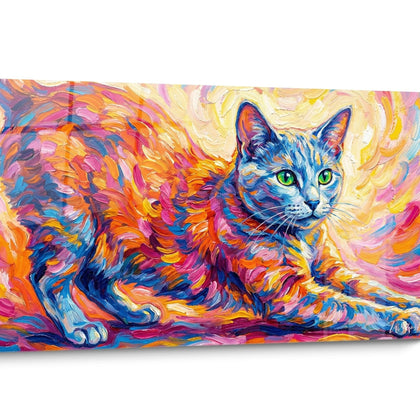
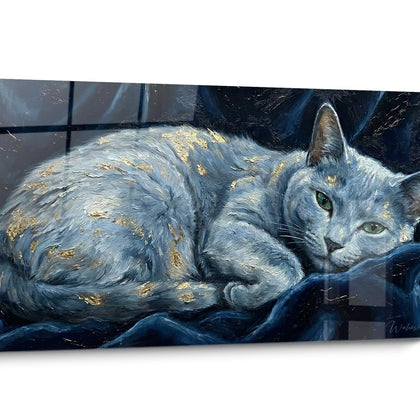
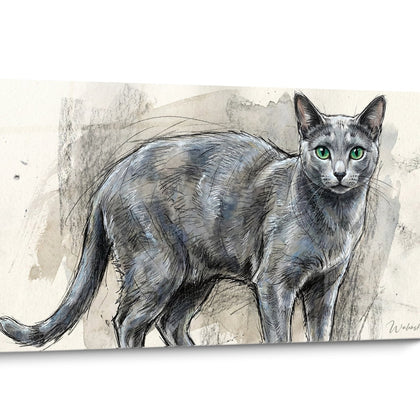
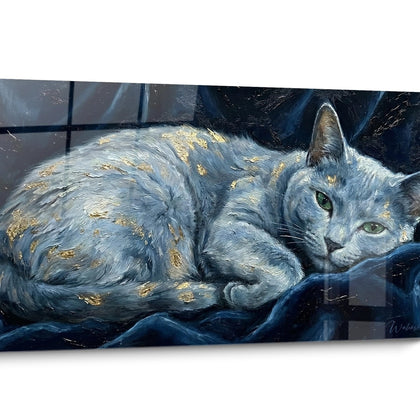
All about Realistic Russian Blue Cat Wall Art
- Painting Presentation Realistic Russian Blue
- Enhance feline authenticity
- Capture the hypnotic gaze
- Magnify the silver coat
A painting Russian Blue cat realistically captures the natural elegance of this aristocratic breed with photographic precision that transcends simple wall decor. Each anatomical detail is rendered with exceptional fidelity, revealing the velvety texture of the blue-gray coat, the emerald intensity of the gaze, and the graceful musculature characteristic of these refined felines. These large-format representations instantly transform a space into a true gallery dedicated to contemporary animal art, offering a visually captivating and soothing presence for lovers of authentic feline beauty.
Hyperrealism at the service of the Russian Blue feline nobility
The Russian Blue cat realistic painting is distinguished by its ability to reproduce with microscopic accuracy the unique physiological characteristics of this iconic breed. The faithful representation of the dense double coat, where each hair seems individually traced, creates a striking three-dimensional effect that gives the illusion of an enlarged photograph of monumental dimensions. This hyperrealistic approach requires careful observation of the specific morphology of the Russian Blue: the wedge-shaped skull, the triangular ears with slightly rounded tips, and above all this aristocratic profile that distinguishes this breed from other domestic felines.
Why prioritize anatomically accurate representation?
Anatomical authenticity is the very foundation of a convincing realistic Russian Blue painting. The exact proportions between the head, body, and limbs create a visual harmony instantly recognizable by connoisseurs of the breed. The graceful but powerful musculature, characteristic of these cats of Russian origin, must transpire beneath the coat with a subtlety that avoids excess while affirming the animal's natural vigor. This anatomical precision ensures that the work resonates emotionally with Russian Blue owners who will immediately recognize the distinctive traits of their companion.
Capturing characteristic facial expressions
A high-quality realistic painting captures not only the physical appearance but also the range of expressions specific to the Russian Blue cat. The slightly distant but curious gaze, the position of the whiskers betraying the emotional state, and this smile sketched naturally by the conformation of the lips are essential narrative elements. These expressive subtleties transform a simple representation into a true psychological portrait, offering an emotional depth that establishes an immediate connection between the viewer and the work.
The importance of the natural environmental context
The most successful realistic representations integrate contextual elements that reinforce the authenticity of the scene without distracting from the main subject. A background suggesting the refined domestic environment preferred by these aristocratic felines, or soft natural light that accentuates the subtle chromatic variations of the coat, enriches the overall composition. These contextual details create a narrative atmosphere that invites the viewer to imagine the reserved but affectionate behavior typical of the breed, transforming the work into a window open on a moment of authentic feline life.
Emerald intensity: signature of the realistic Russian Blue
How does the eye rendering determine the quality of a realistic painting?
The eyes undoubtedly constitute the focal element of a painting of a Russian Blue cat of exceptional quality. This breed is characterized by emerald green irises, sometimes described as bottle green, whose chromatic richness varies depending on the angle of the light. Faithful representation requires capturing not only the exact shade but also the translucent depth of the iris, the subtle tonal variations between the center and the periphery, as well as the luminous reflections that give life and expressiveness to the gaze. A precise rendering of the elliptical pupils, the dilation of which varies according to the suggested light intensity, adds a temporal dimension to the work by capturing a specific moment.
The technique of the following gaze in large format
The monumental dimensions of a realistic painting allow for the exploitation of the "following gaze" optical effect, where the eyes seem to accompany the movement of the viewer in space. This perceptual illusion, particularly powerful with representations of Russian Blues whose gaze intensity is legendary, creates an almost living presence in the room. The precise orientation of the gaze – whether it is direct, slightly averted, or fixed on an imaginary point off-screen – establishes the emotional tone of the whole and determines the nature of the interaction between the work and its audience. A modern painting of a Russian Blue cat can exploit this technique to create dynamic compositions.
Pupillary reflections as markers of authenticity
Micro-reflections in the pupils constitute one of the tests of authenticity of an accomplished realistic rendering. These tiny points of light, often asymmetrical between the two eyes, reveal the light source of the scene and anchor the animal in a specific environment. The meticulous representation of the partially visible nictitating membrane, the delicate tracery of blood vessels in the sclera, and the slightly striated texture of the iris transform the gaze from a simple colored surface into a credible three-dimensional anatomical structure.
Emotional expression through the peri-ocular region
The area surrounding the eyes – vestigial eyebrows, subcutaneous facial muscles, eyelid position – subtly communicates the feline's emotional state. A sophisticated realistic painting captures these micro-expressions that differentiate a calm and confident gaze from a watchful or playful gaze. This expressive subtlety, combined with the large dimensions of the work, allows for a distant emotional reading that considerably enriches the daily decorative experience.
The chromatic complexity of the blue-silver coat in realistic representation
Why does the coat of the Russian Blue represent a unique artistic challenge?
The coat of the Russian Blue constitutes one of the most demanding challenges in realistic feline representation. This breed presents a unique coloration qualified as "blue" but which turns out to be a deep gray with silvery reflections, created by individually bluish hairs ending in translucent tips. A realistic painting of a Russian Blue cat of superior quality reproduces this chromatic complexity by capturing the subtle tonal variations between the different body areas: the back slightly darker, the belly lighter, and the extremities which may present a more intense blueness. This chromatic modulation requires a sophisticated palette of cold grays, desaturated blues and silver reflections that interact with the represented light.
The velvety texture and "double coat" effect in two dimensions
The most distinctive characteristic of the Russian Blue's coat lies in its exceptionally dense and velvety texture, a result of an abundant undercoat covered with guard hairs of equal length. In realistic representation, this textural particularity must be suggested by rendering techniques that create the illusion of depth and tactile softness. Shadow and light areas are treated with an extremely gradual gradation that avoids harsh contrasts, mimicking the way light is absorbed and diffused by the exceptional density of the coat. This approach visually creates an irresistible desire to touch the surface, testing the boundaries between representation and reality.
The play of light on the silver coat
The interaction between light and coat is an essential narrative element in a realistic painting. The fur of the Russian Blue, with its silver tips, creates particularly spectacular halo light effects under certain lighting. A realistic rendering captures these optical phenomena: the concentrated areas of brilliance along the spine, the luminous halo on the contours exposed to a lateral light source, and the variations in chromatic saturation according to the angle of incidence of light. These subtleties transform a static representation into a dynamic composition that seems to evolve according to the ambient lighting of the room where it is exhibited, particularly with a golden Russian Blue cat painting which accentuates these precious reflections.
The direction of the fur as a compositional element
The orientation of the hairs follows precise anatomical patterns that contribute to the credibility of a realistic representation. The directional flow of the fur – from the nose to the back, from the spine to the flanks – creates lines of force that guide the viewer's eye through the composition. An accomplished artist exploits these natural directions to visually structure the work, creating areas of varied texture that avoid monotony while respecting the actual anatomy. This attention to micro-details fundamentally differentiates a photographically accurate representation from a minimalist Russian Blue cat painting.
Is a realistic painting of a Russian Blue suitable for all interior styles?
Animal hyperrealism particularly integrates well into contemporary, chic classic, and refined Scandinavian interiors. The naturally subdued color palette of the Russian Blue – gray, desaturated blue, silver touches – harmonizes with the majority of decorative schemes without creating a visual conflict, while bringing a touch of natural sophistication.
What viewing distance optimizes the experience of a realistic Russian Blue cat painting?
Large dimensions allow for a double reading: at a medium distance (2-3 meters), the photographic effect is striking and the entire composition is revealed; in close approach, the technical details – fur texture, eye reflections, chromatic subtleties – offer an enriched contemplative experience that rewards prolonged observation.
How does a realistic painting of a Russian Blue influence the atmosphere of a room?
The presence of a feline with an intense gaze naturally creates a soothing focal point that attracts the eye without agitation. The Russian Blue, known for its calm and reserved temperament, visually conveys these qualities through its characteristic expression, contributing to a serene and contemplative atmosphere particularly appreciated in rest or concentration areas.


