


French Bulldog Black and White Wall Art
The French Bulldog Black and White painting captures all the endearing personality of this iconic breed in a refined monochrome aesthetic. Our collection celebrates the irresistible charm of the French bulldog through artistic compositions with contrasting elements that enhance its expressive features. Each French bulldog wall art painting brings a touch of contemporary elegance to your interior. Perfect for dog lovers and fans of minimalist black and white decor, this wall art transforms your spaces into dedicated galleries for this unique companion.
 French Bulldog Black and White at Window Wall Art - Urban Melancholy - French Bulldog Edition273,90 €
 Black French Bulldog Under Swirling Starry Night - Cosmic Dream - French Bulldog Wall Art Edition273,90 €
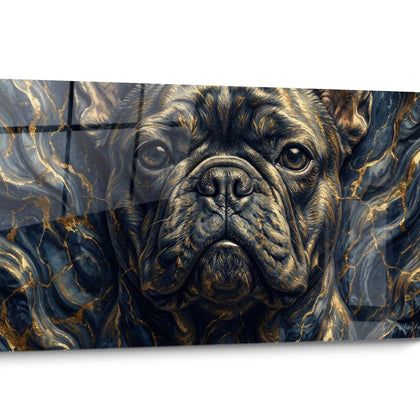
 French Bulldog Black and Gold Portrait Wall Art - Intense Gaze - French Bulldog Edition228,90 €
Explore further
In French Bulldog Black and White Wall Art

All about French Bulldog Black and White Wall Art
- Presentation Painting Bulldog French Black and White
- Monochrome Elegance
- Decorative Impact
- Graphic Composition
The painting of the French bulldog in black and white represents the perfect alliance between canine expressiveness and contemporary minimalist aesthetics. This monochrome representation captures the endearing personality of the bulldog in a reduced palette that enhances every anatomical detail: the characteristic wrinkles of the face, the bat-like ears, and that penetrating gaze typical of the breed. The absence of color transcends simple decoration to create a powerful graphic work, where dramatic contrasts between deep shadows and bright lights transform your space into a modern art gallery. This binary color choice is particularly suitable for sophisticated interiors seeking a timeless masterpiece, capable of weathering decorative trends without ever losing its visual impact.
Monochrome Aesthetics Serving Canine Expression
The painting of the French bulldog in black and white exploits the narrative power of monochrome to reveal the deep soul of this iconic breed. By eliminating chromatic distraction, the work focuses attention on the singular anatomy of the bulldog: its flattened muzzle with unique proportions, expressive eyebrows creating a fascinating range of emotions, and that wrinkled skin texture that tells the genetic history of the breed. Shades of gray create sculptural depth, transforming each facial fold into a memorable graphic element.
Why choose a monochrome representation rather than a colored one?
This reduced chromatic approach amplifies the dramatic impact of the image by creating a radical contrast with the environment. Unlike pop art representations saturated with bright colors, black and white establishes a sober elegance that harmoniously integrates into minimalist, Scandinavian or industrial decors. The play of shadows accentuates the compact musculature of the bulldog, revealing its robust stature and particular anatomical balance.
Tonal variations and their decorative significance
A large-format black and white French bulldog painting explores different contrasted intensities. High-key versions favor light tones with delicate grays, creating a soft and soothing atmosphere perfect for bedrooms or relaxation areas. Conversely, low-key compositions plunge into deep blacks with strategic bursts of light, generating a captivating visual tension for contemporary living rooms or offices. This tonal duality allows for precise adaptation of the emotional atmosphere according to the intended space.
The timelessness of chromatic binary
While golden interpretations respond to specific luxurious trends, monochrome transcends eras without alteration of relevance. This chromatic neutrality guarantees exceptional decorative longevity, resisting stylistic evolutions. The painting affirms itself as a durable aesthetic investment, particularly judicious for professional or commercial spaces requiring a stable and professional image over several years.
Architectural Impact and Spatial Structuring
The installation of a large-format painting of the French bulldog in black and white fundamentally restructures the volumetric perception of a room. This monochrome presence functions as a visual anchor point, creating a reading axis around which other decorative elements are organized. In open spaces with expansive white walls, this graphic concentration avoids visual dispersion by focusing attention on a specific area, transforming an empty wall into an intentional visual destination.
How does an animal monochrome change the perceived luminosity?
Unlike the common perception associating black and white with darkness, a well-composed monochrome French bulldog painting actively redistributes ambient light. Pure white areas reflect natural or artificial brightness, creating points of brilliance that energize the space. Dark masses absorb and structure, creating a three-dimensional depth that adds relief to flat surfaces. This luminous interaction far surpasses that of watercolor versions with diluted tones.
The balance of visual masses in space
The compact and muscular silhouette of the French bulldog generates a concentrated visual density, particularly effective in vertical or square compositions. This graphic mass functions as an aesthetic counterweight to dominant architectural elements: an imposing fireplace, an extended bay window, or bulky furniture. The large format accentuates this spatial balancing function, preventing a single architectural element from monopolizing visual attention.
Compatibility with contemporary raw materials
The French bulldog painting in black and white naturally dialogues with industrial materials: polished concrete, brushed steel, untreated raw wood. This material affinity creates a sensory coherence between the wall surface and three-dimensional elements. In lofts and urban apartments characterized by the exposure of structures, this monochrome work amplifies the raw aesthetic without artificially softening it. The apparent textures of the support reinforce the authenticity of the entire decoration, creating a coherent and assumed universe.
Graphic Composition and Canine Visual Language
The creation of a black and white French bulldog painting relies on strategic compositional choices that determine the final emotional intensity. The close framing on the face, prioritizing direct frontal gaze, establishes an immediate psychological connection with the viewer. This perceptual proximity transforms the animal into a subject portrait in its own right, conferring dignity and human presence to the representation. The absence of environmental context concentrates the characteristic essence of the bulldog in a memorable graphic reduction.
What shooting angles maximize expressiveness?
A slightly three-quarter, low-angle shot enhances the stature of the French bulldog while capturing the complexity of its facial expressions. This perspective simultaneously reveals the width of the skull, the prominence of the globular eyes, and the characteristic implantation of the ears. Photographers and illustrators prefer this point of view for monochrome compositions intended for large formats, as it maintains the balance between physical power and the typical endearing vulnerability of the breed.
The treatment of textures in chromatic binary
Faithfully reproducing the texture of the short coat of the bulldog in black and white requires a particular technical mastery of halftones. Each shiny hair captures light differently, creating micro-tonal variations that distinguish a flat photographic reproduction from a sophisticated graphic work. The transition zones between shadow and light on the wrinkled muzzle constitute the ultimate test of quality, revealing technical know-how in the management of subtle gradients. This textural richness radically differentiates monochrome compositions from standard multicolored interpretations .
Symbolism of contrast and emotional perception
The choice to accentuate or soften contrasts fundamentally alters the emotional reading of the subject. Deep blacks and vibrant whites generate dramatic tension, conferring an authoritative and imposing presence on the bulldog. Gentle transitions in mid-tones produce a nostalgic and contemplative atmosphere, further humanizing the animal. This expressive flexibility allows for precise adaptation of the artwork to the psychological atmosphere sought in the installation space.
Visual hierarchy and focal points
In a successful monochrome composition, the eye follows an intentional path orchestrated by contrasts in light. Typically, the bulldog's eyes constitute the primary visual entry point, reinforced by strategic highlights. The gaze then progresses to the expressive wrinkles of the forehead, then explores the characteristic ears before discovering the subtleties of the muzzle. This visual choreography maintains the observer's prolonged engagement, transforming passive contemplation into active exploration of anatomical details.
Would a black and white French bulldog painting be suitable for professional spaces?
Absolutely, its chromatic neutrality and understated elegance blend perfectly into offices, medical practices, or coworking spaces seeking distinctive but non-controversial decor. The French bulldog conveys values of loyalty and asserted character particularly appreciated in professional environments.
What is the optimal viewing distance for a large-scale black and white French bulldog painting?
For a format exceeding 100 centimeters, a viewing distance of 2.5 to 3 meters allows you to embrace the overall composition while perceiving the textural details. This distance simultaneously reveals the overall graphic power and the subtlety of tonal nuances, offering a complete visual experience that justifies the investment in a large format.
Does the black and white French bulldog painting require specific lighting?
Indirect lateral lighting ideally enhances contrasts by avoiding parasitic reflections, particularly for satin finishes. The absence of colors to be faithfully reproduced simplifies lighting constraints, allowing greater flexibility in the choice of light sources compared to demanding polychrome works.
L'art qui suscite l'envie
Maison belge d'art mural grand format
14 jourspour changer d'avis*
Protection Walenskyincluse
Fabriquéen Italie
FormatXXL
Kit de fixationtoujours fourni
* Hors tableaux personnalisés et tailles personnalisées


