


Spiral Galaxy Wall Art
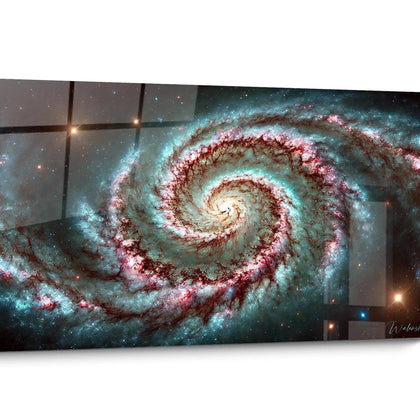
The Spiral Galaxy painting captures the hypnotic majesty of the universe and its swirling celestial formations. This artistic collection transforms your interior into a true cosmic observatory, where each work reveals the mysteries of cosmic spiral nebulae and the sidereal infinity. Perfect for astronomy and contemporary art enthusiasts, it offers a spatial wall decoration that awakens the imagination and enhances your living spaces with elegance.
 Spiral Galaxy Painting - Luminous Cosmos - Galaxy Edition273,90 €
 Galaxy Spiral Painting - Cosmic Vision - Galaxy Edition273,90 €
 Andromeda Galaxy Painting - Cosmic Vision - Galaxy Edition273,90 €
 The Eye of the Universe Painting - Galaxy Space Edition273,90 €
 Echoes of the Stars - Galaxy Space Edition273,90 €
 Galactic Dance Wall Art - Space Edition273,90 €
Explore further
In Spiral Galaxy Wall Art


All about Spiral Galaxy Wall Art
- Spiral Galaxy Wall Art Presentation
- Immersive Cosmic Decoration
- Visual Impact and Depth
- Symbolism and Atmosphere
A spiral galaxy wall art captures the very essence of those majestic cosmic formations that populate our observable universe. These large-scale wall representations radically transform your space by creating a visual window into spatial infinity, where luminous spiral arms draw hypnotic trajectories against a backdrop of deep nebulosity. Unlike simple static astronomical representations, these compositions reveal the swirling dynamics characteristic of spiral galaxies like our Milky Way, with their structures rotating perpetually around a brilliant galactic nucleus. The visual attraction exerted by these works rests on their ability to reproduce the natural fractal geometry of spiral arms, creating an effect of perpetual movement that guides the eye in endless exploration. For astronomy enthusiasts and bold spatial decoration lovers, these artworks offer a striking alternative to conventional galactic representations, prioritizing the distinctive architectural structure of rotating galaxies rather than generic diffuse views.
The Swirling Architecture of Spiral Arms in Wall Decoration
The visual DNA of a spiral galaxy wall art resides in its ability to reproduce the characteristic morphology of Sb and Sc type galaxies, where luminous arms wind according to precise logarithmic angles. This natural geometry creates a magnetic focal point that works particularly well in reflective spaces like creative offices or lounges dedicated to contemplation. The spiral structure naturally generates visual guidelines that direct the eye in a perpetual circular movement, accentuating the perception of spatial depth far beyond the wall support.
How does galactic rotation influence spatial perception?
The cosmic spiral formations reproduced on these large-scale artworks exploit the psychological phenomenon of retinal persistence: the eye instinctively follows the curves of galactic arms from the central nucleus toward peripheral regions scattered with stellar clusters. This visual dynamic transforms a static wall into an animated surface, particularly effective in rooms with generous dimensions where the swirling effect can be appreciated from multiple viewing angles. The star-forming regions represented along the spiral arms create secondary visual anchoring points that enrich the contemplative experience.
Complementarity with other cosmic representations
To accentuate the astronomical atmosphere, many associate their spiral galaxy wall art with other celestial evocations like a blue and gold galaxy wall art that brings complementary chromatic signature, with gold enhancing stellar concentration zones while blue evokes ionized gas regions. This wall composition strategy creates a coherent cosmic panorama that evokes the morphological diversity of galactic structures observable in the distant universe.
The kinetic effect of rotating structures
The representation of spiral arms generates a subtle optical illusion of rotation when observed in peripheral vision, a phenomenon amplified in monumental formats exceeding 120 centimeters in diagonal. This sensation of silent cosmic movement confers meditative dimension to spaces, transforming moments of pause into contemplative journeys toward the depths of space. The luminous gradients along spiral trajectories reinforce this impression of perpetual energetic flow.
Spatial Depth and Visual Stratification of Galactic Structures
A spiral galaxy wall art in imposing format excels in creating multiple depth planes, an essential technique for evoking the vertiginous astronomical distances separating the galactic nucleus from peripheral regions. The visual superposition between the ultra-luminous central bulge, intermediate spiral arms, and diffuse background halos creates a layered architecture that actively engages the viewer's three-dimensional perception. This optical stratification works remarkably well in open spaces where visual distance allows simultaneous appreciation of all detail levels.
Stellar density zones as visual anchoring points
Along the spiral arms, HII regions and open clusters represented by localized luminous concentrations create visual landmarks that punctuate the eye's journey. These stellar accumulations mark the curved trajectory of galactic arms and prevent uniformity, offering temporary destinations for visual exploration before the eye resumes its outward course. In large wall formats, these details gain presence and can be appreciated individually during close observation, revealing unexpected compositional richness.
Why choose a spiral galaxy rather than an elliptical one for your decoration?
Unlike elliptical galaxies that present uniform decreasing luminosity from their center, spiral galaxy wall artworks offer structural complexity that maintains visual interest over time. Spiral arms introduce controlled asymmetries and texture variations that prevent monotony, an essential characteristic for an artwork intended for daily contemplation. This morphological richness justifies investment in generous formats where each spiral arm segment can express its distinctive visual personality.
The interaction between interstellar dust and luminous emissions
Quality representations integrate the contrast between dark absorption bands created by cosmic dust clouds and bright emission regions where new stars are born. This play of shadow and light within spiral arms generates visual relief that accentuates the sensation of tangible spatial matter rather than abstract emptiness. Subtle chromatic variations between different emitted wavelengths enrich the palette while maintaining scientific accuracy of the representation.
Symbolic Dimension and Psychological Resonance of Spiral Forms
Beyond their astronomical accuracy, spiral galaxy wall artworks convey universal symbolism deeply anchored in human psyche. The spiral constitutes a visual archetype present in countless cultures, evoking simultaneously expansion, evolution, and eternal cycle. When applied to galactic cosmic dimensions, this primordial form acquires particular philosophical resonance, inviting reflection on our position in the universe and on the perpetual transformation processes that govern the cosmos.
The spiral as metaphor for inner journey
Spiral arms that wind from a central nucleus toward galactic exterior create a visual metaphor for personal journey, oscillating between deep introspection and expansion toward new horizons. This inherent duality of spiral structures makes them ideal companions for spaces dedicated to meditation, artistic creation, or strategic reflection. The eye can choose to follow the spiral inward, in a concentrating movement, or outward in a gesture of openness, depending on the viewer's state of mind.
How does a spiral galaxy wall art influence nighttime atmosphere?
In reduced lighting conditions characteristic of evenings, a large-scale spiral galaxy wall art maintains its visual presence through marked luminous contrasts between the bright nucleus and darker peripheral zones. This persistent visibility makes it a particularly suitable decorative element for nighttime relaxation spaces, where it subtly evokes the celestial vault observable in clear skies. The spiral structure remains perceptible even in peripheral vision, creating a discrete yet constant cosmic presence.
The evocation of deep cosmic time
Spiral galaxies require several hundred million years to complete one full rotation, a vertiginous timescale that these wall representations allow to visually apprehend. This connection with deep time offers refreshing perspective against daily urgency, reminding us that our existence is inscribed in a cosmic dance with temporal and spatial dimensions that surpass understanding. For scientifically inclined minds, this evocation of deep time constitutes a major attraction justifying the acquisition of imposing formats.
Which room benefits most from a spiral galaxy wall artwork?
Vertical open spaces like staircases or double-height walls particularly value spiral compositions that naturally exploit vertical format in their architectural deployment. Personal offices where reflection and creativity are exercised also benefit from the meditative presence of a galactic structure, which stimulates imagination without creating excessive visual distraction. Rooms oriented toward contemplative relaxation constitute a third ideal context where cosmic spiral accompanies the transition to rest.
Is a spiral galaxy wall art suitable for modern professional spaces?
Absolutely, as spiral representation combines scientific rigor and contemporary aesthetics, creating an impression of intellectual seriousness particularly appropriate for technology sectors, consulting firms, or innovation spaces. The cosmic dimension evokes exploration and discovery, central values in many forward-looking professional environments.
How to maintain the visual impact of a spiral galaxy wall art over time?
Periodic rotation of placement or alternation with other cosmic representations maintains perceptual freshness, although the structural complexity of spiral arms naturally favors progressive discovery of new details even after years of daily observation. Adding accent lighting directed from below amplifies relief effects and renews the visual experience.
Do spiral galaxy wall artworks work in minimalist interiors?
Paradoxically, these dense cosmic representations integrate remarkably well into pared-down environments where they become the sole point of visual complexity, creating striking contrast with neutral wall surfaces. The unique monumental format respects minimalist principles by concentrating attention on a single exceptional artwork rather than scattered decorative accumulation.
L'art qui suscite l'envie
Maison belge d'art mural grand format
14 jourspour changer d'avis*
Protection Walenskyincluse
Fabriquéen Italie
FormatXXL
Kit de fixationtoujours fourni
* Hors tableaux personnalisés et tailles personnalisées


