


Realistic Pug Painting
The Carlin Realistic painting celebrates the endearing beauty of this iconic breed. Our collection captures the unique expression and irresistible charm of the pug with exceptional artistic precision. Each authentic pug portrait reveals the characteristic details of this affectionate companion: its large expressive eyes, its flattened nose, and its distinctive wrinkles. Perfect for dog lovers, our realistic decorative dog art brings a touch of tenderness and personality to your decor.
 Fawn Pug Running in Grass Painting - Spring Energy - Pug Edition273,90 €
 Pug in the Rain Painting with Gray Tones - Canine Melancholy - Carlin Edition273,90 €
 Reclining Pug Canvas with Beige and Brown Tones - Tender Look - Pug Edition273,90 €
 Pug in Wheat Field Under Storm - Golden Tempest - Pug Edition273,90 €
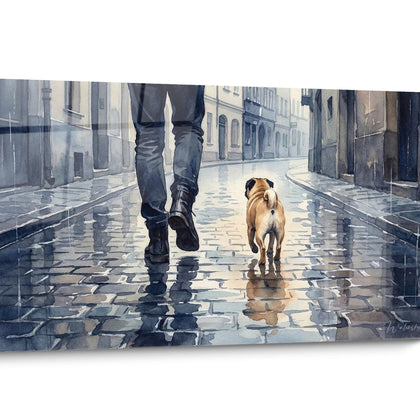
 Pug in the Rain on a Cobbled Street - Urban Complicity - Pug Edition273,90 €
 Fawn Pug Canvas with Warm Tones - Expressive Portrait in Painting - Pug Edition273,90 €
Explore further
In Realistic Pug Painting


All about Realistic Pug Painting
- Painting Carlin Réaliste Presentation
- Reproduire les Détails du Carlin
- Scènes de Vie Authentiques
- Capture des Expressions Faciales
A realistic carlin painting captures with photographic precision every anatomical detail, every skin fold, and every nuance of expression of this breed with such a characteristic face. Unlike stylized or graphic interpretations, this hyperrealistic approach enhances the unique physiology of the carlin: its expressive bulging eyes, its flat muzzle, and its deep facial wrinkles that give each subject a distinct personality. Lovers of this breed specifically seek this anatomical fidelity that allows them to instantly recognize the typical traits of their companion or the archetype of the breed they particularly cherish.
The Art of Hyperrealistic Rendering of the Carlin's Physical Characteristics
A realistic carlin painting is distinguished by its ability to reproduce with scientific fidelity the complex texture of the short and lustrous coat, ranging from light fawn to black. Artists specializing in this style spend hours observing the precise arrangement of hairs, their variable density according to the areas of the body, and the reflections of light that create the characteristic contrast between the black mask and the lighter areas of the face. This meticulous attention allows you to visually differentiate a carlin from other breeds with a flattened face.
How are the distinctive facial wrinkles of the carlin reproduced?
The deep wrinkles of the forehead and muzzle constitute the visual signature of the carlin and represent the major technical challenge of a realistic rendering. Each furrow creates subtle shadows and lights that give volume and depth to the face. A quality realistic carlin painting reproduces these skin undulations with such anatomical precision that one can distinguish the areas where the skin naturally overlaps. This technical expertise radically separates the realistic approach from more modern carlin painting which voluntarily simplify these complex details.
Capturing Pigment Variations and Color Shades
Beyond the coat, an authentic realistic rendering integrates the variations in pigmentation of the moist and shiny truffle, the paw pads, and especially the black facial mask that contrasts with the fawn coat. Any possible depigmentation areas around the mouth or eyes are reproduced with accuracy, conferring a unique visual identity to the subject. Reflections in the dark bulging eyes capture the surrounding light source, creating that impression of a living and questioning gaze typical of the breed. This search for visual authenticity creates an immediate emotional connection with carlin owners who recognize in these minute details the physiognomy of their own companion.
Faithful Representation of the Compact and Muscular Morphology
The carlin's stocky silhouette, with its huddled body, wide chest, and short but robust limbs, requires a precise anatomical understanding to avoid disproportion that would betray an amateur approach. A realistic carlin painting shows the muscle mass under the coat, the joints correctly positioned, and this slightly forward-leaning posture characteristic of the breed. This morphological accuracy clearly distinguishes this style from pop art carlin painting which intentionally distort proportions for a graphic effect.
Naturalistic Staging and Photographic Environments
A realistic Carlin painting gains emotional impact when it places the subject in a credible environmental context rather than against a neutral background. The most sought-after compositions depict the Carlin in authentic everyday situations: lying on a velvet sofa with the folds of the fabric meticulously rendered, exploring a garden with each blade of grass detailed, or looking out a window with the reflections in the glass correctly integrated. This contextual narrative approach transforms a simple Carlin portrait painting into a captivating scene of life.
What backgrounds best enhance a hyperrealistic rendering?
Interior bourgeois environments with wood paneling, libraries, or luxurious upholstery create an elegant contrast with the compact silhouette of the Carlin, evoking the history of this breed once favored by European courts. Photographically blurred backgrounds with reduced depth of field focus attention on the exceptional sharpness of the main subject, a technique borrowed from professional animal photography. Some collectors prefer outdoor compositions showing the Carlin in an urban park or English garden, with vegetation and natural light rendered with the same level of realism as the main subject.
Managing natural lighting in realistic compositions
The orientation and quality of light determine the success of a realistic Carlin painting by revealing or masking essential anatomical details. Soft side lighting accentuates the texture of the facial wrinkles and creates modeling on the stocky body, while diffused frontal light is better suited for subjects with black fur, the details of which would be lost in shadow. Specular reflections on the moist nose and in the eyes indicate the position of the light source, a technical consistency that distinguishes a professional work from an amateur reproduction. This mastery of light joins that observed in gilded Carlin paintings , although the latter use metallic effects rather than naturalistic transparency.
Integrating credible accessories and contextual elements
Collars with engraved medals, embroidered cushions, gnawed toys, or ceramic bowls add a narrative dimension to the composition while requiring the same level of realistic detail as the main subject. Each element must present material consistency: metallic reflections on clasps, texture of aged leather, clear decorative motifs. These secondary details enrich the reading of the work and create a complete visual universe that transforms a simple animal portrait into a testament to the emotional bond between the Carlin and its domestic environment.
Capturing Behavioral and Psychological Expressions of the Carlin
The true expertise of a realistic Carlin painting lies in its ability to freeze a fleeting facial expression revealing the subject's personality. The Carlin has an exceptionally rich expressive register thanks to its prominent, mobile eyes, its forehead wrinkles that move, and its short muzzle which amplifies every change in mood. The most coveted compositions capture these authentic micro-expressions: the head slightly tilted translating curiosity, the furrowed eyebrows suggesting perplexity, or that pleading look typical when the Carlin seeks attention. This psychological dimension transforms an anatomically accurate reproduction into a portrait charged with emotion.
Why prioritize a natural expression over a posed one?
Carlin owners seek representations that capture the essence of the breed's behavior: its playful character, its demonstrative attachment, or its moments of deep rest with a slightly protruding tongue. A successful realistic carlin painting avoids artificially frozen poses to prioritize these moments of spontaneity where the dog's personality naturally shines through. This emotional authenticity creates a particular resonance with breed enthusiasts who immediately recognize the typical attitudes of their own companions. The approach radically differs from graphic styles like conceptual carlin paintings .
The representation of characteristic resting and activity postures
The pug adopts distinctive body positions: lying in a sphinx-like pose with front paws extended, curled into a compact ball during sleep, or sitting with a slightly arched back. A realistic rendering respects these postural particularities that testify to the breed's specific morphology, notably its short spine and deep rib cage. Visible muscle tensions under the fur, the angle of the joints, and the distribution of body weight must present impeccable anatomical coherence. This biomechanical accuracy differentiates the scientific realistic approach from more free artistic interpretations.
The integration of secondary expressive details revealing
Beyond the face, many bodily details betray the emotional state of the pug: the position of the tail tightly or loosely curled, the orientation of the tiny ears, the tension of the paws. An exceptional realistic pug painting integrates these subtle behavioral signals that only breed connoisseurs notice, creating a multi-layered reading. Individually rendered vibrissae, unevenly worn claws according to the gait, or small scars from past adventures add this touch of biographical authenticity that transforms a generic representation into an individualized portrait of a specific subject.
Is a realistic pug painting suitable for all interior styles?
This artistic approach integrates particularly well into classic, minimalist contemporary, or industrial interiors where the contrast with the furniture highlights the hyperrealistic details. Large murals create a striking focal point in a living room or office, while smaller dimensions are suitable for personal spaces like bedrooms. The emotional neutrality of photographic realism transcends decorative trends unlike more dated graphic styles.
How to differentiate a museum-quality realistic pug painting from a standard reproduction?
Discriminatory criteria include the fineness of tonal transitions without visible demarcations, the depth of deep blacks without loss of detail, the correct sheen of the truffle and eyes, and above all, the impeccable anatomical coherence of proportions. A professional rendering also presents a consistent luminous signature throughout the composition and selective sharpness mimicking photographic depth of field. Industrial productions generally betray their origin through simplifications in complex areas such as facial folds or fur-skin transitions.
What size of realistic pug painting to choose for optimal visual impact?
Monumental formats from 120 to 180 cm allow for close observation, revealing every technical detail, creating an immersive experience comparable to a real encounter. These dimensions transform the artwork into a true architectural presence that structures the space. For collectors with more limited spaces, intermediate formats of 80 to 100 cm offer a compromise between visual impact and proportionate integration, while still retaining enough surface to appreciate the technical richness of the hyperrealistic rendering characteristic of this demanding style.


