









Jetski Street Art Canvas
The Jetski Street Art painting merges the adrenaline of water sports and urban creativity into a captivating collection. Each artwork celebrates the freedom and speed of the jetski revisited by contemporary street art artists, creating an explosive and modern visual universe. Ideal for adding a rebellious touch to your decor, this urban watersports painting transforms your spaces into vibrant art galleries. Perfect for thrill-seekers and alternative art enthusiasts.
 Jetski Graffiti Painting - Color Explosion - Jetski Edition242,90 €
 Jetski Graffiti Wall Art - Urban Speed - Jetski Edition273,90 €
 Jetski Pilot Wall Art - Colorful Adrenaline - Jetski Edition228,90 €

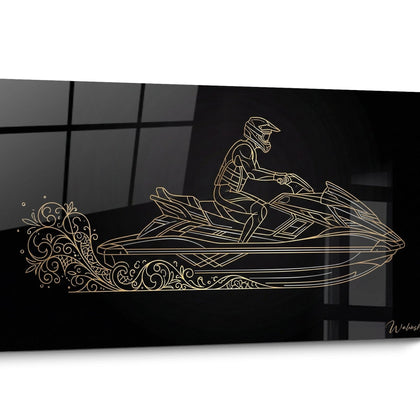


All about Jetski Street Art Canvas
- Jet Ski Street Art Canvas Presentation
- Urban Water Art
- Urban Sports Atmosphere
- Water Vehicle Decoration
A jet ski street art canvas combines the raw energy of urban culture with the adrenaline rush of motorized water sports. This bold fusion transforms a simple decorative element into a visual manifesto for thrill-seekers and alternative culture enthusiasts. These large-format creations capture the rebellious essence of graffiti while celebrating mechanical power and aquatic freedom. Unlike classical representations, these works incorporate graphic codes from urban metropolises – tags, stencils, paint drips – applied to the world of high-performance water vehicles. Each composition tells a story of creative transgression where asphalt meets waves, where urban counterculture appropriates the world of mechanical leisure to create a completely unprecedented visual language.
Graffiti Aesthetics Applied to Water Engines
The jet ski street art canvas transposes urban mural techniques to the universe of motorized water sports. This visual hybridization draws directly from abstract jet ski canvases while adding a narrative dimension unique to street art. Artists use bold color fields, controlled splatters, and graphic overlays to create compositions that evoke both the tagged walls of underground neighborhoods and the spray unleashed by a vehicle at full throttle.
Urban visual codes transposed to water
The dripping letters characteristic of graffiti become here a metaphor for water rushing down the hull of a water vehicle. Areas of shadow and light reproduce the nighttime atmosphere of street art spots, while splatters recall both spray paint projections and the water spray created during radical maneuvers. This double reading significantly enriches the visual experience.
What colors dominate in urban water art?
The palettes favor neon combinations – hot pink, electric cyan, acid yellow – typical of the street art movement of the 80s-90s, mixed with metallic chrome tones evoking high-performance machine bodywork. Deep blacks contrast with brilliant whites to create the characteristic visual tension of nighttime graffiti, while turquoise blues recall the aquatic environment without ever falling into literal representation.
Compositional dynamics and captured movement
The structure of the compositions borrows from the dynamism of large-format murals. Aggressive diagonal lines suggest the trajectory of a vehicle launched at full power, while graphic elements seem to explode from a central focal point. This spatial organization transforms each jet ski street art canvas into a frozen snapshot of action in progress, as if the vehicle were literally crossing the wall surface to emerge into real space.
Creating a Countercultural Atmosphere in Contemporary Spaces
Integrating a jet ski street art canvas into an interior environment amounts to installing a fragment of rebellious attitude in sometimes overly sterile places. These large-format works function particularly well in rehabilitated industrial spaces – lofts with exposed metal structures, converted garages, workshops transformed into showrooms – where their raw aesthetic naturally dialogues with existing architecture.
How to position an urban canvas in a private garage?
The ideal location sits facing the personal vehicle parking zone, creating thematic continuity between terrestrial and aquatic machines. The XXL format allows covering large wall surfaces, typical of spacious garages, while masking potential imperfections. The work then becomes the focal point of the space, visually affirming the owner's mechanical passion through the prism of alternative urban culture.
Association with sports lifestyle universes
These creations resonate perfectly with action sports and boardsports culture codes. They naturally complement an environment already marked by technical equipment – suspended wetsuits, displayed helmets, decorative mechanical parts. The jet ski street art canvas unites these disparate elements under a cohesive aesthetic banner, transforming a simple storage space into a true sanctuary dedicated to urban sports lifestyle.
Resonance with trendy commercial spaces
Water vehicle dealerships, extreme sports boutiques, and lifestyle brand showrooms find in these works a powerful visual branding tool. The imposing format immediately captures attention in vast commercial spaces, while the street aesthetic credibilizes the brand's underground authenticity. This marketing dimension operates without artifice, the work functioning simultaneously as a legitimate decorative element and brand identity amplifier.
Symbolism and Identity in Urban Water Art
Beyond their immediate visual impact, these creations convey a hybrid life philosophy that fuses two apparently contradictory universes. Street art historically represents contestation, appropriation of public spaces, and unauthorized expression. Motorized water sports, on the other hand, symbolize individual freedom, technical mastery, and access to virgin territories. Their combination in a jet ski street art canvas creates a new identity language for those who refuse simplistic categorizations.
For which buyer profile are these works designed?
The typical collector generally combines several passions: a water vehicle owner who also appreciates urban culture, a contemporary art enthusiast seeking strong narrative pieces, or a professional in the water leisure sector wishing to assert a distinctive visual identity. These people value authenticity and seek decorative elements that tell a personal story rather than simply filling empty space.
Transgressive dimension and cultural appropriation
The use of graffiti aesthetics – historically associated with urban marginality – to represent expensive leisure vehicles creates a fascinating creative tension. This juxtaposition questions the boundaries between popular culture and economic privilege, between authentic rebellion and commercial appropriation. The best jet ski street art canvases fully assume this ambiguity, transforming it into strength rather than contradiction, celebrating cultural democratization where visual codes circulate freely between different social strata.
Psychological impact of monumental formats
The generous dimensions of these creations are not merely an aesthetic choice but participate in their narrative effectiveness. An XXL format physically imposes its presence, reproducing the visceral impact of an urban mural discovered around a street corner. This monumental scale amplifies the energy contained in the composition, allowing the viewer to literally immerse themselves in the represented universe rather than simply observe it from a distance.
Is a jet ski street art canvas suitable for a classical residential interior?
Absolutely, provided you fully assume the stylistic contrast. In a conventional domestic environment, these works function as an intentional disruptive element, injecting energy and personality into potentially neutral spaces. Their installation becomes an identity affirmation gesture, signaling that the occupant refuses consensual decoration in favor of more assertive visual expressions.
How to maintain a large-format canvas?
Imposing formats primarily require regular dusting with a dry microfiber cloth. Avoid harsh chemical products that could alter the vibrant pigments characteristic of street art aesthetics. Quarterly cleaning is generally sufficient, as the smooth surface greatly facilitates maintenance despite the considerable dimensions.
Can you combine multiple street art canvases in the same space?
Juxtaposing multiple pieces creates a particularly effective urban gallery effect in large volumes. However, favor works with complementary rather than identical color palettes to avoid visual saturation. Generous spacing between each creation allows each one to breathe while building coherent visual dialogue that amplifies the overall installation impact.


