








Black and White Dachshund Dog Canvas
The Painting Dachshund Dog Black and White celebrates the timeless elegance of this iconic breed. This artistic collection captures the unique character and distinctive silhouette of the dachshund through a refined monochrome dachshund art mural . Perfect for lovers of sophisticated canine decoration, this decorative painting dachshund black and white brings a touch of personality to your interior. Explore a selection of works that sublimate the nobility and charm of this faithful companion.
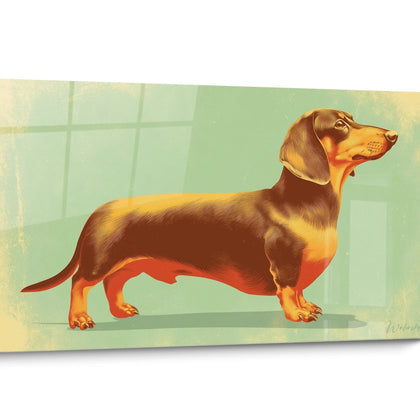
 Dachshund Black and Tan on Solar Background - Golden Rays - Dachshund Wall Art Edition228,90 €
 Black and Tan Dachshund Wall Art in Sitting Posture - Elegant Canine Portrait - Dachshund Wall Art Edition273,90 €
 Black and Tan Dachshund with Golden Eyes in a Garden of Ferns - Tender Gaze - Dachshund Painting Edition273,90 €
 Black and Tan Dachshund Canvas with Melancholic Gaze - Contemplative Portrait - Dachshund Canvas Edition273,90 €
 Black and Tan Dachshund Wall Art Elongated - Canine Elegance - Dachshund Wall Art Edition273,90 €
 Dachshund Portrait Canvas Black and White - Canine Elegance - Dachshund Canvas Edition273,90 €
Explore further
In Black and White Dachshund Dog Canvas



All about Black and White Dachshund Dog Canvas
- Black and White Dachshund Wall Art Presentation
- The Impact of Monochrome Contrast
- Minimalist Design for Contemporary Interiors
- Canine Expression in Black and White
A black and white Dachshund wall art represents far more than simple wall decoration: it is a visual celebration of the iconic Dachshund silhouette through the lens of absolute contrast. This refined graphic interpretation highlights every characteristic curve of this elongated breed, transforming the Dachshund's unique anatomy into a timeless artistic composition. The choice of a monochrome palette gives this canine representation a sculptural elegance that transcends decorative trends, integrating naturally into spaces where sobriety meets emotional authenticity. These large-format creations capture the very essence of the Dachshund without resorting to color seduction, revealing the expressive power of pure lines and contrasted shadow areas.
The Power of Monochrome Contrast in Dachshund Representation
The black and white Dachshund wall art masterfully exploits the visual tension between light and darkness to sculpt the distinctive appearance of this elongated breed. Unlike colorful approaches, bi-chromatic design forces the eye to concentrate exclusively on the contours, textures, and characteristic proportions of the Dachshund. This aesthetic choice reveals anatomical details often lost in polychromatic work: the precise curve of the back, the angle of drooping ears, or even the compact musculature of short legs.
The visual architecture of shadow and light areas
In a large-scale monochrome composition, each black area becomes a structuring element that guides the eye through the Dachshund's silhouette. Artists exploit this dynamic to create three-dimensional depth without resorting to chromatic nuances. White spaces are never empty: they actively sculpt volumes, defining the coat, muzzle, and limbs with graphic precision. This approach proves particularly effective for spaces with light-colored walls where dramatic contrast creates an immediate focal point.
What emotions does a pure black and white Dachshund convey?
The absence of color paradoxically amplifies the emotional intensity of the canine representation. A gaze captured in black and white contrast acquires melancholic depth, while a playful posture gains graphic dynamism. This chromatic refinement particularly suits those seeking emotional connection free from decorative artifice. The large format magnifies this effect, transforming the Dachshund's facial expression into a genuine psychological window.
Tonal balance in service of breed recognition
For Dachshund enthusiasts, monochrome representation demands absolute technical mastery of the breed's specific proportions. The body-to-legs ratio, muzzle length, or the characteristic ear position must be rendered with graphic accuracy that color might obscure. The best black and white creations function as immediately identifiable silhouettes, even when observed from a distance—a quality essential for large formats intended for expansive living spaces.
Integration of Black and White Dachshund Wall Art in Minimalist Interior Architecture
The black and white Dachshund wall art naturally asserts itself as a focal element in refined environments where every decorative object must justify its presence. Its reduced palette harmonizes beautifully with contemporary raw materials: polished concrete, brushed steel, untreated natural wood. This material compatibility transforms the canine representation into a visual bridge between architectural coldness and emotional warmth, introducing living presence without disrupting the space's chromatic balance.
How does monumental format redefine residential space?
A Dachshund represented in very large format on a monochrome background creates an almost sculptural presence effect that modifies spatial perception. In a Scandinavian or industrial design living room, this canine monumentality can occupy an entire wall, transforming a neutral architectural surface into an affirmative visual statement. The Dachshund's elongated geometry adapts particularly well to horizontal wall configurations, naturally following the lines of low sofas or linear shelving.
The strategy of a single focal point in refined decoration
Minimalist spaces rely on the principle of "less is more," where a single powerful visual element replaces decorative accumulation. A large black and white Dachshund wall art perfectly fulfills this strategic function, capturing attention without creating visual saturation. Its lack of color prevents any chromatic competition with surrounding furniture, while introducing the organic curve necessary to soften dominant architectural angles. For those exploring other styling interpretations, a watercolor Dachshund wall art offers a more fluid alternative while maintaining breed recognition.
Which professional spaces benefit from this bi-chromatic aesthetic?
Beyond residential settings, architecture offices, high-end veterinary clinics, or conceptual pet boutiques adopt these monochrome representations for their ability to simultaneously convey professionalism and animal passion. Large format imposes memorable presence without frivolity, while black and white ensures compatibility with all corporate graphic standards. This chromatic neutrality also allows seasonal decorative rotations without requiring complete environmental recoloring.
Capturing Dachshund Personality Through Absolute Contrast
The transition to black and white Dachshund wall art represents a radical artistic choice: stripping the representation of all chromatic realism to retain only the behavioral and morphological essence of the breed. This graphic approach works particularly well for the Dachshund, whose distinctive silhouette and marked facial expressions lend themselves exceptionally to bi-chromatic stylization. Artists exploit contrasts to emphasize the determined character, natural curiosity, or proud posture characteristic of this hunting breed.
Emblematic Dachshund postures in monochrome composition
Certain canine attitudes prove particularly expressive when rendered in pure black and white. The typical alert position of the Dachshund, with its elongated body in tension and ears raised, gains graphic dynamism when conveyed through contrasted flat areas. Large formats allow capturing these behavioral moments with near-photographic precision while benefiting from the monochrome's aesthetic simplification. This combination creates works that faithfully document the breed's temperament while functioning as contemporary graphic design.
How does black and white reveal the texture of short coat?
Paradoxically, the absence of color enables subtler exploration of textural variations in the Dachshund's coat. Artists use different hatching, pointillism, or tonal gradient techniques to differentiate areas of smooth hair from denser zones. On a large-scale wall surface, these micro-variations create visual play that rewards close observation while maintaining distance readability. This textural richness transforms simple canine representation into visual tactile exploration.
The timelessness of monochrome against decorative trends
While colored palettes follow decoration trend cycles (terracotta, sage green, navy blue...), black and white transcends decades without aesthetic aging. A black and white Dachshund wall art acquired today will retain its decorative relevance in fifteen years—a quality particularly appreciated for large-format investments. This stylistic permanence stems from bi-chromatic anchoring in photographic and graphic history, creating deep cultural references that exceed ephemeral fashions.
Why do Dachshund owners choose monochrome format?
Owners of this breed often seek representations capturing their companion's authenticity rather than decorative idealization. Black and white conveys this sincerity: it documents without beautifying, celebrates without artifice. For many, this approach resonates more deeply with their daily relationship to their Dachshund than saturated color representation. The monumental format then allows transforming this emotional connection into permanent presence in domestic space, a constant visual reminder of the human-animal bond.
Does a black and white Dachshund wall art suit all interior styles?
Absolutely. The chromatic neutrality of black and white allows it to integrate equally well in an industrial loft, a reinterpreted classic interior, or a contemporary country home. Only the contrast intensity and representation style (graphic, realistic, abstract) should be adjusted according to the desired ambiance.
What is the impact difference between small and large monochrome formats?
Small format functions as subtle decorative accent, while large format transforms the work into an architectural element in its own right. For the Dachshund, whose elongated morphology suits extended horizontal compositions, large format allows respecting the breed's actual proportions while creating memorable visual impact that structures the entire room.
How do you maintain a large black and white Dachshund wall art?
Monochrome surfaces reveal dust more than colored compositions. Regular dusting with antistatic microfiber generally suffices. For large formats, verify that the mounting system remains stable, as combined weight and exposed surface area can create mechanical stress on wall attachment points over time.


