Pagoda painting by the lake: the ideal zen motif for a calming bedroom
8 min read · by Walensky
PAGODA PAINTING
There's that precise moment, just before falling asleep, when your gaze drifts to the wall opposite the bed. If it lands on a black screen or a cluttered shelf, the brain stays on alert. If it lands on a pagoda reflected in still water, something lets go. It's not a decorator's coincidence, it's an old Asian recipe that still works beautifully in a Paris apartment or a suburban house.
- The pagoda and still water duo combines architectural stability with the symbolism of mental clarity, a classic of feng shui.
- Three moods dominate: morning mist, twilight with reflections, and blossoming cherry trees, each one changing the tone of the bedroom.
- The size is chosen according to the width of the wall or headboard, never on a single impulse.
Why the pagoda-lake motif embodies absolute serenity
The pagoda is a building that does not move, one that has crossed the centuries without seeking to impress through height but through the balance of its tiers. Set at the edge of a lake, it doubles itself in the water: what we see above, we see again below, inverted and calmed. It is an image of perfect symmetry, and the human brain loves symmetry when it seeks to calm down.
In feng shui tradition, still water represents inner wealth and clarity of mind, unlike running water that stimulates action. A bedroom doesn't need stimulation. It needs this water mirror that asks nothing, that doesn't move, that simply waits for the gaze to settle on it.
A still lake beneath a pagoda is the very image of a mind that has stopped chasing after something.
Asian architecture adds another layer: the pagoda is never aggressive in its lines. Its curved roofs guide the eye upward without ever startling it. It is the exact opposite of an overbearing skyscraper.
The different moods of pagoda by the water
Not all pagoda-lake scenes look alike, and that's a good thing: each bedroom has its own codes of color and mood.
Morning mist and a hushed atmosphere
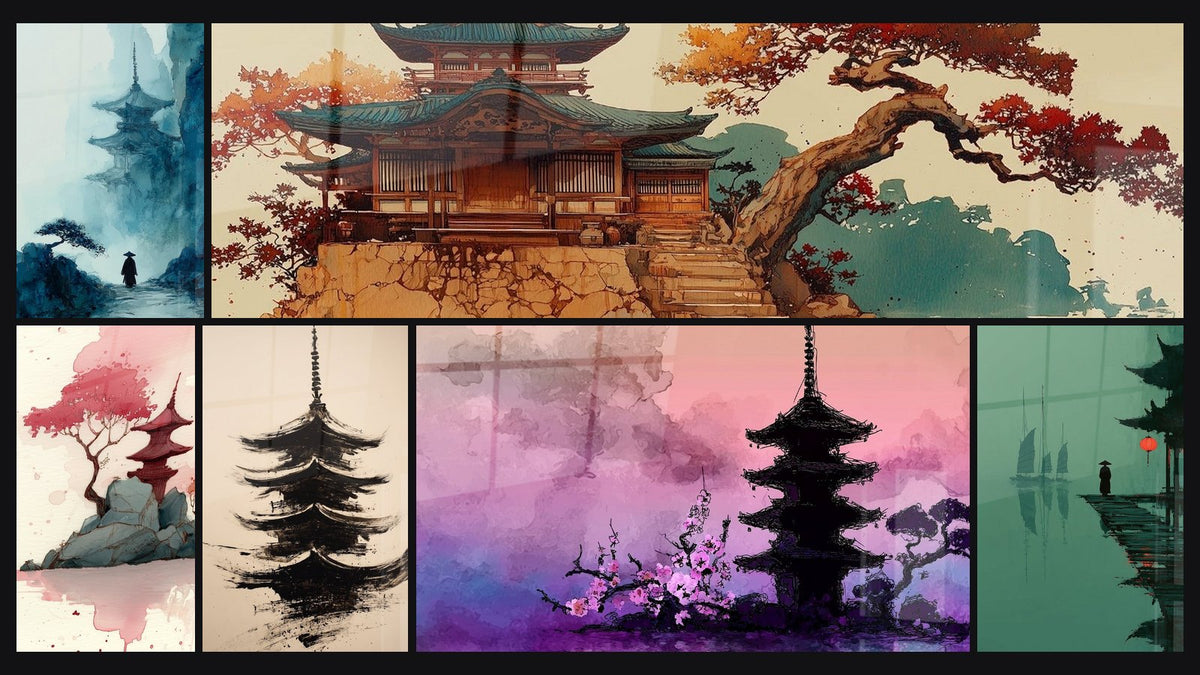
The mist erases unnecessary details. It only hints at the essential outlines of the pagoda, submerged in a range of blue-grey tones. It is the most restful mood of all, the one best suited to a bedroom where you really need to disconnect.
The Mystical Pagoda in the Blue Mist painting illustrates this principle well: a pagoda gently emerging from morning mist, in blue-grey tones that impose nothing on the eye.
Twilight and reflections on the water
Twilight brings warmth without aggression: powdery pink, muted violet, discreet orange. Reflections on the water double these hues and create a depth that changes with the light in the room, more intense in the evening, softer upon waking.
Pagoda surrounded by blossoming cherry trees
Sakura introduces a romantic, lively note without breaking the zen spirit. It is the option for those who find the mist a little austere and want a touch of color without leaving the contemplative register.
The pastel tones of twilight and sakura pair well with off-white or taupe bed linen, whereas the mist or monochrome versions prefer an already cool setting (grey, midnight blue).
For the twilight version, the Japanese Architecture Rose and Violet Sunset painting captures exactly this pastel and mystical atmosphere, while for the cherry blossom, the Red and Blue Pagoda with Blossoming Cherry Tree painting blends watercolor and floral motifs in a more assertive zen harmony.


Our selection
Mystical Pagoda in the Blue Mist Painting - Zen Spirituality - Pagoda Edition
From €233.90
Discover this paintingHow to choose your pagoda-lake painting according to your bedroom decor
The right choice always starts with the walls, not the painting. A bedroom with white or light grey walls accommodates almost any palette without friction. A room that is already colorful calls for more restraint.
- Neutral walls (white, beige, light grey) : every mood works, including the colorful twilight or sakura versions.
- Dark walls (midnight blue, fir green) : opt for a black and white monochrome or a mist version, so as not to overload the eye.
- Bed linen already printed or textured : choose a black and white watercolor-style pagoda, visually more understated.
The Japanese Pagoda Black and White Watercolor Style painting remains a safe bet for anyone wanting a minimalist zen style that clashes with nothing. At the opposite end, versions inked on a beige background bring a softer, almost calligraphic warmth.

On the finish side: acrylic glass reflects light and accentuates the reflections on the water, perfect if the bedroom receives little direct light. Matte Alu Dibond is more convincing facing a window or in full natural light, as it avoids any stray reflections upon waking.
— Also to discover

Where and how to hang this painting to enhance the zen effect
The most effective position remains facing the bed, visible as soon as you open your eyes. It is the only wall we truly look at effortlessly, morning and evening.
The ideal height places the center of the artwork at standing eye level, about 1.50 m from the floor. Soft lighting, a bedside lamp or a directed spotlight, is enough to bring the reflections on the water to life without breaking the nighttime atmosphere.
For a bedroom where the headboard faces a window, the Blue Pagoda in the Mist with Bridge Silhouette painting lends itself well to a square format, such as XL 120x120 cm, which naturally balances a wall with no furniture beneath it. If the available space is more modest, the L format remains the recommended minimum so as not to lose the depth effect of the reflection.
— In the same spirit


Combining several Asian scenes for a complete zen corner
A single pagoda already has its effect. Two or three Asian scenes that converse with each other do even more, especially in a spacious bedroom or an adjoining dressing room.
You can pair the pagoda-lake motif with a painting of Asian rice fields to extend the sense of open horizon, somewhat along the lines of what we explore in our article on the Asian rice field painting for a zen living room. Sakura also comes in a dedicated version, with its own codes of softness, detailed in our guide to the sakura painting for an adult bedroom.
For a single wall that synthesizes all three moods, the architectural pagoda painting in black and white with cream clouds works as a neutral centerpiece, around which more vivid tones can gravitate elsewhere in the room.
Those who want to explore calming motifs more broadly beyond the pagoda will find other ideas in the collection of zen paintings, or for aquatic landscapes in the selection of lake paintings.

Other selected pieces
Red Pagoda on Rocks with Blossoming Cherry Trees Painting - Zen Watercolor Art - Pagoda Edition
From €233.90
Discover this painting →Frequently asked questions
Why is a painting with water calming in a bedroom?
Still water evokes mental clarity and the absence of movement, unlike a waterfall or a rough sea. A lake at rest acts as a visual anchor point that slows the gaze before sleep.
What size of pagoda painting should you choose for a bedroom?
Allow 60 to 75% of the width of the wall or headboard. For a classic double bed, an XL format (140x80 cm) or a 120x120 cm square generally fills the space well without overwhelming it.
Should you choose a color or black and white pagoda painting for sleeping?
Black and white calms visual activity more before bedtime, ideal for sleepers sensitive to light and vivid colors. Pastel versions (twilight, sakura) remain gentle but suit those who prefer a warmer waking moment.
Can you combine a pagoda painting with other Asian motifs?
Yes, rice fields and cherry blossoms pair naturally with the pagoda, as long as you keep a consistent color palette across the whole wall to avoid a patchwork effect.
The bedroom that awaits you each evening doesn't need much: a wall, soft lighting, and this pagoda reflected in water that never moves. The rest follows on its own.
To find the size and mood that suit your room, the pagoda painting collection brings together all the variations mentioned here, from mist to sakura.
Explore our collections