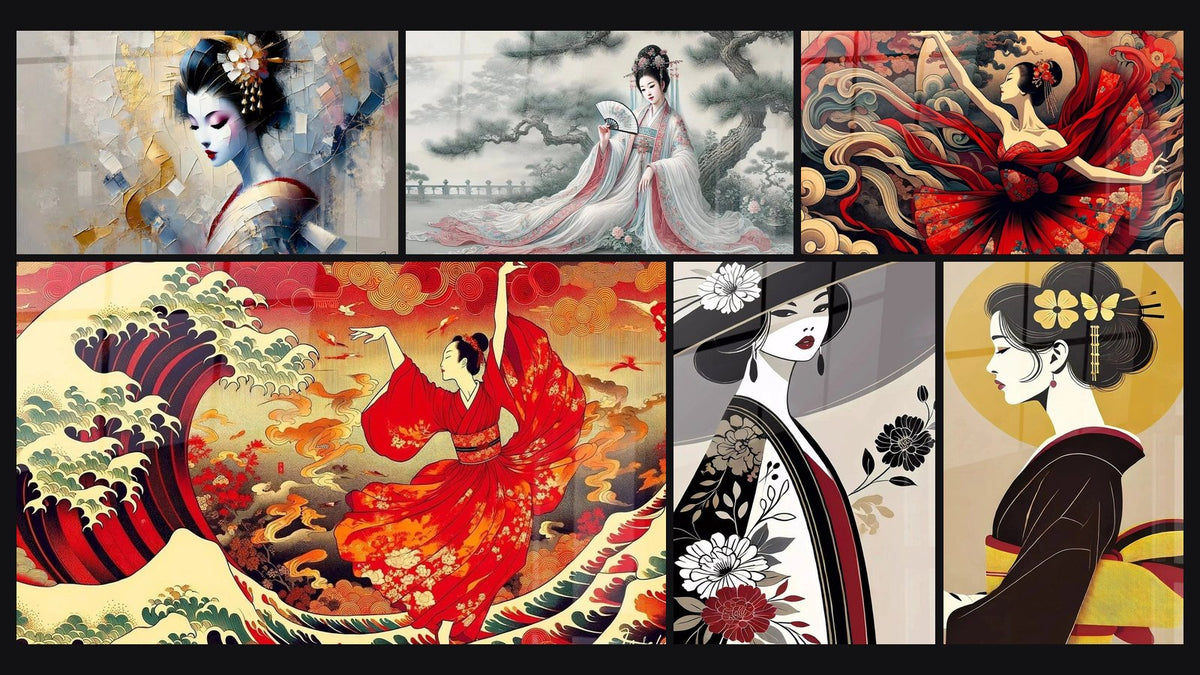
Geisha painting in pastel watercolor: harmonizing each room for a zen décor
7 min read · by Walensky
There is that moment in the morning when light slips through the sheer curtains and brushes a still-bare wall. Often it is in front of that empty rectangle, waiting for months, that you finally think of the geisha painting you spotted long ago. But a single artwork placed at random is not enough to create a true zen atmosphere: it is the harmony between the rooms that makes all the difference.
- The pastel palette (powder pink, ivory blue, pearl grey) works better in soft, indirect light than under full sun.
- Each room has its purpose: the living room welcomes, the bedroom soothes, the entryway sets the tone for the whole house.
- Acrylic glass suits rooms with controlled light, Dibond aluminum suits walls exposed to full daylight.
Why the pastel watercolor geisha embodies the zen spirit
The geisha is more than a decorative motif: she carries a whole grammar of silence and restraint, inherited from traditional Japanese art. A kimono barely rustling, a fan suspended in the instant before the gesture: it is this stillness that soothes the eye, far more than the scene itself.
Powdery tones amplify this effect. Where a saturated palette catches the eye and holds it, pastel watercolor lets it glide and breathe. This is the very point of zen minimalism: a composition that imposes nothing, yet establishes a gentle presence.
A zen painting is not noticed upon entering a room: it reveals itself after a few seconds, when the eye finally settles.
Choosing the location according to the room's function
The same geisha painting can seem magnetic in a bedroom and almost mute in an overly lit living room. Placement is never neutral: it converses with the use of the room.
Living room and reception space
The living room is a place of passage and conversation: it can support a more present artwork, with more pronounced golden contrasts, without losing its calm. It is the ideal spot for a piece such as Silent Grace, whose golden fan unfolds in the half-light. Positioned facing the sofa, it becomes the visual anchor of the room.
For a living room, aim for an artwork width representing 60 to 75% of the sofa's width: this proportion avoids both the "postage stamp" effect and the "billboard" effect.
Bedroom and meditation corner
The bedroom calls for the opposite: a presence that fades, that does not capture attention on waking but accompanies it. This is where ivory blue or powder pink tones find their full meaning, in the japandi spirit where emptiness counts as much as form.
Facing the bed or in a meditation corner, an artwork in soft tones such as Moonlight Clarity establishes a continuous breath, never jolting the eye too abruptly.
Entryway and hallway
The entryway sets the tone for the whole house: it is the first impression, the one that mentally prepares you for what follows. A more intimate format, in Dibond aluminum to avoid reflections from daylight entering through the door, works particularly well here.
- Entryway: narrow format, neutral tones, matte surface.
- Hallway: a succession of small pastel touches rather than a single piece.

Favorite
Painting Black and gold fan with swirling curls - Ribbons floating in the wind - Geisha edition
From 242.90 €
Discover this paintingCombining natural light and pastel tones
Daylight is never fixed: it moves, changes temperature, softens in the late afternoon. A pastel that looks dull at noon can become luminous at dusk.
This is why the choice of support matters as much as the choice of artwork. Facing a window or in a very bright room, Dibond aluminum absorbs light without glare and preserves the softness of powdery tones. In a room with more controlled light, acrylic glass restores depth and more vibrant colors, almost like a gallery.
In a home oriented according to feng shui, one generally avoids placing an artwork in permanent backlight: it turns into a dark silhouette, losing all the finesse of the watercolor.
— Our selection


Creating zen continuity with several geisha paintings
A single isolated geisha tells one scene. Several, intelligently distributed, tell a whole home. This is where the "zen gallery" angle takes on its full meaning: instead of an isolated purchase, you think in terms of a journey.
A chromatic thread is enough to hold the whole together: for example muted golds in the living room and entryway, ivory blues in the bedroom, and a fan in panoramic format in an office or a wide passageway.
The painting Ribbons Hanging in the Wind, with its panoramic format and black background dotted with gold, works very well as a transitional piece, above a low sideboard or in a wide hallway, to create a breathing point between two spaces.
To go further in this logic of floral and zen harmonization, you may also look toward our article on the azalea painting in Japanese-style watercolor, which explores another variation of the same japandi spirit.
Mistakes to avoid to preserve the zen atmosphere
Zen is often lost through accumulation, not lack. Too many pieces, too many contrasts, too many mixed styles: visual overload is what breaks the sought-after balance.
- Mixing too many decorative styles in one room (industrial, Scandinavian, Japanese) without a common thread.
- Placing the artwork directly under a powerful halogen spotlight that washes out the pastel nuances.
- Choosing a format too small for a large wall: the "lost in space" effect breaks all the serenity sought.

Also to discover
Painting Dancer in the blue and orange kimono - Nocturnal Whirl - Geisha Edition
From €273.90
Discover this painting →Frequently asked questions
Where to hang a geisha painting in a home?
Preferably in calm rooms: bedroom, entryway, dimmed living room or meditation corner. Avoid walls in direct sun all day, which wash out pastel tones.
Which colors to pair with a pastel geisha painting?
Beiges, pearl greys, light woods and sage greens naturally accompany powdery tones. Avoid bright, saturated colors that create a visual break with the zen atmosphere sought.
How to create a zen atmosphere with Japanese paintings?
By limiting the number of artworks per room, respecting a shared palette from one room to the next, and leaving empty space around each painting. The emptiness is part of the composition, not just the motif.
Can several geisha paintings be mixed in the same room?
Yes, provided they share the same tonality or background (gold on black, for example), and that they do not face each other directly, to avoid an overly visually loaded dialogue.
Composing a zen home around the pastel watercolor geisha means accepting to think room by room rather than in a single purchase. The bare wall of the living room, the corridor you cross without looking, the entryway that sets the tone within the first seconds: each of these spaces calls for its own response, in a shared chromatic language. Explore the geisha painting collection to compose your own journey, room after room, until the whole house breathes at the same rhythm.
Explore our collections