Rubens's The Three Graces in an adult bedroom: daring to embrace Baroque nudity with taste
8 min read · by Walensky
PAINTINGS INSPIRED BY PETER PAUL RUBENS
You've just painted the back wall a deep burgundy, the bed is made, and something is missing above the headboard that will say something about the two of you. Then you come across this Rubens canvas, three nude women entwined in honey-colored light, and a question crosses your mind: do we dare, in our bedroom?
The direct answerYes, a reproduction inspired by Rubens's The Three Graces has every right to a place in an adult bedroom, provided you choose the right wall (a side wall rather than one facing the bed for a calm discretion), a size that suits the proportions of the room, and warm lighting that enhances the skin tones without harshness. It's a matter of dosage, not prohibition.Peter Paul Rubens painted this scene around 1635, for himself, in his own Antwerp home. That detail changes everything: it was not a public commission but an intimate work, conceived for a domestic gaze. It therefore had, from the outset, its place in a home.
- A side wall or an angled placement defuses discomfort better than a wall facing the bed, without diminishing the intensity of the work.
- Formats L (120x70 cm) to XL (140x80 cm) are more than sufficient for a bedroom: there's no need to aim for the 4XL intended for a living room.
- Warm, subdued light, never a harsh white ceiling light, brings out the ochres and the Flemish Baroque flesh tones.
Why Rubens's The Three Graces appeals for the adult bedroom
This composition does not display nudity for its own sake: it celebrates friendship, abundance and femininity united in a single gesture of trust. The three figures touch, support one another, and look at each other without unease. This is precisely what makes the work tenable in an intimate space: it speaks of connection, not exhibition.
Rubens's Flemish Baroque works flesh as no one before him: pearly complexions, assumed curves, and a palette of ochre and burgundy that literally warms the atmosphere of a room. In a romantic bedroom, this painterly material naturally echoes the textiles, dark woods and low lights.
Rubens doesn't paint bodies to be looked at, he paints bodies that look at one another, and that difference changes everything in a bedroom.
Baroque nudity and modesty: how to calibrate according to your sensibility
The right location depends less on the work than on your couple: it's up to you to set the dial between embracing it fully and reserving it for your own eyes alone.
A wall facing the bed versus a side wall or an adjoining corridor
The wall facing the bed is the most visible, the one you look at when lying down and upon waking. It's a strong choice, almost a declaration: you embrace the work without filter, and it becomes the focal point of the room.
A side wall, or the wall section of an adjoining dressing room, offers a more muted presence. The work exists, it reveals itself at a glance, but it imposes nothing on anyone who enters the room for other reasons. It is often the most comfortable choice for a couple who loves Rubens's art without wanting to make it a topic of conversation with guests.
Opting for a refocused crop or a more discreet format
Some contemporary interpretations tighten the framing on silhouettes and movement rather than anatomical detail, with a more graphic black-and-white palette. It's an elegant way to keep the spirit of the composition (grace, gesture, momentum) without the literalness of the academic nude.
If one of the two partners is more reserved, start with an L format rather than a large format: the work remains present, but it doesn't dominate the room. You can always move up in size later.
The painting inspired by The Three Graces by Peter Paul Rubens No. 2, in black and white, illustrates this approach well, refocused on the movement and elegance of the silhouettes rather than on the harshness of the nude.

Favorite
Painting Inspired by The Three Graces by Peter Paul Rubens No. 2 – Tribute to a Famous Artist
From €273.90
Discover this paintingSize and proportions suited to an adult bedroom
A bedroom is not a living room: viewing distances are shorter, and the wall space available above the headboard is often more modest than that of a lounge. The usual proportion rule still applies: the work should occupy about 60 to 75% of the width of the piece of furniture beneath which it hangs, here the headboard.
For a 160 cm headboard, an L format (120x70 cm) or XL format (140x80 cm) works very well. Beyond that, for a king-size bed and a generous wall, the XXL (160x90 cm) still keeps a measured presence, without tipping into a show of force reserved for large reception rooms.
- Standard double bed (140-160 cm): L format, 120x70 cm
- King-size bed (180 cm and above): XL or XXL format, 140x80 to 160x90 cm
- Narrow wall or side alcove: custom size, from 80x46 cm
Lighting and ambiance: enhancing Rubens's flesh and ochre tones
A Rubens painting dislikes cold light: the flesh tones painted in this Baroque vein need warmth to come alive, not clinical white.
A bedside lamp with a warm bulb, a dimmer set low, or a small dedicated spotlight angled slightly sideways is enough to reveal the ochres and burgundies without ever making the details appear harsh. The matte Alu Dibond surface, free of glare, is particularly well suited here: it keeps its soft tones even under dim light, unlike a glossy finish that could reflect too much light in an already dark room in the evening.
To extend this warm atmosphere into the dining room or an adjoining corridor, Rubens's palette adapts very well beyond the bedroom: our article on ochre and burgundy decoration inspired by Rubens explores this work with warm tones room by room.
Alternatives to The Three Graces if you're looking for a more discreet nude
All Baroque sensuality does not necessarily pass through frontal nudity. The Judgment of Paris, another mythological scene painted by Rubens, emphasizes the movement of bodies and silhouettes in a more narrative than carnal atmosphere: the version offered here, in yellow and grey, plays precisely on this graphic and contemporary distance.
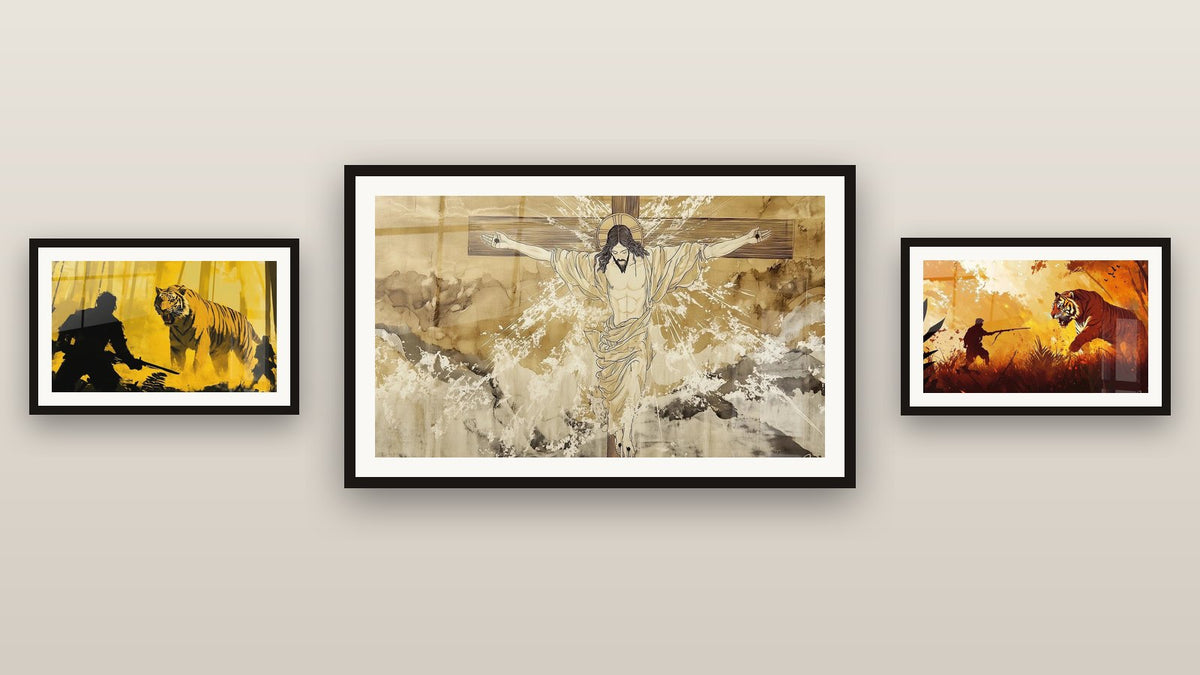
For a bedroom seeking the gravity and depth of Flemish Baroque without any ambiguity linked to nudity, The Descent from the Cross offers a completely different tone: spiritual, dramatic, bathed in a beige and gold monochrome that remains perfectly coherent with an adult bedroom in a classic style.
Finally, for a couple who prefers energy to softness, The Tiger Hunt, with its dramatic ochres and golds, brings a very different tension and power, without any of the modesty issues raised by a nude.
— Our selection


Frequently asked questions
Is Rubens's The Three Graces disturbing for a bedroom?
No, not in its intent: the work celebrates friendship and femininity, not exhibition. The only real risk is a poor placement choice, too exposed to outside eyes, not the work itself.
Where to hang a nude painting in an adult bedroom?
A wall to the side of the bed, or the wall section of an adjoining dressing room, offers the best balance between presence and discretion. The wall facing the bed suits couples who want to make it a true, embraced focal point.
What size to choose for The Three Graces in a bedroom?
For a standard headboard, an L format (120x70 cm) or XL format (140x80 cm) respects the proportions of the room without overwhelming it. Very large formats are rather reserved for living rooms and large reception walls.
What alternatives to a Baroque nude for an adult bedroom?
The Judgment of Paris, The Descent from the Cross or The Tiger Hunt, all inspired by Rubens, let you keep the ochre and burgundy palette and the Baroque intensity without resorting to frontal nudity.
An adult bedroom, at heart, belongs only to those who sleep in it: neither to the gaze of guests nor to a standard of good taste that exists only on paper. Whether you choose the full intensity of The Three Graces or the restraint of a Descent from the Cross, what matters is that the wall speaks to you both, every evening. the collection of paintings inspired by Rubens gathers all these interpretations to find the one that truly suits your intimacy.
Explore our collections