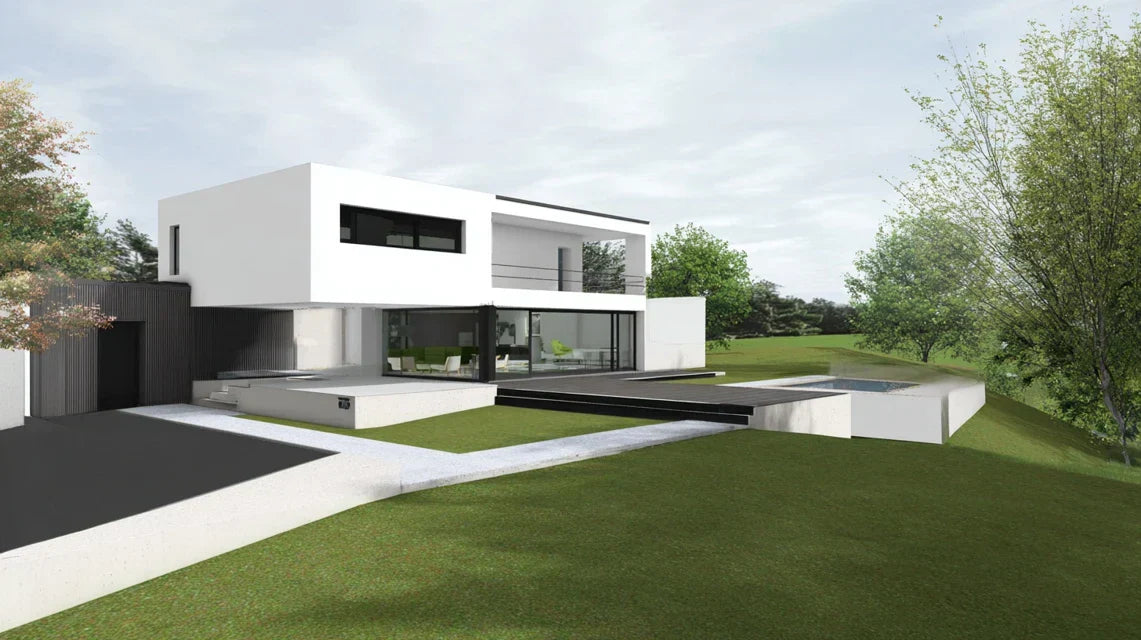
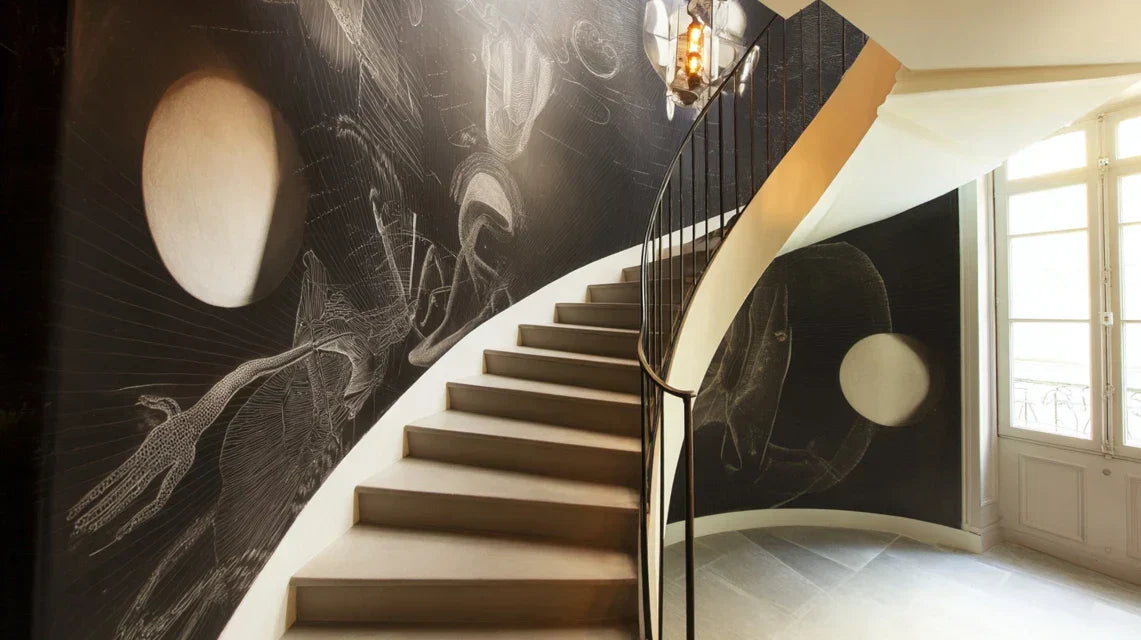
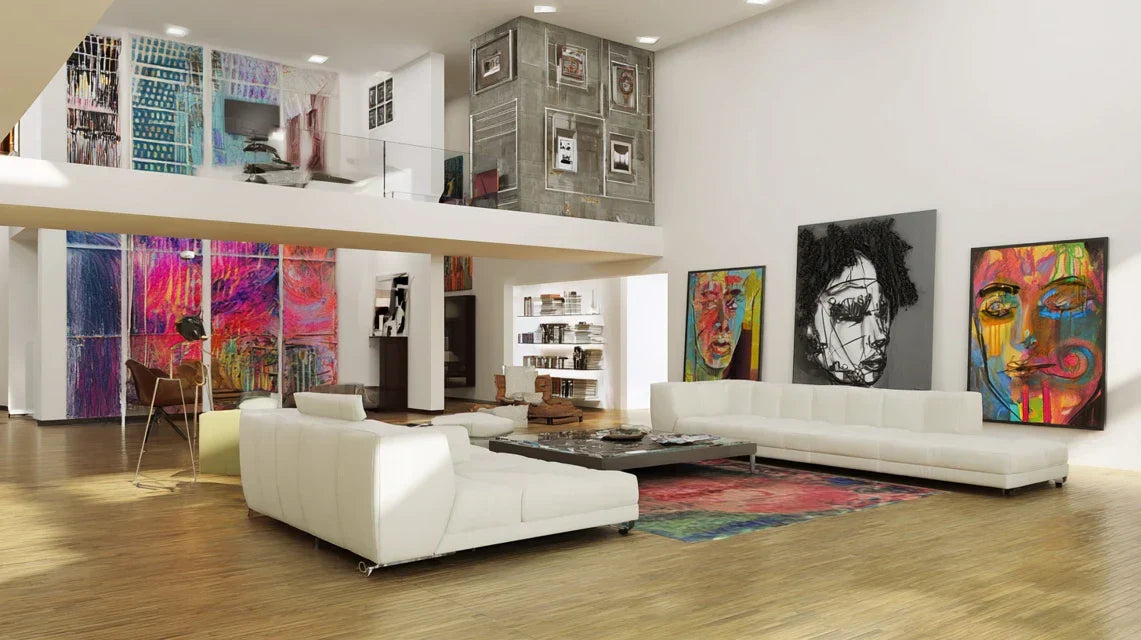
Integrating a painting into an architect-designed home without disrupting the lines
By Alexandre MARY
⏱️ Reading time: 8 minutes
You've just had your dream architect-designed house built, every detail has been carefully considered, and now you find yourself facing these immaculate walls that seem to challenge you. How do you dare hang anything on them without betraying that clean aesthetic you’ve longed for?
This feeling of decorative paralysis overwhelms you every time you imagine a painting on these perfect surfaces. You feel this nagging fear of breaking the harmony, of committing a faux pas that would instantly destroy the architectural elegance of your interior.
You've probably already tried a few impulsive purchases: that too classic painting that seemed perfect in a gallery but now clashes with your contemporary lines, or that modern artwork that’s too aggressive and turns your living room into a cold showroom. Each attempt ends in the same disappointment.
Rest assured, this hesitation is not a lack of taste on your part. On the contrary, it reveals your aesthetic sensitivity. The problem is that traditional wall decoration completely ignores the specifics of contemporary architecture.
By the end of this article, you will know exactly how to select and integrate a painting that enhances your architecture without ever competing with it, to create that perfect harmony between wall art and architectural design that you are looking for.
Why your architect-designed home deserves exceptional wall art?
The urgency is not to decorate at all costs, but to understand that your architect-designed house without artistic soul resembles an empty case. Each month that passes without personalized wall art is a missed opportunity to reveal the unique character of your interior. It's like owning a Stradivarius violin and never playing it.
🏠 Architect’s testimony: "I visited this exceptional villa near Cannes, impeccable contemporary architecture, noble materials, perfect volumes. But the overall impression? That of a luxury hotel without personality. Three months later, the owners had installed a collection of sober and powerful works. Same house, but this time inhabited by a soul."
💬 Conversation with a decor expert
"I'm afraid my new painting won’t match if I change my wall color..."
Relax! It's exactly the opposite. A true artistic crush adapts and even reveals itself with new colors. It's like a diamond that shines differently depending on the lighting!
"But I was told you always had to match colors..."
Who told you that? Modern decor plays on subtle contrasts. A tastefully integrated painting with warm tones on a cold wall is like a fireplace in a blue room: magical!
The golden rule of architectural art: A carefully chosen artwork doesn't fill a void, it reveals an intention. Like a bright accent that highlights the natural beauty of a face, it amplifies the existing elegance of your architecture in just 24 hours.
Understanding why your previous attempts have failed
You may recognize yourself in these situations: you stand frozen in front of a wall for minutes, unable to visualize anything. You compulsively buy "safe" works that end up stored in the garage. You constantly change the placement of your paintings without ever being satisfied with the result.
What's really happening is that you are unconsciously applying traditional decorative codes to an environment that operates according to completely different rules. It’s like trying to tune a piano using guitar techniques.
Imagine trying to fit a baroque piece of furniture into an industrial loft. The mismatch is obvious. With wall art, it's more subtle, but the principle is identical.
🎯 First hidden cause: The war of volumes
Contrary to popular belief, the main problem isn’t color or style, but volumetric competition. Your contemporary architecture already imposes its own spatial rhythm, its lines of force, its visual tension zones.
It's exactly like two people talking at the same time: even if both speeches are excellent individually, the result is cacophonous.
This silent war between architecture and art explains why you feel this inexplicable discomfort, even with objectively beautiful paintings. Your eye perceives the dissonance without you being able to identify it rationally.
🔍 Revealing test: Place your hand in front of a painting that you find “not bad” in your interior. If you immediately feel relief or the space seems more harmonious, then this is proof that the work conflicts with your architecture.
⚡ Second hidden cause: The scale trap
Most people choose their paintings based on the size of furniture or the room. A serious mistake! In an architect-designed home, it's the ceiling height and depth of perspectives that dictate proportions.
Think of a theater actor: his gestures must be broader than in real life to carry to the last row. Your wall art should follow the same logic of amplification.
As a result, you end up with works that seem “lost” on your large walls, creating that frustrating feeling of incompleteness, as if you had forgotten to remove the price tag.
🎨 Third hidden cause: Amnesia of light
Here's the detail that 99% of people ignore: your architect-designed home was designed around a specific lighting plan. Every opening, every surface, every material plays with natural light in a calculated way.
Carefully observe: at 2 PM, this area receives a golden light that makes the waxed concrete vibrate. At 6 PM, this other surface captures the last rays that sublimate the brushed steel.
Ignoring this luminous choreography when choosing your artwork, is like installing a theater spotlight without considering the staging. Art and architecture fight instead of dancing together.
🔍 The 3 warning signs to watch out for:
The "afterthought" effect: Your artwork seems added as an afterthought, like a decorative patch on a bare wall
The "disappearance" phenomenon: The work becomes invisible after a few days, your eye completely ignores it
Emotional dissonance: You like the artwork individually, but it irritates you in your interior
💎 The trigger element: Revealing architectural intention
The game-changer is when you stop wanting to decorate your architecture and start to reveal it. Like good lighting that highlights the beauty of a diamond, the right wall art amplifies your architect's intention. This mental shift immediately transforms your approach and your choices.
Fundamental rule of architectural art: Never ask "what would go well here?" but "what does this space want to express?". Observe the play of light and shadow for 10 minutes, you will discover your wall's secret personality.
❌ Classic decorative approach
✅ Architectural approach
💡 Key difference
🎯 Visible result
I'm looking for a painting that goes with my sofa
I'm looking for a work that dialogues with my volumesOverall vision vs isolated detailsImmediate spatial coherence
I avoid contrasts to stay "safe"
I use creative tensions skillfullyDynamic harmony vs monotonyCharacter and affirmed personality
I choose the size first, then the style
I choose the intention first, then the scaleSpatial logic vs decorative logicPowerful and accurate visual impact
My painting must "go everywhere"
My work reveals this unique placeSpecificity vs generalityAuthenticity and emotional attachment
The 3-step method to perfectly integrate your wall art
Now that you understand the hidden mechanisms, let's move on to practice with a progressive and reassuring approach. Think of this method as building a bridge: solid foundations, visible structure, refined finishes. Each step brings you closer to that perfect harmony where art and architecture mutually sublimate each other.
🗺️ Your roadmap: Spatial analysis (understanding your architecture), strategic selection (choosing the ideal artwork), harmonious integration (perfect installation). This logical progression leads you from expert observation to total satisfaction in a maximum of 3 weeks.
🔍 Step 1: Decoding Your Space's DNA (Week 1)
Starting with this analysis is crucial as it avoids 90% of costly mistakes. It’s like studying the terrain before building: this solid foundation determines the success of the entire project. Once you have mastered this step, you will feel a new confidence when looking at your walls.
🛠️ What You Need for This Analysis
A measuring tape: Classic model of 5 meters minimum to measure setback distances and proportions. Opt for a rigid model that stays straight against high walls. Smartphone apps are inaccurate for large surfaces and distort your perception of scales.
A flashlight or smartphone: To reveal the micro-reliefs and textures that ambient lighting hides. The goal is to understand how your wall "breathes" according to the angle of light. A headlamp frees your hands to take notes.
An A4 sketchbook: Essential physical support because it forces you to slow down and really observe. The brain processes information differently when it passes through the hand. Avoid digital notes which encourage haste and harm spatial intuition.
Let's move on to methodical observation of your space now
🎯 In-Depth Analysis Phase
Map light flows: Photograph the same wall at 9am, 2pm and 6pm for three consecutive days. This documentation reveals your space's "light seasons" that the accustomed eye no longer perceives. Each orientation creates its own dramatic effects that an artwork can amplify or hinder.
⏱️ Time: 20 minutes per day | ✅ Successful when: You clearly identify 2-3 moments of "magic light" | ⚠️ Attention: Avoid very cloudy days which distort the analysis of natural contrasts
Measure force lines: Identify dominant architectural elements (beams, bay windows, partitions) and trace their imaginary extensions on your sketch. These invisible lines create the secret geometry of your space that your wall art must respect or intelligently counterbalance.
⏱️ Time: 15 minutes | ✅ Successful when: Your plan reveals 3-4 main axes | ⚠️ Attention: Do not confuse existing decoration with architectural structure
Test impact zones: Place temporary objects (colored cushion, plant) in different places and observe where your gaze naturally rests when entering the room. These magnetic zones are the preferred locations for your artwork.
⏱️ Time : 10 minutes | ✅ Successful when: You identify 1-2 impact zones maximum | ⚠️ Warning: The most obvious location is not always the most effective
✅ Step 1 Validation : You must be able to describe the "personality" of your wall in 3 words (example: "bright-vertical-mineral") and visualize mentally the effect of a artwork before even choosing it. If you are still hesitating, extend observation for 2-3 days.
OUR RECOMMENDED PRODUCTS
🎨 Step 2: Selecting Your Revealing Artwork (Week 2)
Now that you know your space intimately, selection becomes a game of expert rather than a risky bet. This step transforms your technical analysis into an enlightened emotional choice. You will feel this evidence when the right artwork "speaks" exactly the same language as your architecture.
🔍 Architectural Selection Criteria
Format and proportions: First calculate the ideal width/height ratio according to your measurements from step 1. For a 4m wide wall, a artwork of at least 120cm avoids the "stamp-post" effect. Panoramic formats (3:1) naturally dialogue with contemporary horizontality.
Color palette: Choose a maximum of 2 colors that resonate with your existing materials (concrete, wood, steel). The goal is not perfect matching but the creation of a subtle visual bridge. A contrasting shade (20% of the artwork) energizes the whole.
Energy and movement: The artwork must compensate or amplify the rhythm of your architecture. Very geometric space = more organic art. Curved volumes = pure geometry. This complementarity creates perfect balance.
🛒 Expert Selection Process
Preselection by intention: List 3 emotions that your space should convey (serenity, dynamism, sophistication...). Immediately eliminate any artwork that does not carry at least 2 of these qualities. This emotional filtering precedes aesthetic filtering.
⏱️ Time : 30 minutes | ✅ Successful when: Your selection goes from 50+ to 10-15 artworks | ⚠️ Warning: Resist crushes that do not match your intention
Mental projection test: For each preselected artwork, close your eyes and visualize it in your space for 30 seconds. Your first sensation (excitement, indifference, discomfort) reveals instinctive compatibility. Trust this intuition educated by your analysis.
⏱️ Time : 2 minutes per artwork | ✅ Successful when: 2-3 artworks generate a real positive emotion | ⚠️ Warning: Superficial excitement differs from deep resonance
🏠 Step 3: Orchestrate the Perfect Integration (Week 3)
Installation is not merely hanging but the culmination of your architectural approach. This final phase reveals whether your analysis and selection were correct. When executed well, it transforms your architect-designed home into a total work of art where every element finds its natural place.
🎯 Technical and Aesthetic Installation
Precise Positioning: Use kraft paper to draw the exact silhouette of your artwork and test several locations. The standard height (150cm from the floor at the center) does not apply to contemporary spaces. Aim for the upper third of your total wall surface.
⏱️ Time: 45 minutes | ✅ Success when: The location seems obvious from 3 different viewpoints | ⚠️ Attention: Check the effect from the entrance to the room, not just facing the wall
Accent Lighting: Install dedicated lighting that reveals your work without creating reflections. An adjustable spotlight at 3000K and a minimum of 30° from the artwork avoids parasitic shadows. Existing architectural lighting is never sufficient to fully enhance a quality wall art.
⏱️ Time: 1 hour | ✅ Success when: The work "stands out" naturally without appearing overlit | ⚠️ Attention: Test the lighting during the day AND at night
Finalization Rule: Allow yourself 48 hours of observation before definitively validating the installation. If after 2 days, you continue to positively notice your artwork as you pass by, it is proof of a successful integration.
You now master the fundamentals of architectural integration. Here are the expert subtleties that distinguish an informed amateur from a true connoisseur of contemporary wall art.
💎 Pro's Secret - The "Spatial Silence" Rule: In an architect-designed home, every wall does not necessarily need a work. Consciously identifying areas of "visual breathing room" magnifies the impact of the chosen works. This is the difference between an informed collector and a compulsive decorator.
🤔 "But what do we do if my spouse and I don't have the same tastes?"
"I tend to be modern and minimalist, but my husband prefers more expressive works. How can we find common ground without compromising the architecture?"
This creative tension is actually an opportunity! Your difference in taste probably reflects two facets of your shared personality that a unique artwork can reconcile. Look for works with "double reading": minimalist from afar (clean lines, simple composition) but revealing their expressive richness up close (texture, subtle nuances, details). Contemporary abstract artworks excel at this balancing act.
🎯 Shared validation technique: Spend 10 minutes separately in front of each candidate artwork, then share your feelings without trying to convince. The work that generates two different positive descriptions is often the richest and most suitable for your shared space.
⚠️ The 5 mistakes to absolutely avoid
Even with the best method, some errors can ruin weeks of effort. Here are the pitfalls that 80% of architect-designed homes owners encounter, and how to avoid them intelligently.
🚫 The "merchant gallery" effect: Multiplying small works to "enliven" a large wall. This approach instantly destroys architectural serenity and turns your interior into a chic flea market. Always prefer ONE strong work that fully assumes the space rather than several hesitant pieces.
⚡ Inappropriate fixing: Underestimating the weight and constraints of your contemporary walls. Cellular concrete, very present in modern architecture, requires specific anchors. A painting that falls damages both the artwork AND the wall. Invest in professional hanging from 15kg.
🌡️ Exposure to the elements: Ignoring temperature variations near bay windows or underfloor heating. Your architect-designed home often generates microclimates that not all artistic supports can withstand. Check material compatibility before purchase.
📐 The progressive scale error: Starting with a "reasonable" work, promising to enlarge it later. This initial timidity condemns you to permanent dissatisfaction. In contemporary architecture, measured boldness always surpasses excessive caution.
🎨 The trap of temporary fashion: Choosing according to Pinterest trends rather than your specific architecture. Your architect-designed home will outlast trends, your wall art should share that timelessness. Prioritize intrinsic quality over instant recognition.
🔍 Final safety checklist: Do your guests spontaneously notice the overall harmony rather than the painting in isolation? Does the work reveal an aspect of your architecture that you hadn't noticed? Do you feel proud to present this ensemble? These 3 criteria validate a successful architectural integration.
Because you took the time to inform yourself, enjoy 10% discount on your first order:
ART10
⏰ Valid for 72h after reading • Applicable to all our products
❓ Your expert decor questions
🕒 "How long do I need to see if my choice of artwork is truly successful?"
Allow 2-3 weeks of daily observation. The first few days reveal the immediate impact, but it's between the 2nd and 3rd week that your eye gets used to it and you perceive the true integration. If after 21 days you continue to appreciate the whole without boredom, your choice is validated. A well-integrated wall art becomes invisible by evidence, not by indifference.
💰 "What budget should I plan for a painting suitable for an architect's house of 200m²?"
For a main room, allow 3-5% of the value of your renovation/construction on wall art. That is 1500-3000€ for a project at 60k€. This proportion ensures consistent quality with your architectural investment. Better one strong piece than three average ones: the impact is multiplied and satisfaction is lasting.
🎨 "Original work or high-end reproduction: which to choose?"
In contemporary architecture, the authenticity of the support is more important than the originality of the work. A giclée print on linen canvas stretched over a museum stretcher far surpasses an original piece on low-quality paper. Favor paintings with archival certification (pigment inks, durable supports) guaranteeing 50+ years without degradation.
🔧 "Can my concrete wall receive any type of mounting system?"
Architectural concrete imposes specific constraints. Avoid standard plastic dowels: they shatter the material. Use metal expansion dowels or, ideally, a suspended rail system that preserves the surface and allows for future adjustments. For heavy works (+20kg), consult a professional who will assess the load-bearing structure.
✨ "How to maintain a painting in a very bright architectural environment?"
The abundant natural light of architect's houses requires specific precautions. Install UV films on large bay windows (transparent, they preserve the view). Alternate direct lighting: your painting doesn't need to be illuminated 12 hours a day. A monthly dusting with a soft brush and an annual check of the mounting are sufficient to preserve it for 20+ years.
🎯 Your transformation into an architectural art expert
In 3 weeks, you will contemplate your architect's house with a feeling of total fulfillment. Every guest will notice this perfect harmony between architecture and art without being able to precisely identify what creates this impression of refinement. You will feel the discreet pride of the connoisseur who has managed to reveal the hidden potential of their space.
This mastery of integrated wall art transforms your gaze on all contemporary spaces. You develop this sensitivity of an expert who instantly distinguishes a thought-out arrangement from applied decoration. This skill, far beyond your interior, enriches your general aesthetic culture.
The most difficult part was understanding the secret rules of architectural harmony. Now that you have mastered them, all that remains is to take action. Your first move? Observe your walls with your new expert eye for 48h. You will immediately see the opportunities that escaped you before.
🚀 Your next level: You now have the keys to perfect artistic integration. The architectural excellence of your home deserves wall art to match. Trust your methodical analysis and educated intuition: the result will surprise you with its natural accuracy.
📚 Deepen your knowledge of architectural art
Discover our other expert guides on artistic integration in contemporary spaces, wall lighting techniques, and sustainable trends in wall art architecture.