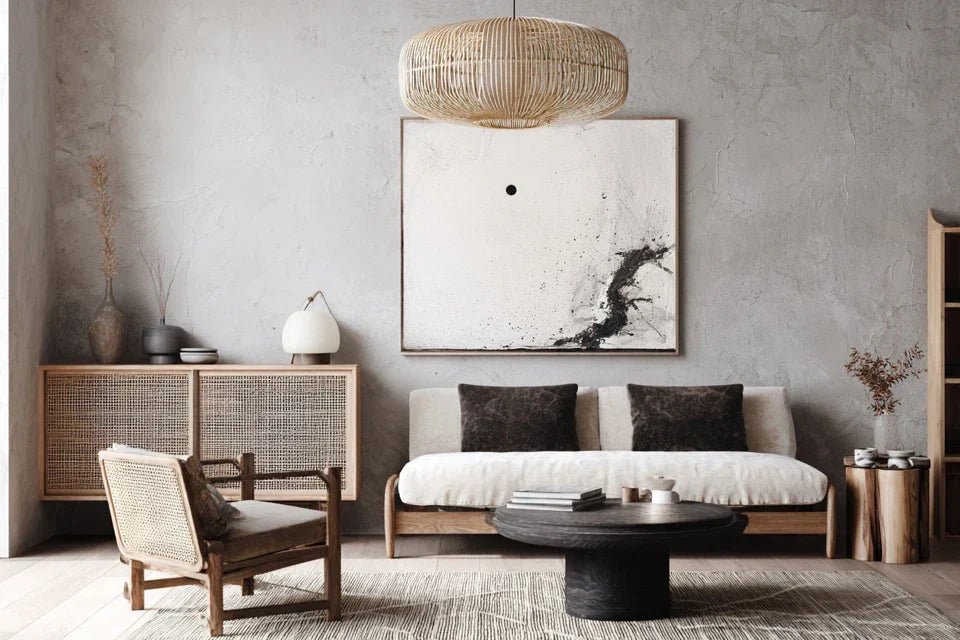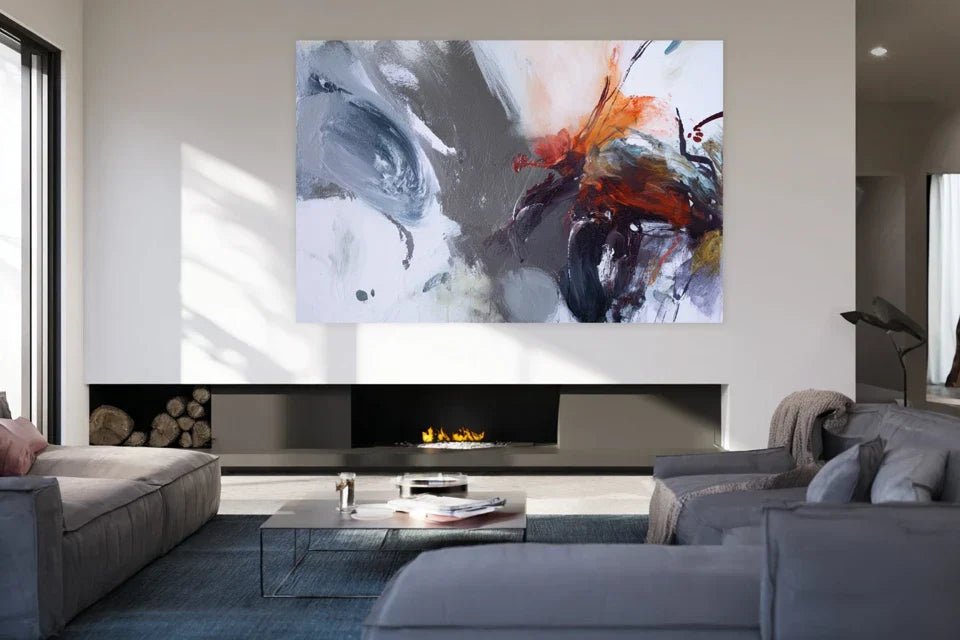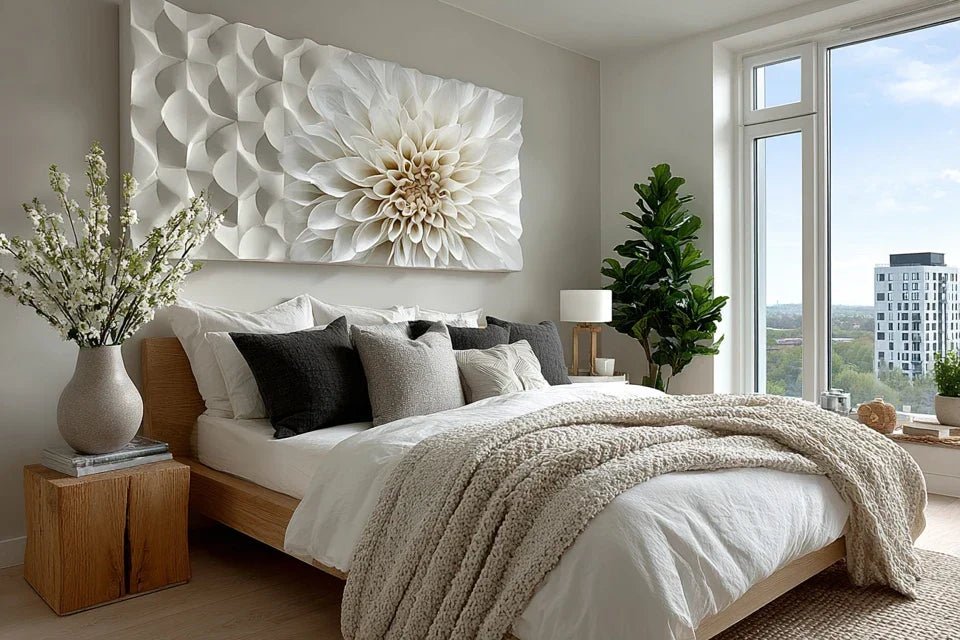
You're looking at your streamlined living room, so carefully orchestrated in its pure lines and neutral colors, but something’s off. That pristine white wall in front of your Scandinavian sofa has been taunting you for weeks. You know it needs a work of art, but the mere thought of choosing a painting paralyzes you.
You can already imagine the horror: a garish canvas that would shatter the harmony of your minimalist cocoon, transforming your zen sanctuary into a decorative bazaar. You see yourself explaining to your guests why this imposing artwork throws off the entire room, bitterly regretting that impulsive purchase.
You may have already tried the Pinterest adventure, frantically pinning minimalist wall art that seemed perfect online. But when it comes time to place an order, anxiety sets in: what if the colors don’t look the same at your place? What if the dimensions disrupt your entire visual balance?
This paralysis is perfectly normal. The problem isn't your taste, but the lack of a method for choosing a refined wall art piece that enhances your minimalist lifestyle instead of compromising it.
By the end of this article, you will know exactly how to select the perfect artwork that will transform your bare wall into a magnetic focal point, while preserving that minimalist serenity that is so dear to you.
Why Your Bare Wall Secretly Sabotages Your Daily Well-being?
A blank wall in a minimalist interior isn't an accomplished aesthetic choice; it’s an unfinished project that generates subconscious tension. Like a puzzle with a missing piece, your brain registers this lack of visual anchor and translates it into a feeling of incompleteness. Without artwork to create a focal point, your gaze wanders without settling, creating the diffuse impression that something is missing from your domestic happiness.
📖 Revelatory testimony: Sarah, an interior architect, lived with her “perfect” minimalist living room for six months before realizing why she never felt completely at peace. The day she hung an abstract artwork in powdery tones above her sofa, she immediately felt that sense of “home” that had been missing.
💬 Conversation with a Decor Expert
The golden rule of minimalist decor: A single, well-chosen piece is better than ten scattered accessories. It becomes the heart of your room, what makes you smile when you come home every evening.
Finally understand why all your decorating attempts have failed
If you recognize yourself in these situations: you buy a painting that seems perfect in store but disappoints once at home, you hesitate for weeks before finally buying a piece that ends up stored in a closet, or you constantly change the placement of your paintings without ever finding the ideal location.
What's really happening is that you are trying to fill a void instead of creating harmony. Your brain pushes you to "add something" when minimalist art works on the inverse principle: revealing essence.
It’s like wanting to season a dish before tasting it. You can't choose the perfect piece without first understanding the soul of your space.
First revelation: You confuse "simple" and "faded"
Contrary to what 90% of minimalist decor enthusiasts think, clean doesn’t mean neutral. A minimalist work can be vibrant, emotional, even bold, as long as it remains pure in its message.
Imagine a Zen master who says only one sentence per day, but that sentence moves you. That's exactly the principle of a minimalist wall art piece.
This confusion makes you miss magnificent works that could have transformed your interior, because you judge them "too much" when they are just perfect.
🔍 Immediate test: Look at your room and identify the element that attracts your gaze the most. If it's your television or a functional object, your space lacks a strong artistic focal point.
Second revelation: You choose with your eyes, not with your heart
Most people select a work of art as they would curtains: based on purely visual and rational criteria. But clean wall art works on emotion, not logic.
It’s like falling in love: you don't make a list of qualities, you feel an obviousness. A perfect minimalist work makes you feel something at first glance.
Result: you accumulate "correct" purchases that don't speak to you, instead of having that unique piece that makes your heart beat every time you look at it.
Third revelation: You neglect the impact of light
Here’s what no one tells you: the same work can be sublime or dull depending on the lighting in your room. Natural light, the orientation of your windows, even the color of your walls, completely transform the perception of colors and textures.
You can easily check this: observe your walls at different times of the day and note how they change shade. That's exactly what will happen to your future painting.
This neglect explains why so many decorative purchases are disappointing: the work was perfect, but not in YOUR lighting conditions.
3 telltale signs:
- You often photograph your room from different angles: Your subconscious is searching for the perfect angle that doesn't exist without an artistic focal point Your guests compliment your "clean style" but don’t stay long: The space is beautiful, but lacks emotional warmth You regularly rearrange your furniture: You try to create visual interest with the furnishings, lacking a work of artThe trigger factor that 95% of people ignore
- Your daily feelings: Observe how you feel in your room at different times. Calm? Energized? Nostalgic? This dominant emotion should guide your choice, not contradict it. Avoid choosing a "stimulating" artwork if your living room is your relaxation retreat.
- Your instinctive color palette: Look at your wardrobe and note the 3 colors that appear most often. These shades naturally soothe you and will create a subconscious coherence with your new artwork. Ignore “trendy” colors that don’t speak to you.
- Your personal visual references: Collect 5 images (landscapes, materials, objects) that make you feel good. These references reveal your aesthetic DNA and will help you recognize your natural artistic style.
- Harmonious Dimensions: Your artwork should occupy between 60% and 75% of the width of the furniture it overlooks. Too small, it will look lost; too large, it will overwhelm the whole ensemble. Measure your sofa or console and multiply by 0.7 to get the ideal width.
- Optimal Hanging Height: The center of your artwork should be 1.60m from the floor, at eye level. This universal rule guarantees optimal visual comfort and natural integration into your space.
- The Artistic Style That Suits You: Abstract geometric for rational minds, abstract organic for sensitive souls, refined figurative for nostalgics. Your choice should resonate with your deep personality.
- ⚠️ Choosing based on Pinterest photos: Online photos never reflect the reality of your light and colors. That "perfect" picture on the screen can be disappointing at home. Always ask to see the artwork in real conditions or order samples. 📏 Neglecting scale effect: A piece that's too small in a large space looks like a failure, even if it's beautiful. Your brain perceives an imbalance that ruins everything. Respect proportions, it’s non-negotiable. 💰 Prioritizing price over love at first sight: A painting costing €50 that doesn't move you will cost you more than a piece costing €200 that makes you vibrate. The wrong calculation is to choose the cheapest rather than the most appropriate. 🎯 Wanting to be like everyone else: Copying a style seen at friends’ places or on social networks guarantees you a bland result. Your interior should tell YOUR story, not someone else's. Embrace your uniqueness. ⏰ Buying in a hurry: Choosing a work of art isn't done in 5 minutes during sales. This haste always leads to disappointing purchases. Take the time to reflect, it’s a long-term investment.
What really makes the difference between a cold minimalist interior and a warm minimalist cocoon is the story your artwork tells. Like a perfume that evokes memories, the right painting creates an emotional atmosphere that reflects you. You can check this: The spaces that mark you the most always have a work of art that tells something, even subconsciously.
The "shiver" rule: If a piece doesn't give you a small shiver of emotion in the first 3 seconds, it will never transform your space. Trust this instinctive reaction.
| ❌ Rational approach | ✅ Emotional approach | 💡 Why it works | 🎯 Visible result |
|---|---|---|---|
| I'm looking for a painting that goes with my cushions | I’m looking for a work of art that resonates with meEmotion creates natural coherenceYour space becomes magneticI want beige to stay neutral | I want a color that recharges meYour well-being takes precedence over codesYou feel at homeI measure everything so it’s perfect | I trust my instinctArt doesn't obey the rules of mathematicsHarmony is created naturallyI read all reviews before buying | I rely on my favorite pieceYour taste is more reliable than others’You proudly embrace your choices
Step 2: Select the Perfect Characteristics
Now that you know the emotional DNA of your space, we're going to translate that emotion into precise technical criteria. It’s like moving from inspiration to realization: you keep the magic but add the method. This step is more rewarding because you feel your project becoming concrete.
Your Decisive Technical Criteria
Your Technical Selection in 20 Minutes
Calculate Perfect Dimensions: Measure your available wall and reference furniture. Apply the 2/3 rule: your artwork should be about 2/3 of the width of the furniture to create a perfect visual balance.
⏱️ Time: 5 minutes | ✅ Success when: You have the dimensions in centimeters | ⚠️ Attention: Allow for a 10cm margin on each side
Test Artistic Style: Among the artworks that made you react at step 1, identify common points: geometric shapes, colors, textures. These recurrences reveal your natural artistic style, which must be fully embraced.
⏱️ Time: 10 minutes | ✅ Success when: You can describe your style in 3 words | ⚠️ Attention: Don't force yourself to like a style because it is "trendy"
Validate Integration: Visualize mentally your ideal artwork in your space. If you can project yourself with pleasure, you are on the right track. If you hesitate, it means that the criteria are not yet precise enough.
⏱️ Time: 5 minutes | ✅ Success when: You smile imagining the result | ⚠️ Attention: The excitement must be immediate, not built
Step 3: Integrate Your Artwork Like a Pro
You’ve reached expert level: transforming your choice into a true decorative masterpiece. At this stage, you no longer just “hang a painting”, you create a visual experience that tells your story. The final result? A space that is 100% you and impresses with its natural coherence.
Perfect integration in 30 minutes
Precise placement: Mark the exact position with a pencil before drilling. Use a level and take the time to ensure your artwork complements the other elements of the room. A centimeter can make the difference between "nice" and "perfect".
⏱️ Time: 15 minutes | ✅ Success when: The artwork feels "natural" in your space | ⚠️ Attention: Step back regularly to check the overall effect
Enhancing lighting: Adjust the lighting in your room so that your artwork is highlighted without being dazzling. Indirect lighting reveals nuances, direct lighting creates contrast. Test at different times of the day.
⏱️ Time: 10 minutes | ✅ Success when: Your artwork naturally attracts the eye | ⚠️ Attention: Avoid reflections that break the effect
Final validation: Live with your new artwork for 48 hours before making a decision. This "digestion" period will allow you to verify that the emotion endures and that the integration is successful.
⏱️ Time: 5 minutes of reflection | ✅ Success when: You continue to smile when looking at it | ⚠️ Attention: If doubt persists after 48 hours, it means the choice was not right
The rule of natural progression: You are ready to move on to the next step when the previous one seems obvious and you can't wait to make it a reality. Haste is the enemy of the perfect choice.
You now master the fundamentals of minimalist artwork selection. Here are the secrets that only professional decorators know to transform a good choice into an exceptional one.
🎨 Pro tip: Create a "dialogue" between your artwork and just one other element in the room (cushion, plant, object). This subtle connection creates sophistication that impresses effortlessly, as if everything had always been thought together.
🤔 "What if I'm still wrong?"
"I'm afraid of making the wrong choice and regretting it for years..."
This fear is legitimate and shows that you are taking this decision seriously, which is already a good sign! But here's the truth: a "bad" choice made with this method will teach you more about your tastes than years of hesitation. Moreover, a quality work of art retains its value and can always be relocated or given as a gift. The real failure would be to never dare to take the plunge and continue to live with that wall which frustrates you.
💡 Secure advice: Start with a medium-sized artwork (50x70cm) in tones close to your existing palette. You can always evolve towards more boldness once you have gained confidence.
The 5 pitfalls that ruin even the most beautiful minimalist paintings
Warning: these mistakes are so common that they even affect enlightened enthusiasts. I'm revealing them to you to avoid months of frustration and regretted purchases.
🔍 Your warning signs: You hesitate for more than 2 weeks on a piece (it's not the right choice), you ask 5 different people for advice (you don’t trust yourself), you calculate how many other things you could buy with this budget (you are not ready), you wonder if it will go with your curtains (you are missing the essential).
🎁 Special reader offer
Because you took the time to inform yourself, enjoy 10% discount on your first order:
Your most frequently asked questions about choosing a minimalist painting
Allow between €80 and €300 for an original work of artistic quality and durable materials. This investment amortizes over 10-15 years and provides daily satisfaction. Start with €150: it’s the sweet spot between quality and accessibility.
Both work! Abstract offers more freedom of interpretation and integrates easily, while refined figurative adds a narrative dimension. Your choice should reflect your personality: rational or emotional, contemplative or narrative.
Cut a piece of cardboard to the dimensions of the artwork and temporarily attach it to the wall. Live with this "mock painting" for 24 hours: you will immediately know if the proportions are correct. This technique avoids 90% of sizing errors.
Absolutely! A quality work of art adapts to the evolution of your decor. It even becomes your reference point for your future choices. This is the advantage of choosing with your heart rather than with reason.
With the right tools (level, drill, suitable wall plugs), it is accessible to everyone. Allow 30 minutes for a careful installation. If you are not comfortable, many craftsmen offer this service for €30-50.
Your decor transformation starts now
In 3 weeks, you will look at your living room with that feeling of satisfaction you have never felt before. Your artwork, perfectly integrated, will completely transform the energy of your space. Your guests will immediately notice this "something extra" that makes all the difference, without being able to explain it.
This metamorphosis goes far beyond decoration: you have just developed confidence in your artistic taste. This newly acquired assurance will accompany you in all your future decorative choices, definitively freeing you from the anxiety of "doing wrong".
The hardest part is behind you: you now know exactly how to proceed. All that remains is to take action. Start tonight with step 1, and within 72 hours you will have identified your perfect artwork. Your future self will thank you for daring.
✨ Your new decor chapter begins here: You have all the tools to succeed. Trust yourself, your artistic instinct is more reliable than you think. In a month, you'll wonder why you waited so long!