Where to hang a red and white Christmas painting in your home
9 min read · by Walensky
RED AND WHITE CHRISTMAS PAINTING
The box is open. The painting is there, leaning against the living room wall, and you've been circling it for ten minutes without knowing where to hang it for good. This is when doubt sets in: too high, too low, too close to the radiator, not visible enough from the entrance. Reassure yourself: placing a Christmas painting follows simple rules, the same ones you apply all year round, with a few adjustments specific to the festive season.
In the lines that follow, we move room by room, with precise heights and concrete distances. No vague theories about the "feel" of a space: just benchmarks you can check right away with a tape measure.
- The reference height is 145 cm from the floor to the centre of the painting, the one used in museums.
- Above a piece of furniture (sofa, sideboard, fireplace), the artwork should occupy 60 to 75% of its width.
- Entryways and staircases are the most underused locations during the festive season, yet they create the first visual impression.
The basic rules for hanging a Christmas painting well
A badly placed painting is noticed just as much as a leaning Christmas tree: you can't quite say why, but something is off. Two rules are enough to avoid most mistakes, and they apply to a Christmas painting just as much as to the rest of the year's decor.
The ideal hanging height
Museums apply a rule that has proven itself: the centre of the artwork is placed at 145 cm from the floor. This is the average eye level, the one that avoids tilting your head up or down to appreciate a painting.
Above a piece of furniture, this rule is slightly adjusted: leave a gap of 15 to 20 cm between the top of the furniture and the bottom of the painting, so the whole arrangement breathes. Above a low sofa, the centre can drop a little below 145 cm without the eye being bothered.
Centring relative to the furniture or the wall
On a bare wall, centre the painting relative to the entire wall. Above a piece of furniture (sofa, sideboard, fireplace), centre relative to the furniture, not the wall: visual coherence with the object below matters most, even if this shifts the artwork slightly along the partition.
A painting centred on the wrong reference always gives the impression of a decor that is "almost" successful — and it's often this detail that tires the eye without you knowing why.
In the entrance: creating a first festive impression
The entrance is the first wall your guests pass, even before taking off their coats. Yet it is the location most often forgotten when decorating for Christmas, in favour of the living room, which attracts all the attention.
An entrance hallway rarely measures more than 90 to 110 cm wide. So it's best to choose a proportionate format: the L format (120x70 cm) already covers a good part of the wall without overwhelming the space. Hang it at 145 cm from the floor, as everywhere else, and avoid placing it right above a console cluttered with keys and mail: the painting should remain the element you notice first, not the one competing with daily clutter.
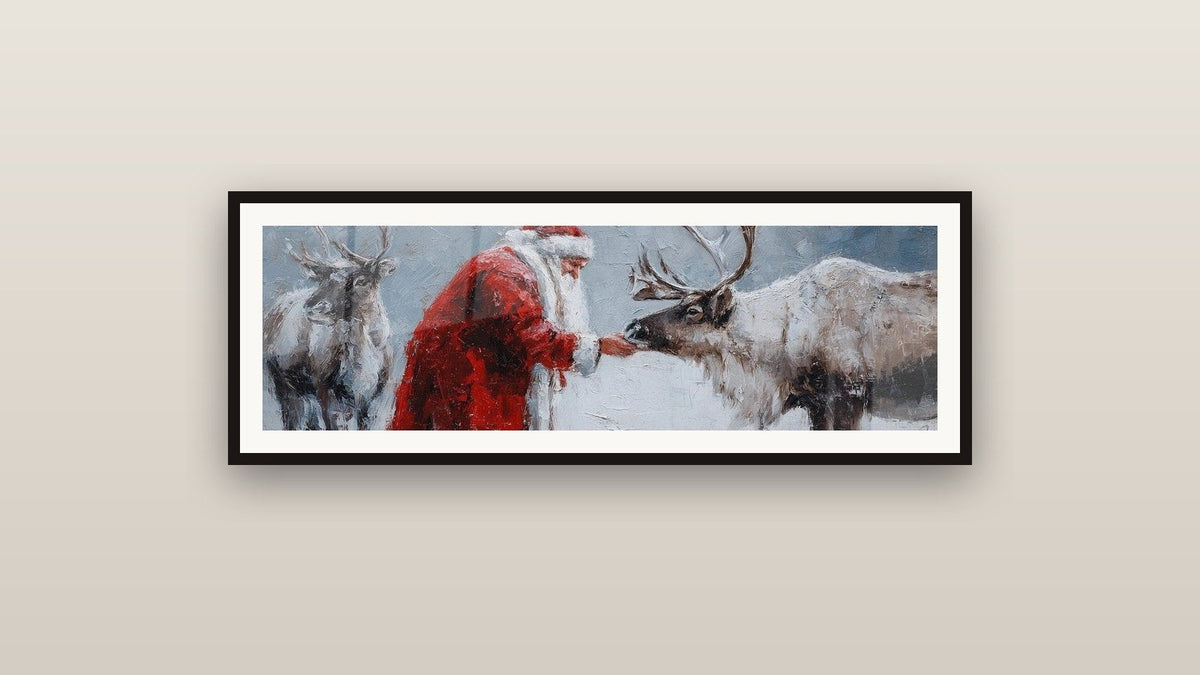
A painting of Santa Claus or a wintry figure works particularly well here, as it is an immediately recognisable figure, even at a quick glance while passing through the door.

Favorite
Snowman with Red Hat and Tender Heart Painting - Christmas Edition
From €273.90
Discover this paintingIn the living room: above the sofa or fireplace
The living room offers two natural locations for a red and white Christmas painting: above the sofa, or above the fireplace if you have one. Both follow different logics.
Above the sofa, the rule is well known: the painting (or group of paintings) should occupy 60 to 75% of the sofa's width. For a 200 cm sofa, this gives an artwork width between 120 and 150 cm — the XL format (140x80 cm) falls exactly within this range. Then leave 15 to 20 cm between the top of the backrest and the bottom of the frame.
Above the fireplace, the exercise is slightly different: you take into account the height of the mantelpiece, not that of a sofa backrest. The bottom of the painting is placed about 15 cm above the mantel shelf, and the centre of the artwork stays close to 145 cm if the room's layout allows, never dropping too close to the fire for obvious heat reasons.
For a gentle winter scene, a painting of a snowman surrounded by rabbits creates a warm atmosphere without tipping into excess. You can also compose a small gallery wall by combining two paintings of different sizes, as long as you keep a regular spacing of 5 to 8 cm between the works.
If you're looking for a more traditional scene with a clearly identifiable central figure, the painting of Santa Claus in the white storm works particularly well as a centrepiece, especially in elongated formats that stretch above a wide sofa.
To go further on choosing between a very colourful or more subdued visual depending on your living room, our comparison between a colourful and a monochrome Christmas painting details both approaches.
— Our selection


In the kitchen or dining room: a choice still too often overlooked
The kitchen remains the least decorated room for Christmas, even though much of the festive preparation happens there. A red and white painting brings a warm touch without obstructing movement, provided you observe two precautions: stay clear of splash zones (hobs, sink) and avoid direct exposure to high humidity.
Above a sideboard or dining table
Above a dining room sideboard, the same rule applies as for the sofa: 60 to 75% of the furniture's width, centred on the sideboard rather than the wall. A 150 cm sideboard comfortably accommodates an XL format (140x80 cm).
In a dining room open to the kitchen, a painting of a lantern and holly brings a traditional touch without dominating the table: the Christmas painting collection offers several variations in this style.
For a more natural mood, a painting of tits in a wintry setting works well in a rustic kitchen, especially if the furniture is raw wood. Warm kitchens also suit a red and white Christmas painting for a cosy kitchen very well, depending on the style of the furniture.
— Also to discover


Staircase, hallway, bedroom: the secondary locations that make all the difference
A staircase decorated for Christmas turns a simple passage into a true decorative moment. Generally, a series of small formats is hung along the wall of the climb, following the slope of the stairs rather than a strict horizontal line.
- Staircase: space the paintings 70 to 90 cm apart along the banister, keeping the same angle as the slope.
- Hallway: favour an elongated format rather than a square one, to accompany the perspective of the passage.
- Bedroom: avoid the direct axis of the bed if you sleep facing the wall; shifting slightly onto a side wall calms the room further.
The hallway is also the ideal place to test a painting you're not entirely sure about: less exposed than the living room, it lets you live with the artwork for a few days before moving it elsewhere if needed.
A painting hung on a dark wall, inside a poorly lit hallway, benefits from acrylic glass finishes, whose glossy surface reflects a little light. Facing a window or in full natural light, the matte Alu Dibond avoids unwanted reflections.
To understand how a snowy scene plays with the natural light of a room, our article on the atmosphere created by a snowy painting explores this effect in depth.

In the same spirit
Lantern Hope Light Christmas Painting - Christmas Edition
From €233.90
Discover this painting →Frequently asked questions
At what height should you hang a painting above a sofa?
The bottom of the frame should sit 15-20 cm above the sofa backrest, and the centre of the artwork stays close to 145 cm if the height of the sofa allows it.
Can you hang a Christmas painting in a kitchen?
Yes, as long as you keep it away from water or grease splash zones and avoid prolonged high humidity, which can eventually affect the surface of the support.
How do you hang several Christmas paintings together?
Keep a regular spacing of 5 to 8 cm between each artwork, and align either the centre or the bottom of the frames depending on the effect sought — aligning by the bottom works better for formats of different sizes.
Should you take down the Christmas painting after the holidays?
Not necessarily: a snowman painting or a subdued winter scene can stay up throughout the cold season, well beyond 25 December. Only motifs that are very explicitly tied to Christmas Day (Santa Claus, presents) are best removed in January.
A red and white Christmas painting that is well placed doesn't just decorate a wall: it becomes the point the eye seeks on entering the room, the one you look at for a second longer as you walk past. Placement matters as much as the artwork itself, and now you have the benchmarks to stop hesitating with the tape measure in hand. To find the piece that suits your wall, the red and white Christmas painting collection brings together the formats and subjects discussed here, ready to hang.
Explore our collections