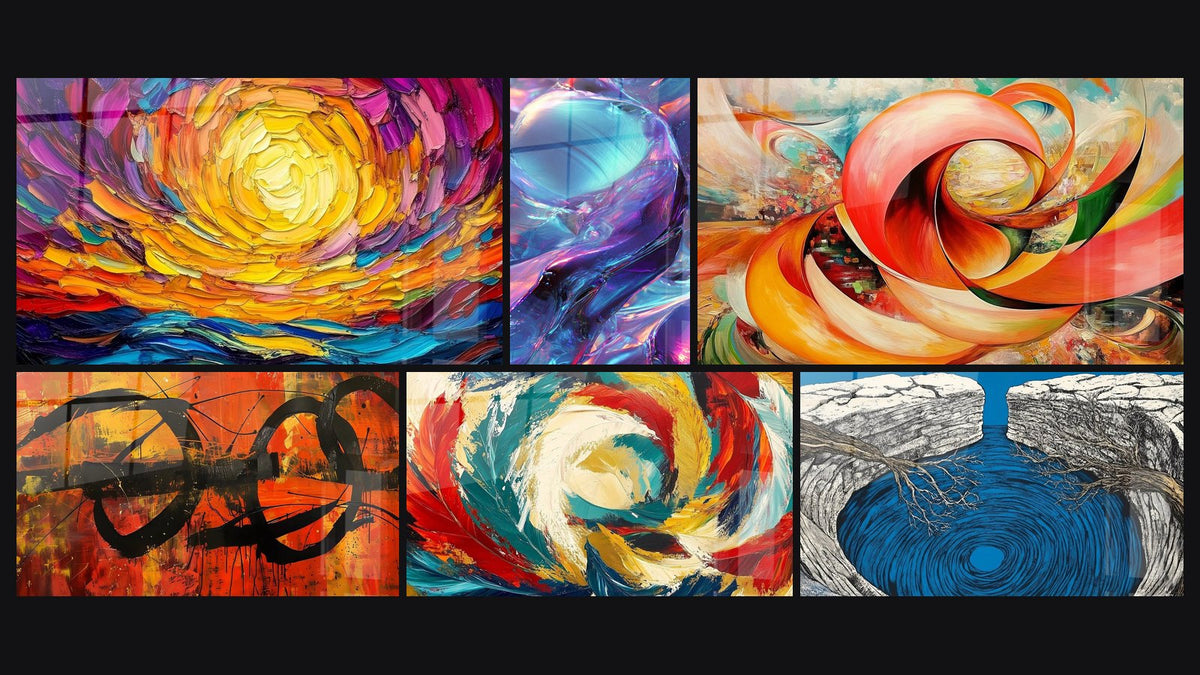
Symbolism of abstract shapes: what your painting communicates subconsciously
11 October 2025 · 17 min read · by Walensky
You've been looking at this abstract painting hanging in your living room for months, and you feel something... but you can't quite put your finger on it. These geometric shapes seem to be talking to you, but in a language you don't quite understand.
Every time your guests stop in front of this artwork, they ask you what it represents. And each time, you remain speechless, with this strange feeling that your painting communicates something important... but what exactly?
You may have tried to search for the "right" interpretation online, or asked more "cultured" friends. Result? Complex explanations that don't quite fit what you feel in front of your artwork.
That's normal, and it's absolutely not your fault. Most "explanations" of abstract art completely ignore the unconscious emotional dimension that makes these works so magical.
By the end of this article, you will know how to decode the hidden messages of your abstract painting and understand why certain shapes soothe you while others energize you.
Why your eyes can't help but return to this artwork?
Imagine your brain is like an ultra-sophisticated scanner that analyzes 11 million visual pieces of information per second. When your eyes fall on an abstract painting, your subconscious instantly decodes a secret language made of shapes, curves, and angles. It's as if each circle, each triangle, each broken line was a word in a silent conversation with your unconscious emotion. If you try to understand this language through logic, you miss 90% of the message.
🎨 Customer testimonial: "I didn't understand why I was obsessed with this painting with orange and angular shapes in the gallery. I ended up buying it... and later realized that it was exactly the period when I was looking to assert my creativity at work. Those pointed triangles expressed my thirst for action!"
Conversation with a decor expert
Abstract shapes activate your emotional memory even before you are aware of it: like a scent that instantly brings you back to childhood, each geometric form awakens buried memories and sensations. Result? In less than 3 seconds, you know if a work "speaks" to you or leaves you cold.

Our eye-catcher
Sunset spiral painting - Golden light vortex - spiral abstract edition
233.90€
Discover this painting →What Your Attraction to Certain Shapes Reveals About Your Personality
Have you ever wondered why you are irresistibly drawn to curved shapes while your neighbor only raves about sharp angles ? Or why these spirals hypnotize you while perfect squares stress you out? Your reptilian brain makes aesthetic choices that reflect your deep psychological needs.
It's not a question of "good taste" or artistic culture. It's your unconscious mind expressing its needs through your visual preferences. When you say "I like" or "I don't like," you reveal much more than your decorative taste.
It's as if your soul is choosing its visual food. A person seeking stability will naturally be drawn to geometric shapes that are regular, while a creative mind brimming with ideas will prefer dynamic and asymmetrical compositions .
The Hidden Truth Behind Your Love of Circles and Curves
Contrary to popular belief, being attracted to round shapes doesn't necessarily mean you are seeking softness. In reality, curves activate your deep need for emotional fluidity and a harmonious connection with your environment.
It's like water that naturally finds its way: curves speak to that part of you that rejects rigidity and seeks creative adaptation. That's why you feel soothed by a painting with undulating shapes even after a stressful day.
This preference often reveals a personality that prioritizes emotional intelligence and empathy. You instinctively perceive nuances and prefer diplomacy to direct confrontation.
🔍 Instant test: Look around you now. Count how many round vs. angular objects you have chosen in your decor. If circles dominate, you are probably someone who avoids conflict and prioritizes harmonious relationships.
Why Triangles and Sharp Angles Galvanize You
It is often believed that attraction to angular shapes translates to an aggressive personality. Mistake! These shapes activate your creative energy center and your need for constructive action.
Angles are like arrows pointing to the future. They speak to that part of you that wants to build, transform, and innovate. That's why you feel a surge of energy when looking at a painting with dynamic triangles.
This preference reveals a temperament of natural leader or entrepreneur, even if you are not yet aware of it. You need challenges and stimulating projects to thrive.
The Mystery of Spirals and Organic Shapes
Few people notice the hypnotic effect of spirals and organic shapes in abstract art. These motifs activate your connection to nature and your deep intuitive wisdom.
You can easily spot it: these shapes give you a feeling of "reconnection" with yourself, as if they remind you of something essential that you have forgotten in the daily stress.
This attraction often signals a period of personal transition where you seek to rediscover your authenticity and free yourself from restrictive social expectations.
🎯 The 4 Signals Your Decor Reveals About Your Emotional State:
- Proliferation of straight lines: You are going through a period where you need structure and control - like a captain righting the helm of their ship
- Accumulation of circular shapes: Your psyche craves more gentleness and kindness - your soul tells you "breathe and let go"
- Obsession for asymmetries: You are in the midst of creative transformation and your mind rejects old patterns - like a butterfly emerging from its chrysalis
The trigger: the hidden golden ratio
What really makes the difference is the proportion between the different shapes. Your eye subconsciously detects the hidden mathematical harmony, like a musician who automatically recognizes a perfect chord. When these proportions respect certain natural ratios (Fibonacci spiral, golden number), your brain releases endorphins. That's why some paintings give you a feeling of "rightness" that is impossible to explain rationally.
Golden rule of emotional recognition: If you feel a strong emotion (positive or negative) in front of a work in less than 5 seconds, it is that the shapes activate a deep psychological pattern. Trust this first impression - it reveals your authentic needs.
| ❌ What they tell you | ✅ The emotional reality | 💡 Why it works | 🎯 Benefit for you |
|---|---|---|---|
| "It's just decoration" | Each shape influences your daily mood | Your brain processes visuals before rational thought | Custom ambiance according to your needs |
| "Abstract art means nothing" | Shapes speak directly to your unconscious | Universal language of primal emotions | Immediate connection with your feelings |
| "You have to understand the history of art" | Your personal feeling is the key | Emotion always precedes analysis | Trust in your own perception |
| "Colors are enough" | Shapes structure the emotional impact | Visual architecture = mental architecture | More durable and profound decorative effect |

Our selection
Abstract geometric shapes painting - Modern dynamic - drawing edition
233,90€
Discover this paintingHow to Decode Your Artwork in 3 Simple Steps
Rassurez-vous, you don't need a psychology degree to understand what your abstract artwork whispers to you every day. It's like learning to listen to a conversation: once you know the codes, everything becomes clear. Imagine yourself as a detective of your own emotions, equipped with a magnifying glass to observe visual clues. By the end of these 3 steps, you will know exactly why this artwork attracts you and how it influences your daily well-being.
🗺️ Your Decoding Plan: First, you will identify the dominant shapes (your emotional vocabulary), then you will analyze their organization (the grammar of your feelings), and finally you will discover the overall effect on your psyche (the complete message). Each step reveals a deeper layer of meaning.
Step 1: Identify Your Emotional Anchor Shapes
Start with this step because it's your emotional foundation - like identifying the main ingredients of a dish before understanding the recipe. Once you know which shapes first catch your eye, you will already feel that sense of "finally understanding" why this artwork speaks to you.
What You Need for Proper Observation
- A Moment of Mental Calm: Choose a moment when you are not rushed, ideally at the end of the day when your analytical mind relaxes. It's like creating a sacred space to listen to your intuition. Avoid stressful moments when your logical brain dominates and masks your authentic feelings.
- Natural or Neutral Lighting: Artificial colored light distorts your emotional perception of shapes - it's like listening to music with misaligned headphones. Position yourself so that you see the artwork without glare and check that shadows do not create misleading shapes.
- Optimal Viewing Distance: Stand about 2-3 meters from the artwork - the distance where you see the whole without getting lost in the details. This is the zone where your overall perception works best, like a conductor who hears the entire symphony.
Now, let's move on to active observation:
How to Proceed Without Making Mistakes
First Impression Visual Scan: Look at the artwork for exactly 10 seconds without thinking, and mentally note the first shape that catches your eye. This shape reveals your dominant emotional need at the moment - it's your "psychological hunger" manifesting visually. Do not try to be logical, let your gaze wander naturally.
⏱️ Time: 30 seconds | ✅ Successful when: You can name a specific shape ("this red triangle", "this golden spiral") | ⚠️ Attention: If you see "everything at once", it means you are analyzing too much - redo the exercise by closing your eyes for 5 seconds
Mapping of Secondary Shapes: Now identify the other 2-3 shapes that structure the composition, noting their relative size and position. These elements reveal nuances of your personality - your complementary character traits that express themselves more subtly.
⏱️ Time: 1 minute | ✅ Successful when: You have a clear "mental map" of the visual organization | ⚠️ Attention: Do not confuse colors with shapes - focus only on contours and volumes
Body Feeling Test: Focus in turn on each identified shape and observe the micro-sensations in your body - tension, relaxation, energy, appeasement. Your body is an ultra-precise emotional detector that never lies, unlike your mind which can rationalize.
⏱️ Time: 2 minutes | ✅ Successful when: You feel clear differences between the shapes | ⚠️ Attention: If everything seems the same, you are in analysis - take a deep breath and reconnect with your sensations
✨ Step 1 validation: You should now have identified 3-4 key shapes with a distinct feeling for each. If you are still hesitating, that's normal for a beginner - the important thing is to have felt at least one clear emotional connection with a shape. Congratulations, you have just discovered your personal "visual signature”!
Step 2: Analyze the dynamics between shapes
Now that you know your visual "characters”, discover how they interact - that's where the real magic happens. This step reveals the complexity of your inner world and why some artworks create that feeling of impossible-to-explain "completeness”.
Analysis grid of interactions
- Observation of visual tensions: Identify areas where shapes seem to "push” or "attract” each other - these tensions reveal your creative inner conflicts and contradictory aspirations. It's your psyche staging its personal dilemmas on the canvas.
- Identification of rhythms: Note whether the shapes create a soothing repetition or a dynamic break - this visual cadence reflects your current need for a reassuring routine or stimulating novelty. Your eye naturally follows the tempo that corresponds to your psychological state.
- Analysis of empty spaces: The areas without shapes are as important as the filled ones - they reveal your relationship to silence, meditation and your need for personal space. An "airy” painting speaks to someone who feels stifled in their daily life.
Decoding relationships between shapes
Mapping of energy flows: Mentally trace the path your eye takes across the painting - this path reveals how you process emotional information in your life. A circular path indicates a need for harmony, a zigzag reveals an exploratory mind, a straight line translates a forward-looking temperament.
⏱️ Time: 3 minutes | ✅ Successful when: You can mentally draw the "path” of your gaze | ⚠️ Attention: If your eye "jumps” everywhere, it's because the composition reflects your current mental dispersion
Test of hidden balances: Alternately cover different parts of the painting with your hand and observe how the emotion changes. This technique reveals which elements are essential to your visual well-being and which create a stimulating creative tension.
⏱️ Time: 2 minutes | ✅ Successful when: You clearly feel the changes in atmosphere | ⚠️ Attention: Focus on your sensations, not on "objective” aesthetics
Step 3: Discover your personal message
This is the revelation stage where all the elements come together to reveal the unique message that this work addresses to you. Like a puzzle that finally makes sense, you will understand why your unconscious chose precisely this composition to accompany your personal evolution.
Synthesis of your emotional signature
Connection with your personal history: Associate each emotion felt with a period or aspect of your current life. This work acts as a mirror of your psychological evolution - it shows you where you come from and where you are going. The shapes that soothe you reveal your achievements, those that energize you show your potential to develop.
⏱️ Time: 5 minutes | ✅ Successful when: You establish concrete links between shapes and personal experience | ⚠️ Attention: Stay authentic - avoid "intellectually correct” interpretations
Compose your personal message: Summarize in a simple sentence what this artwork says to you about yourself. This message evolves with you - in 6 months, the same artwork may reveal something else to you. This is proof that abstract art grows with your emotional maturity.
⏱️ Time: 2 minutes | ✅ Successful when: Your sentence gives you chills of recognition | ⚠️ Attention: If it sounds "banal", dig deeper - your truth is always surprising
Final validation rule: Your interpretation is correct if it brings you a feeling of clarity AND emotion. Authentic abstract art always provokes this double reaction: "Aha, I understand!" accompanied by a bodily sensation. If it is purely intellectual, start over by reconnecting with your sensations.
Now that you have mastered the basic decoding, let's explore the subtleties that make the difference between looking and truly communicating with your artwork. These nuances transform your relationship with art from passive to active.
🎯 Collector's secret: The artworks that really "speak" to you change appearance depending on your mood and the lighting. This is a sign of a sophisticated composition that activates different layers of your psyche according to your emotional state. Test your painting at different times of the day - you will discover its multiple facets.
"But what if I'm wrong in my interpretation?"
"I'm afraid of saying anything about my painting and being seen as someone who doesn't understand art..."
I perfectly understand this fear - it's even proof that you take your relationship with art seriously! But here's a liberating truth: in abstract art, there is no "right" or "wrong" interpretation, only more or less authentic feelings. Your perception evolves with you - the message you receive today may be different in 6 months, and that's exactly how it should work. The artwork grows with your emotional maturity.
💡 Reassuring tip: Test your interpretation by sharing it with a kind and supportive friend. If your explanation makes them feel something similar when looking at the artwork, then you've hit the mark. Authentic art creates emotional bridges between people.
— Also to discover


The 5 mistakes that prevent you from feeling the true power of your artwork
Attention, these mistakes are so common that they go unnoticed - yet they create an invisible barrier between you and the authentic emotion of your abstract painting. I share them to avoid months of frustration in front of a work that could nourish you emotionally every day.
- 🧠 Seeking the "official" meaning: It's tempting to want to "understand" well like at school, but abstract art works exactly the opposite. The more you intellectualize, the more you cut yourself off from direct emotion. As a result: you miss 90% of the message. Instead, trust your first impression and dig from there.
- 👀 Looking too quickly or distractedly: Your brain needs a minimum of 30 seconds to switch from "scan" mode to "feeling" mode. If you just glance quickly, you only capture the decorative surface. Allow yourself these precious seconds of "visual digestion" - it's an appointment with your sensitivity.
- 🎨 Compare with other works or styles: As soon as you think "it reminds me of a Kandinsky" or "it's worse than my neighbors", you leave YOUR experience to enter an external judgment. Abstract art then loses its ability to reveal something unique about yourself.
- 📱 Watching under poor conditions: Artificial colored lighting, reflections, partial vision... Your emotional perception is based on micro-visual details that these parasites distort. It's like trying to listen to classical music in a noisy bar - impossible to grasp the nuances.
- 🤷 Abandoning if "it doesn't come right away": Abstract art reveals its secrets in successive layers, like a perfume that develops its notes. If you expect an immediate lightning strike each time, you miss the works that grow with you. Sometimes, the most beautiful artistic relationship begins with a discreet curiosity.
🛡️ Your anti-error checklist: Check that you are alone and quiet, that the lighting is neutral, that you allow at least 2 minutes of observation, and that you start from YOUR feelings before any analysis. If you feel emotion (even slight), you are on the right track!
— In the same spirit


Your most frequent questions about decoding abstract forms
For a first satisfying emotional reading, allow 5-10 minutes of attentive observation. But here's the best part: your understanding is enriched with each look! After 3 months of "cohabitation" daily, you will still discover nuances. It's like a close friend - the more you frequent them, the deeper the relationship becomes.
Absolutely not! Emotional intensity depends on the quality of the composition and your personal resonance, not the price. I have seen people moved by 50€ reproductions and indifferent to 5000€ originals. Your heart doesn't know labels - rely only on your authentic feelings.
Your interpretation is correct if it provokes an authentic emotion in you and helps you to better understand yourself. Abstract art has no official "instruction manual" - it is a personal dialogue between the work and your psyche. If your reading nourishes you emotionally and evolves with you, then it is perfectly right.
Yes, and it's even fascinating! Each work reveals a different facet of your personality, like the instruments of an orchestra. Observe how they dialogue with each other - this "visual conversation" reflects the harmonious complexity of your inner world. Alternate decoding sessions to avoid emotional saturation.
That's even a sign of a quality work! Like a prism that reveals different colors depending on the angle of the light, a sophisticated abstract composition resonates with your different emotional states. These variations reveal the richness of your sensitivity and the ability of the work to accompany your psychological evolution.
Your new look at art that transforms your daily life
In a few weeks, when you catch the eye of a friend in front of your abstract painting, you’ll smile secretly. Because you now know how to decode this silent conversation between shapes and your soul. You understand why this spiral calms you after a difficult day, and why these orange triangles give you that creative energy in the morning.
This new skill goes far beyond wall art. You develop an emotional visual intelligence that enriches your perception of the world - architecture, design, nature... Your gaze becomes a tool for self-knowledge, and your aesthetic sensitivity turns out to be a form of intuitive wisdom.
The best part? Every artwork you encounter from now on can become a mirror of your personal evolution. Start today with the painting that’s looking at you right now - give it those 5 minutes of authentic attention you used to give to your smartphone. Your soul will thank you.
🎨 Your first mission: Choose the time of day when you feel most connected to yourself, and offer this privileged appointment to your artwork. You are more sensitive and intuitive than you think - trust this visual wisdom that lies dormant within you!
Also read: 🎯 Read more articles about art and emotions
— Other selected pieces