

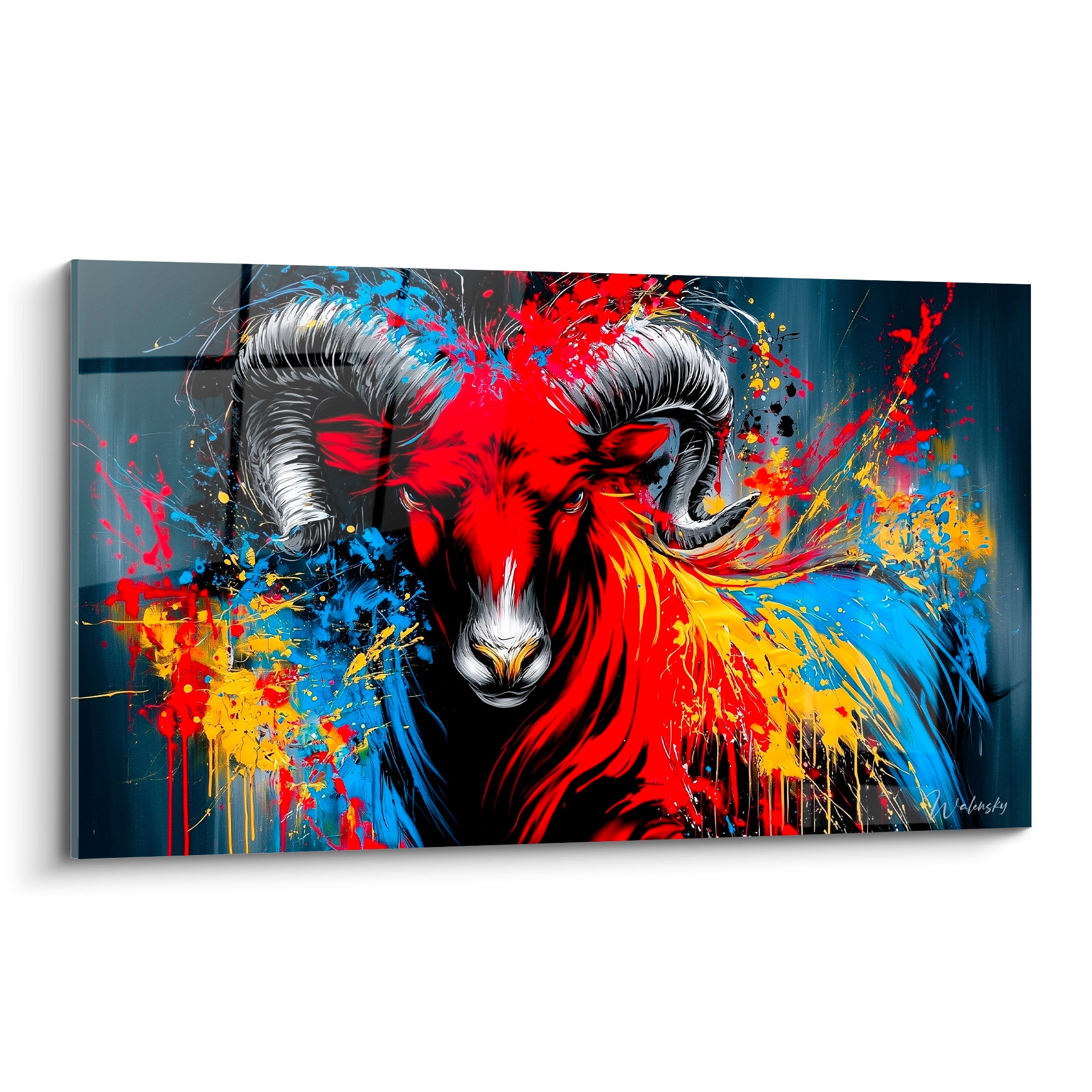






Executive office minimalist style painting: why choose acrylic printing
8 min read · by Walensky
PROFESSIONAL SPACE PAINTING
An executive office says something before a single word is spoken. The sober furniture, the filtered light, the hushed silence of the corridor leading to it: everything is designed to establish a quiet authority. And then there is that wall, often bare, behind the chair or facing the meeting table, waiting for its piece.
The choice of a minimalist style for this space is rarely debated anymore. What is less often discussed, however, is the printing technique behind the painting you are about to hang. And yet it is this that makes all the difference between a flat rendering and a piece that truly holds the light.
The direct answerAcrylic printing involves printing a high-definition visual that is then mounted beneath a sheet of acrylic glass (plexiglas): this glossy surface enhances the depth of the colours and gives a gallery effect, which makes it a fitting choice for a minimalist executive office, provided the room's lighting is controlled. The matt alternative, Alu Dibond, is better suited to rooms facing a window or in full natural light.- Acrylic renders deep blacks and ultra-vibrant colours thanks to the glass effect.
- It suits rooms with controlled lighting; matt Alu Dibond is preferable opposite a glass wall.
- Both finishes are delivered without a frame, lightweight, with fixings included.
Acrylic printing, a technique in service of minimalist style
Acrylic printing is first of all a process: a high-definition visual printed and then laminated beneath a sheet of acrylic glass. The result is a smooth, glossy surface that plays with the ambient light rather than absorbing it.
This finish is particularly suited to the minimalism sought in an executive office. No visible grain, no relief of material: just a sharp image, almost suspended beneath a layer of glass. It is exactly the aesthetic sought when you want a wall that breathes without distracting.
A minimalist painting should not draw attention through its texture, but through the accuracy of its colours.
In a room where the furniture is already reduced to the essentials — light wood desk, understated leather armchair, low shelves — acrylic glass adds that extra depth without visually overloading the space. It is a finish that blends in; it does not impose itself.
Technical criteria to check before buying
A painting in acrylic printing is not chosen solely on its subject or colours. Two technical elements determine the real quality of the rendering over time.
Thickness and quality of the acrylic glass
The plexiglas sheet must be thick enough to avoid any bending effect or light waviness across the surface. A thin sheet will tend to slightly ripple the reflected light, which breaks the sought-after sense of depth.
Paintings printed in Italy on acrylic glass generally benefit from a sheet calibrated to remain perfectly flat, even in large formats such as the 4XL (240x140cm).
Resolution and colour fidelity
A high-definition photographic rendering is judged by the finesse of its gradients: on an abstract visual with fluid forms, a poorly resolved file produces visible bands in the colour transitions. The larger the format, the more the original resolution requirement matters.
- Check that the supplier specifies high-definition printing, not a basic digital reproduction.
- Favour visuals with few fine details if the chosen format is very large: broad, fluid shapes age better visually.
- Compare the rendering in Acrylic Glass and Alu Dibond on the product sheet before deciding.

Integrating an acrylic painting into a minimalist executive office
In an executive office, the painting often faces the door or dominates the wall behind the seat. It is a position that calls for a certain restraint in the choice of visual: fluid abstract forms, palettes of beige, gold or grey, work better than a figurative subject that is too busy. For a reception area, a black and white painting with geometric patterns offers an elegant and structured alternative.
The Souffle d'Or Painting - Acrylic Edition illustrates this principle well: organic curves in beige and gold, a discreet elegance that does not steal the spotlight from the rest of the room.
For a slightly wider wall, the Élan d'Harmonie Painting - Acrylic Edition offers a similar movement, with tones that harmonise with the light panelling and camel leather armchairs often found in this type of space.
As for dimensions, keep one simple rule: the artwork should occupy roughly 60 to 75% of the width of the wall or piece of furniture beneath which it is hung. An L format (120x70cm) suits a standard office wall; beyond that, the XL to 4XL formats take over for larger meeting rooms.
If you are looking for a fresher alternative in tone, the Enveloping Nuances Painting, with its fluid curves and grey and gold palette, brings the same sophistication while shifting the chromatic register.
— Our selection


Maintenance and durability: the advantage of acrylic over the long term
An executive office rarely changes its décor. The painting hung today will probably still be there for years, continuously exposed to window light and artificial lighting. This is also why a personalised painting given to a colleague retiring takes on real meaning: a lasting work, chosen with care.
This is where acrylic glass shows a concrete advantage: its surface offers UV resistance that limits the fading of colours over time, unlike more porous supports that absorb light and visibly age faster.
Maintenance is straightforward: a soft, slightly damp cloth is enough to remove dust without scratching the surface. Avoid abrasive or alcohol-based products, which can dull the gloss of the acrylic glass over time.
— Also to discover


Acrylic, glass or canvas: which technique for which professional use
The choice between finishes depends almost entirely on the light available in the room, more than on the style sought. Here is how to decide according to your office's configuration.
| Finish | Rendering | Ideal for |
|---|---|---|
| Acrylic Glass | Gloss, vibrant colours, depth | Controlled-light room, gallery effect |
| Alu Dibond | Matte, zero reflection, soft colours | Facing a window, abundant natural light |
If your executive office is bathed in natural light all day, Alu Dibond remains the safest choice. In a darker room or one with controlled lighting, acrylic glass reveals its full potential. To explore the question of style choice for the office further, our article on the abstract painting for an executive's office complements this technical reflection from the angle of atmosphere and confidence.
For a more elongated format, printing on acrylic glass also lends itself very well to subjects such as those presented in our article on woodcock printing on acrylic glass for the office, which details another use case of this same technique.
Want to compare several options before deciding? Browse the collection of acrylic-print paintings to see all the renderings available, or go directly to paintings designed for office spaces if you are looking for formats suited to meeting rooms.

In the same spirit
Painting Mist of Azure - Abstract Seaside Edition
From €273.90
Discover this painting →Frequently asked questions
What is an acrylic print?
It is a high-definition visual printed and then mounted beneath a sheet of acrylic glass (plexiglas), giving a glossy surface and a sense of depth close to a gallery rendering.
What is the difference between an acrylic painting and a canvas painting?
The shop does not offer stretched canvas: the works are printed on acrylic glass or Alu Dibond. Acrylic glass is glossy and vibrant, Alu Dibond is matt and free of reflections.
How do you care for an acrylic print?
A soft, slightly damp cloth is enough. Avoid abrasive or alcohol-based products, which can dull the glossy surface over time.
Which painting format should you choose for an executive office?
Allow roughly 60 to 75% of the width of the wall or piece of furniture concerned. The L format (120x70cm) suits a classic office wall; the XL to 4XL formats are better for larger meeting rooms.
For a selection of visuals suited to this configuration, these three pieces share the same technique and a restrained palette:
And for an additional option if you are looking for a fresher, more soothing tone:
Conclusion
The minimalist style of an executive office depends not only on the choice of shapes or colours. It also depends, very concretely, on the printing technique that carries the visual: a well-chosen acrylic glass, well oriented in relation to the light, makes all the difference between a painting that fades into the background and one that establishes a discreet and lasting presence.
Before validating a purely aesthetic choice, ask yourself the technical question first. To explore all the pieces designed for these spaces, head to the collection of paintings for professional spaces.
Explore our collections


