

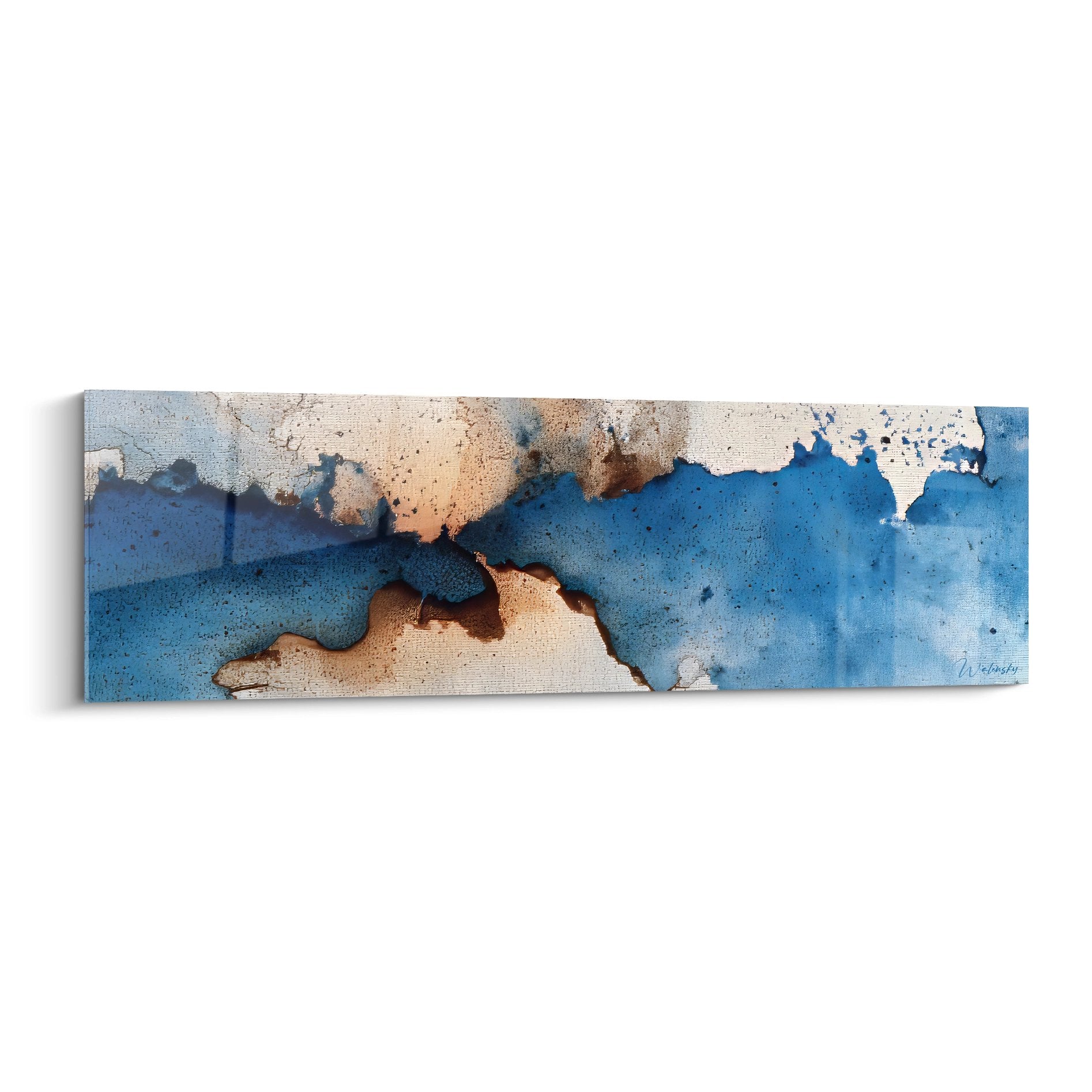






Which size of orange painting to choose for a small office based on real use
8 min read · by Walensky
ORANGE PAINTINGS
You're seated 70 centimeters from your wall, eight hours a day, and that wall has been bare since you moved in. Or worse: it holds a painting that's too small, bought on impulse, that gets lost behind the screen during video calls. The problem with a small office isn't just the wall's surface. It's the distance from which you view it, and what the webcam captures.
The direct answerFor a small office, the ideal size of an orange painting is calculated based on the seating distance (roughly 0.5 to 0.75 times that distance) rather than the wall's width. For a standard office with 90 to 130 cm between the chair and the wall, an L format (120x70 cm) works in most cases, and remains readable on screen during video conferences.- The wall rule (60 to 75% of its width) doesn't account for the actual viewing distance in a compact office.
- The L format (120x70 cm) is the smallest standard size in the shop and often remains the most relevant for a workspace.
- During video calls, an orange painting that is too busy or too large within the webcam frame distracts more than it enhances.
Why the standard size isn't enough for a small office
The classic rule says to cover 60 to 75% of the width of a piece of furniture or a wall. It works very well above a sofa, in a living room where you move around and glance at the painting from afar while passing by. An office is a different story.
In a home office, you don't cross the room: you stay seated, still, at a fixed and often short distance. A 2-meter-wide wall may look vast on paper, but if your chair is set 80 centimeters from that wall, a painting sized to occupy 70% of the wall's width will become overwhelming, almost oppressive, in your daily field of view.
This is the classic trap of small professional offices or home office nooks: a rule designed for a 4-meter living room is applied to a 2.5-by-2-meter room. The result feels cramped.
Calculating size based on seating distance and field of view
The right method starts with you, not the wall. Measure the distance between your chair and the wall where you want to hang the painting: that's your true unit of calculation.
The rule of distance x 0.5 to 0.75 for an office
Multiply this distance by 0.5 to 0.75 to get the most comfortable painting width for the eye, seated, continuously. At 1 meter of distance, this gives a width between 50 and 75 cm, which corresponds, in custom sizes, to the lower end of the range offered by the shop (starting at 80x46 cm). At 1.50 meters, you move toward 75 to 110 cm, already within the range of the L format (120x70 cm).
The L-shaped or corner office case
An L-shaped office changes the equation: the visible wall is often not the one facing the screen, but the side wall, perceived through peripheral rather than frontal vision. In this case, a panoramic format (from 120x40 cm) fits the available strip of wall better than a square format, which would look placed there by chance rather than designed for the space.
In a corner, measure the actually free wall width between furniture and the corner before choosing a format: a panoramic that's too wide would visually spill over onto the window or the neighboring bookshelf.

The overlooked criterion: video call framing
An orange painting placed behind you during a video call is no longer merely a decorative object: it's a professional backdrop, seen by your colleagues or clients several times a week. Its size and format are judged not only in person, but also within the rectangle of a webcam.
A painting designed for the room and a painting designed for the screen aren't always the same size.
Which size of orange painting is visible on screen
A standard webcam typically frames an area 60 to 90 cm wide behind you, depending on distance and lens angle. An L format (120x70 cm) hung slightly back from your position will never be seen in full on screen: only a portion, often the center, appears. That's why a painting with a centered, legible subject, such as a warm orange palette with a sharp focal point, works better on screen than a composition that is too scattered across its full width.
Example configurations and recommended sizes
Two setups come up constantly in small offices. Here's how to handle them concretely.
Wall facing the screen
You sit facing the wall, the screen between you. The painting then goes on the side wall or behind you, never directly in front of you against the screen, as it would create a distracting reflection on an acrylic glass finish. In this setup, the Autumn Symphony Painting - Forest Landscape Edition in L format suits most seating distances between 1 and 1.60 meters.
Office with a free side wall
If the available wall is on the side, outside the webcam's field, you have more freedom: the video constraint disappears, and only the proportion with the wall matters. An XL format (140x80 cm) can then fully occupy the space without ever interfering with your meetings.
| Configuration | Seating distance | Recommended format |
|---|---|---|
| Wall facing the screen, visible on video | 1 to 1.60 m | L (120x70 cm), centered subject |
| L-shaped office, narrow side wall | variable | Panoramic (120x40 cm and up) |
| Free side wall, outside webcam field | 1.60 m and more | XL (140x80 cm) or more |
— Also to discover


Common mistakes to avoid in a confined space
An empty wall is intimidating, and the most common mistake is choosing too small out of caution. The result: a painting that floats, looking like an oversized sticky note rather than an artwork.
- Too small for the wall : a painting that leaves too much empty space around it loses all presence, especially in a nook already visually busy with shelves or storage.
- Too large for the seating distance : at under one meter, a 2XL format (180x100 cm) becomes overwhelming, almost oppressive over time.
- Poor alignment with the screen : a painting hung too high or too low relative to the webcam framing cuts off the subject on screen, in an unsightly way.
- Wrong finish choice : acrylic glass reflects light from a nearby screen or window; in a small office with little distance, matte Dibond aluminum avoids that distracting glare during video calls.
For a softer mood than bright orange, the Amber Softness Painting - Abstract Seaside Edition offers more muted orange and beige tones, well suited to a small space where you want to soothe rather than stimulate.

If your office faces onto a collection designed for these uses, the office painting collection gathers formats already calibrated for this type of constraint.

In the same spirit
Red Poetry Painting - Essence Sauvage Edition
From €273.90
Discover this painting →Frequently asked questions
What size painting for a 2-meter office wall?
It all depends on seating distance, not just the wall's width. At 1.50 m of distance, an L format (120x70 cm) or XL format (140x80 cm) is more than sufficient, even on a 2-meter wall.
How to choose the hanging height of a painting in an office?
The center of the artwork is generally placed at seated eye level, often lower than the standing eye level used in a living room. Plan on roughly 1.30 to 1.40 m from the floor for a classic seated position.
Is an orange painting suitable as a video call backdrop?
Yes, provided you choose a warm orange tone rather than a bright, saturated one: it stays legible on screen without overpowering the face under video compression.
A small office isn't a problem to solve, it's a frame to compose: your chair's distance, your webcam's rectangle, and the actual width of your wall together define the right size, well before any generic rule. All that remains is to choose the tone and subject that will make you want to look up between two meetings.
To go further with this logic, the orange painting collection and the selection of paintings for professionals let you compare the available formats according to your own setup.
Explore our collections


