







Full Solar System Painting in High-Definition Alu Dibond Print
8 min read · by Walensky
PLANET PAINTING
Eight planets, a central star, hairline rings and colour gradients that are anything but arbitrary. Reproducing the solar system on a wall isn't simply placing coloured circles side by side: it's an attempt to render celestial mechanics where every hue, every proportion, tells something true. And on that front, not all print media are created equal.
The direct answerHigh-definition Alu Dibond printing renders the solar system with a sharpness and colour fidelity that few media can match, thanks to a matte surface that eliminates stray reflections and a calibrated printing process that respects the true nuances of the celestial bodies. It is the recommended medium for a scientific visual hung opposite a window or in full natural light, where a glossy finish would create distracting glare over fine details such as Saturn's rings.At Walensky, our solar system compositions don't aim to copy an astronomy textbook, but they draw on the same demands for visual rigour. Here is why the medium changes everything, and how to choose yours without getting it wrong.
- Matte Alu Dibond eliminates reflections and suits bright rooms, whereas glossy acrylic glass intensifies colours in controlled lighting.
- High definition determines the legibility of fine details: planetary rings, solar gradients, surface textures.
- The format should be chosen according to the width of the wall or piece of furniture, not only the height under the ceiling.
The complete solar system: a visual representation challenge
Representing eight planets on a single surface forces a constant compromise between accuracy and legibility. Mercury is barely a third the diameter of Earth, while Jupiter is eleven times its size: respecting these ratios to scale would make some planets invisible to the naked eye on a standard wall format.
This is why most artistic representations of the solar system rely on symbolic rather than mathematical scales. The real technical challenge then shifts elsewhere: to the fidelity of colours and the sharpness of the details that remain visible, whatever scale is chosen.
- Jupiter's pale yellow and banded cloud layers.
- Saturn's translucent rings, streaked with ice particles.
- The incandescent gradients of the Sun, from yellow to deep red.
- Neptune's deep blue, almost indigo in places.
A medium that flattens these nuances, or that smears them under insufficient resolution, betrays all the compositional work. The reference imagery in the collective imagination, notably that released by NASA, has trained the eye to expect a certain level of detail: it cannot be viewed up close in a print of average quality.
Why high definition changes everything on Alu Dibond
A low-resolution print blurs exactly the areas where a visual's scientific credibility is at stake: the edges of the rings, the colour transitions across the surface of the celestial bodies. High definition, by contrast, keeps these details crisp even when viewed up close.
Resolution and fidelity of astronomical details
On a large wall format, every pixel of the source file is enlarged considerably. A poorly prepared file will yield a pixelated or blurry result as soon as you approach within two metres. High-definition printing preserves the sharpness of fine outlines — Saturn's rings, Jupiter's storms — even on the largest formats.
Planetary rings are the most technically demanding element: they combine a fineness of line and an apparent transparency that tolerate no loss of resolution. It is often on this detail that the true quality of a print is judged.
Colour rendering and deep contrasts of Dibond
Alu Dibond offers a matte, reflection-free surface that softens colours slightly compared with acrylic glass. This choice is not a default compromise: it is the most suitable solution facing a window or in a very bright room, where a glossy support would reflect light and mask part of the visual.
Colour calibration, carried out before printing, ensures that the deep blue of a cosmic atmosphere or the incandescent orange of a solar eclipse remain faithful to the original file, without colour drift during the print run.
A good solar system painting should not merely be beautiful: it must remain accurate, even when viewed up close.

Favorite
Painting Black and terracotta sphere with linear rings - Watermarked solar diagram - Planète Edition
From €273.90
Discover this paintingExamples of full solar system compositions at Walensky
The Planète collection offers several artistic readings of space, ranging between graphic abstraction and contemplative scenes. Some compositions play on pure geometric spheres, others incorporate a more narrative dimension.
This painting stages a ballet of spheres and orbits suspended in a cream sky, in a graphic, minimalist style that evokes planetary trajectories without seeking photographic realism. An approach that favours compositional rigour over strict scientific reproduction.
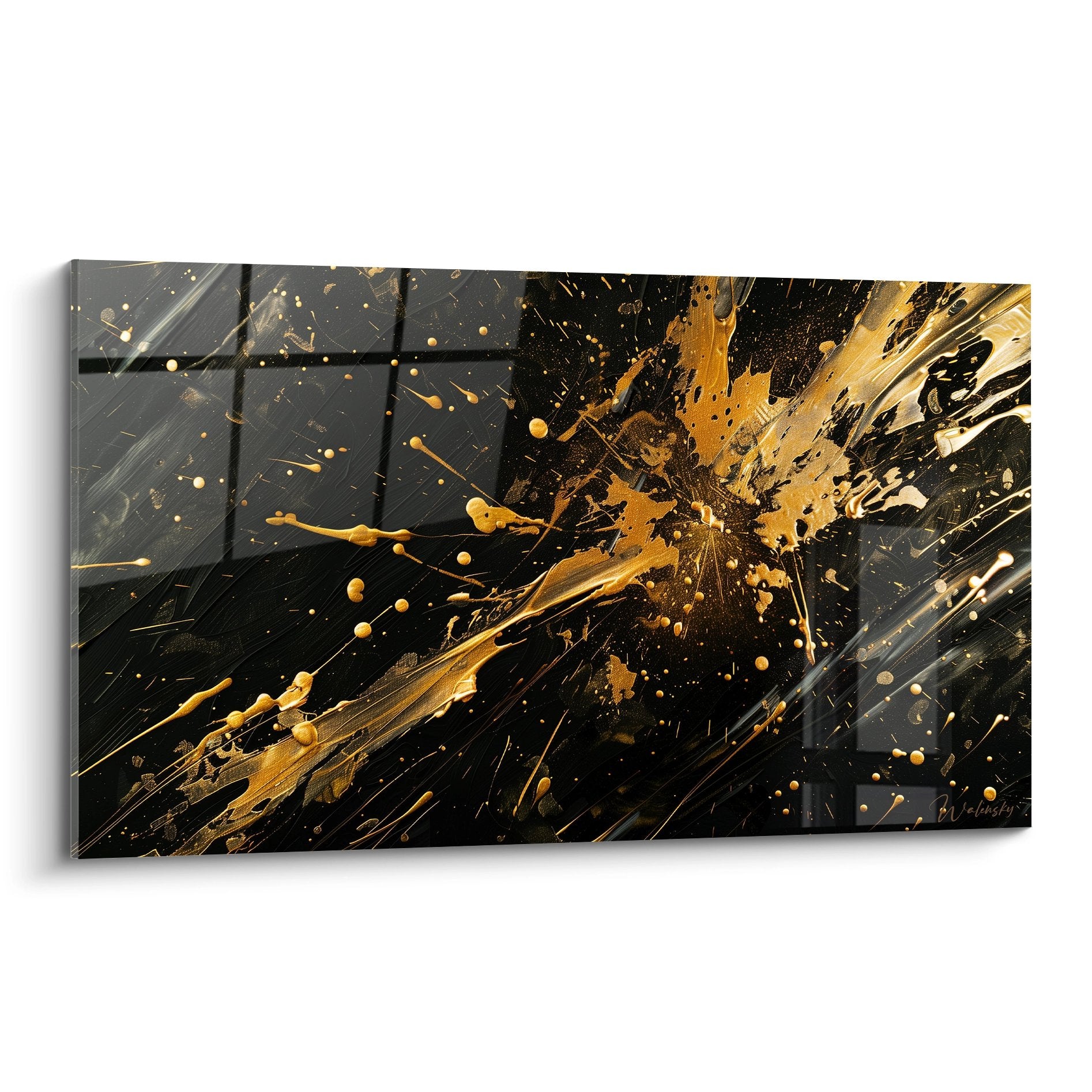
At the opposite end, this work captures a moment of cosmic upheaval: an incandescent yellow centre tearing through a petrol-blue background, close to the birth of a star. The contrast between the two tones demands exactly the colorimetric precision that only a well-calibrated print can deliver.
These three compositions share a common visual language: a celestial sphere as focal point, set against a landscape or horizon that anchors the scene in something tangible. They are particularly suited to a living room or office where one seeks a contemplative visual rather than mere decoration.
To go further on installation in a professional setting, our article on decorating a home office with the solar system details the hanging choices suited to this type of space.
— Our selection


Tips for choosing your full solar system painting
The size of a cosmic painting is calculated against the width of the wall or piece of furniture beneath which it will hang, not against the available height. The usual proportion rule suggests the artwork should occupy 60 to 75% of the width of the reference furniture — a sofa, a console, a desk.
The choice between matte (Alu Dibond) and glossy (acrylic glass) finish depends above all on the ambient light of the room:
| Criteria | Dibond aluminum (matte) | Acrylic glass (glossy) |
|---|---|---|
| Reflections | None | Slight reflections possible |
| Very bright room / facing a window | Recommended | To avoid |
| Controlled lighting (curtains, indirect orientation) | Suitable | Very vivid rendering, gallery effect |
| Colours | Softer | Ultra vibrant |
For a visual that spans the entire width of a wall, our guide to panoramic format for a living room details the proportions to respect depending on the room's layout.
— Also to discover


Towards ever more realistic representation: the evolution of printing
Printing processes are advancing along two axes: the density of resolution usable at large format, and the fidelity of inks against light over time. Acrylic printing continues to progress in depth and colorimetric intensity, while Alu Dibond remains the reference for stable, glare-free rendering whatever the room's exposure.
These two media are not competitors but complementary: the choice depends almost entirely on the room where the painting will hang, not on a hierarchy of quality between the two.
This composition around Earth, caught in a whirl of multicoloured pixels, illustrates well the tension between graphic abstraction and scientific fidelity: the visual remains legible and striking while preserving genuine rigour in the treatment of colours.

In the same spirit
Painting Silhouette facing an orange and blue planet - Cosmic contemplation - Planète Edition
From €228.90
Discover this painting →Frequently asked questions
What is the best print for a solar system painting?
High-definition Alu Dibond is the most reliable choice for a faithful, glare-free rendering, particularly in a bright room. Acrylic glass remains relevant if the room's light can be controlled, for a more vibrant effect.
How do you choose the size of a full solar system painting?
Measure the width of the reference wall or piece of furniture, then aim for 60 to 75% of that width for the artwork. Available formats generally range from L (120x70 cm) up to 4XL (240x140 cm), with bespoke options for special cases.
Does Alu Dibond printing withstand light and time?
Yes: the matte surface limits damage caused by reflections and keeps colours stable over time, provided direct and prolonged sun exposure is avoided, as with any printed medium.
What is the difference between Alu Dibond and acrylic printing for space imagery?
Alu Dibond offers softer colours and no reflections, ideal facing a window. Acrylic glass intensifies contrasts and gives a more pronounced sense of depth, but requires more controlled ambient lighting.
Choosing a full solar system painting in high-definition Alu Dibond means refusing to choose between scientific rigour and the aesthetic power of a cosmic visual. The two can coexist, provided you select the right medium and the right resolution from the outset. To find the composition that will dress your wall without ever betraying the accuracy of celestial colours, head to the solar system painting collection.
Explore our collections


