

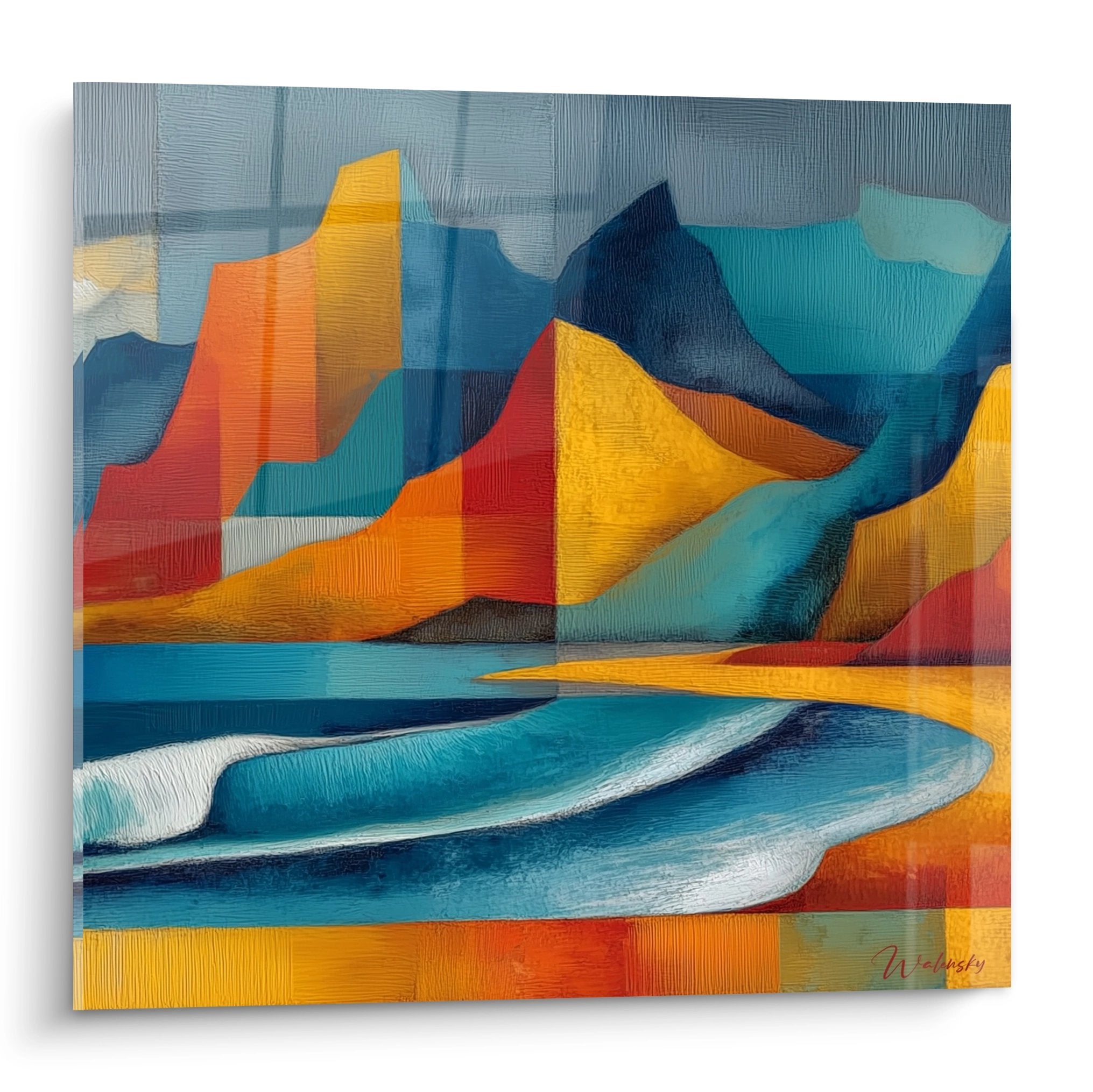






Cave painting on acrylic glass: the depth effect that transforms a wall
8 min read · by Walensky
NATURAL CAVE PAINTINGS
There is that moment, in front of certain paintings, when the eye hesitates. You step closer, step back, tilt your head, because you can't believe it's flat. With a natural cave printed on acrylic glass, this moment almost always happens: the rock seems to sink into the wall, the stalactites appear suspended in the void, and the bluish light from the back gives the impression of a real underground passage.
The direct answerAcrylic glass creates a genuine depth effect on a natural cave painting thanks to its transparency and thickness: light passes through several layers of material before reaching the image printed on the back, producing an illusion of relief and perspective that a matte support such as aluminium Dibond cannot reproduce. Combined with high-definition printing and strong contrast, this support gives the impression of looking through a real rocky opening rather than gazing at a photo.- The transparency and thickness of acrylic glass create a refraction of light that gives the image relief, unlike a matte support.
- HD printing and strong light contrasts (very dense dark areas, very bright light areas) reinforce the sense of perspective within a cave.
- To fully enjoy the effect, install the painting in a room where the light can be controlled, not in direct sunlight.
Why acrylic glass enhances the depth effect of a natural cave
Acrylic glass is not a simple glossy varnish laid over an image. It is a thick, transparent support on which the print is applied to the back, so light must pass through several millimetres of material before reaching the viewer's eye. This path of light is precisely what creates the illusion of depth.
On a natural cave, the phenomenon takes on its full meaning. The darkest areas of the cavern, the back and the recesses between stalactites, seem to recede into the wall, while water reflections or flashes of light in the foreground appear almost to float in front of the surface. It is this refraction of light that gives acrylic glass its famous "gallery art" look: colours are more vibrant and dense, and the image gains a thickness that paper or canvas does not possess.
A cave painting on acrylic glass is not looked at, it is looked through.
It is no coincidence that the artists who create these works for Walensky think about light before colour. A cave poorly constructed visually, without true perspective, will remain flat whatever the support. But a composition designed for depth, mounted on acrylic glass, changes dimension.
Printing techniques that reinforce the 3D illusion
The depth effect comes not only from the support: it is built from the design stage, layer by layer.
Layering and play of shadows
The artists who create these digital caves work in strata: a very dark, blurred background to suggest the infinity of the cavern, an intermediate plane where stalactites and textured rock appear, then a sharp, high-contrast foreground, often a water reflection or a lit mineral vein. This layering exactly imitates the way the human eye perceives perspective in real space: the blurred recedes, the sharp comes forward.
Add to this coherent cast shadows, such as a stalactite casting its shadow onto the wall below, and the brain automatically reconstructs a volume, even on a rigorously flat surface.
HD printing and management of light contrasts
HD printing preserves extreme sharpness on fine details: cracks in the rock, suspended water droplets, the metallic glints of a golden vein. The more precise the definition, the more the brain accepts the illusion of realism.
Light contrast plays an equally decisive role. An underground cave that opposes a deep, almost black blue to a very vivid golden or turquoise halo creates a difference in luminosity that mechanically accentuates the sense of distance between the background and the foreground.

The more marked the gap between the dark and light areas of a cave, the more striking the depth effect on acrylic glass will be. Favour high-contrast visuals if you are seeking the maximum 3D effect.

Favorite
Mediterranean Coastal Landscape Painting - Capri with Blue Rocks - Natural Caves Edition
From €273.90
Discover this paintingWhich cave paintings make the best use of this depth effect
Not all cave compositions are equal when faced with this exercise in perspective. Some rely on a point of light piercing the darkness, others on water reflections that double the light: two different strategies for the same result, making you want to step into the wall.
The Underground Cave painting with Crystal Lake - Aquatic Reflections plays on this duality between dark rock and luminous turquoise water, a contrast that clearly accentuates the perspective.
In another register, the illuminated cavern with golden accents builds its depth around a single point of light, like a shaft of sunlight piercing the vault, a classic technique for guiding the eye toward the back of the image. This play of light also appears in underwater cave paintings in blue and turquoise tones, where light filtered through water creates an even more enchanting depth.
These three compositions share a common feature: a sharp, textured foreground and a background that dissolves into darkness or luminous haze. This is exactly the recipe that works best on a series of abstract and mineral still-life compositions where the rocky material becomes almost an abstract pattern.
— Our selection


Where and how to hang this type of painting for maximum immersive effect
A cave painting on acrylic glass only reveals its full potential in good lighting conditions. The glossy surface reflects part of the ambient light: hung opposite a glazed bay window in full sun, the work may produce reflections that break the illusion rather than reinforce it.
- Prefer a wall perpendicular to the windows rather than facing them.
- Supplementary lighting directed slightly at an angle, rather than head-on, accentuates the relief without creating a disturbing reflection.
- Step back at least two metres so the eye can fully perceive the layering of the planes.
For a living room, an L format of 120x70 cm above a standard-sized sofa already creates a real presence. For a corridor or narrower wall, the panoramic cave format with stalactites further accentuates the sense of passage, almost like a window opening onto an underground world.
As for maintenance, acrylic glass is simply cleaned with a soft, slightly damp cloth, without abrasive products or alcohol; the key is to avoid rough sponges that could mark the glossy surface over time.
— Also to discover


Acrylic glass vs other supports: is the depth effect really superior
Yes, for this type of subject in particular. Aluminium Dibond, with its matte surface and softer colours, suits rooms bathed in natural light very well, but it does not produce the refraction that gives the illusion of looking through an opening. The rendering remains beautiful and faithful, but flatter on an image that precisely seeks to suggest volume.
| Criteria | Acrylic glass | Dibond aluminium |
|---|---|---|
| Depth effect | Marked, thanks to refraction | More limited, flat rendering |
| Reflections | Present, to be managed according to lighting | No reflections |
| Colour intensity | Very vivid, gallery rendering | Softer, matte |
| Recommended room | Controlled light | Facing a window, strong brightness |
The same refraction logic also applies to other dense, textured worlds, such as acrylic glass printing of a misty forest, where depth is played out on the mist rather than on the rock.

In the same spirit
Painting Sea Cave with Golden Reflections - Mysterious Light - Natural Caves edition
From €273.90
Discover this painting →Frequently asked questions
Does acrylic glass really give a 3D effect?
It gives an illusion of depth through light refraction, not a physical relief to the touch. The eye perceives a volume that the surface itself remains perfectly smooth.
How do you maintain an acrylic glass painting?
A soft, dry or slightly damp cloth is enough. Avoid abrasive or alcohol-based household products that could dull the surface's shine over time.
What is the difference between acrylic glass and Plexiglas for a painting?
In everyday decorating use, the two terms designate a similar transparent surface. What makes the difference is the print quality and the thickness of the support, not the name.
Which lighting to choose for a cave painting with a depth effect?
Indirect, slightly angled lighting, rather than frontal light or direct sun, which would create reflections. The aim is to reveal the contrast without crushing it.
A natural cave painting on acrylic glass is not just an image hung on the wall; it is an opening in a fault line in an otherwise closed room. The light passing through the support and the contrasts that hollow out the perspective all contribute to this rare sensation: that of a wall that breathes.
Before choosing, compare the finishes in the collection of natural cave paintings and let your eye decide between the reflection of the glass and the soft matte of aluminium.
Explore our collections


